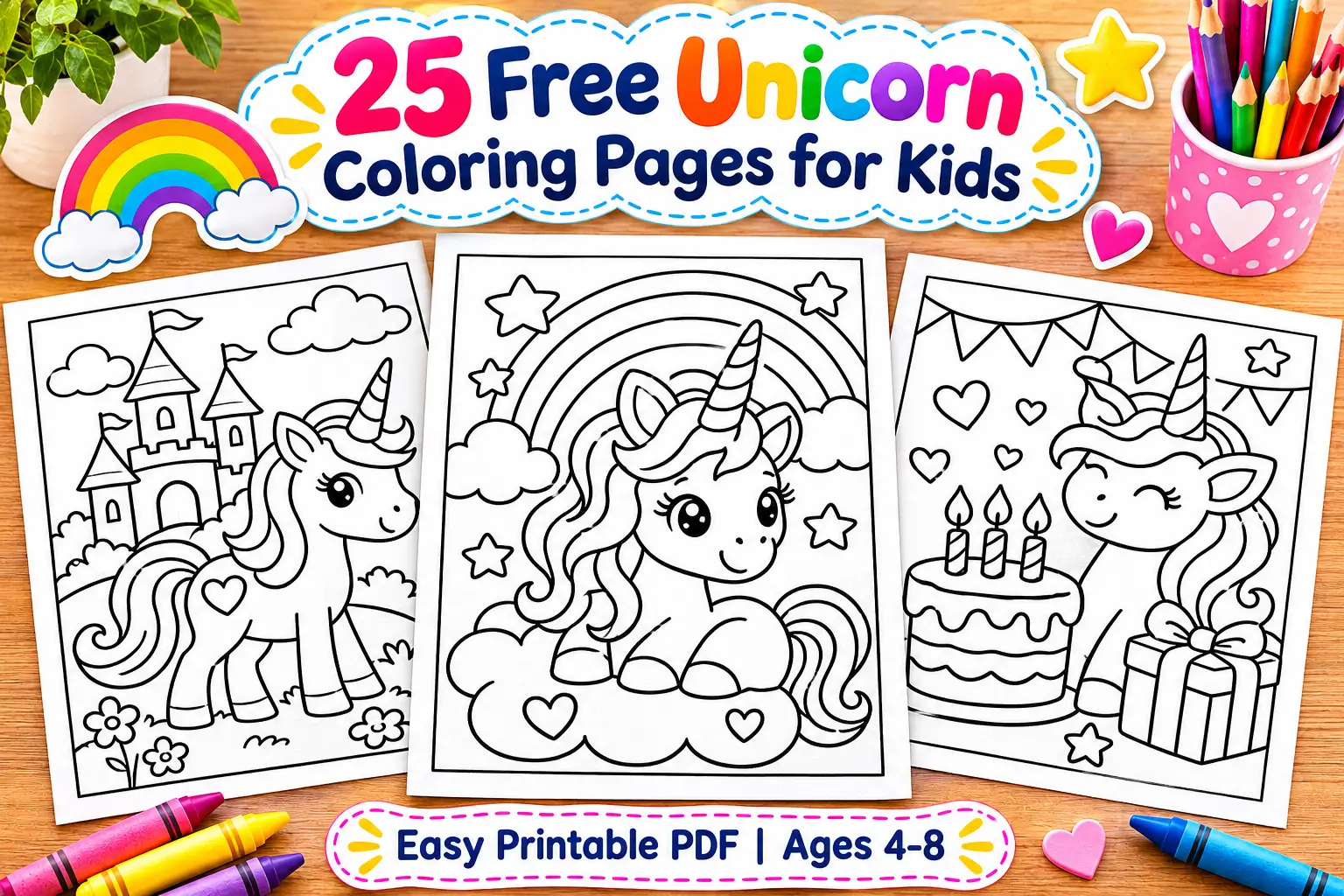
Looking for unicorn coloring pages that are simple enough for little hands and still fun to color? This free printable set gives you 25 different unicorn scenes in black and white, with a mix of large beginner-friendly spaces and smaller details for children who enjoy more intricate coloring.
Parents can use them for a rainy afternoon. Preschool and kindergarten teachers can use them for centers, quiet time, or a party table.
Below you will find what is in the PDF, how the scenes are grouped, which coloring tools work best for different ages, and practical ways to use every page.
What’s Included in the Free Unicorn Coloring Pages PDF
The printable is called “25 Free Unicorn Coloring Pages for Kids – Easy Printable PDF.” It has exactly 27 pages:
- 25 unique black-and-white unicorn coloring pages (pages 2–26). Each one is a different scene, so children can choose from a variety of magical designs.
- 1 short instruction page for parents and teachers (page 1). It gives quick guidance so you can get started without much preparation.
- 1 colored example (page 27). It uses a colored-pencil style and matches the baby unicorn with stars design on page 2, so children can see one way a finished page might look.
Every design has clear black outlines and areas ready for coloring. Some pages feature simple, open spaces, while garden, castle, and forest scenes contain smaller details for children who enjoy more intricate pictures.
That variety makes the printable useful for different coloring abilities and interests.
Unicorns are fictional, so there is no “correct” way for one to look. A child can give a unicorn a purple mane, a striped tail, or polka dots, and nobody needs to fact-check it.
That freedom is part of why these pages work so well for creative play.
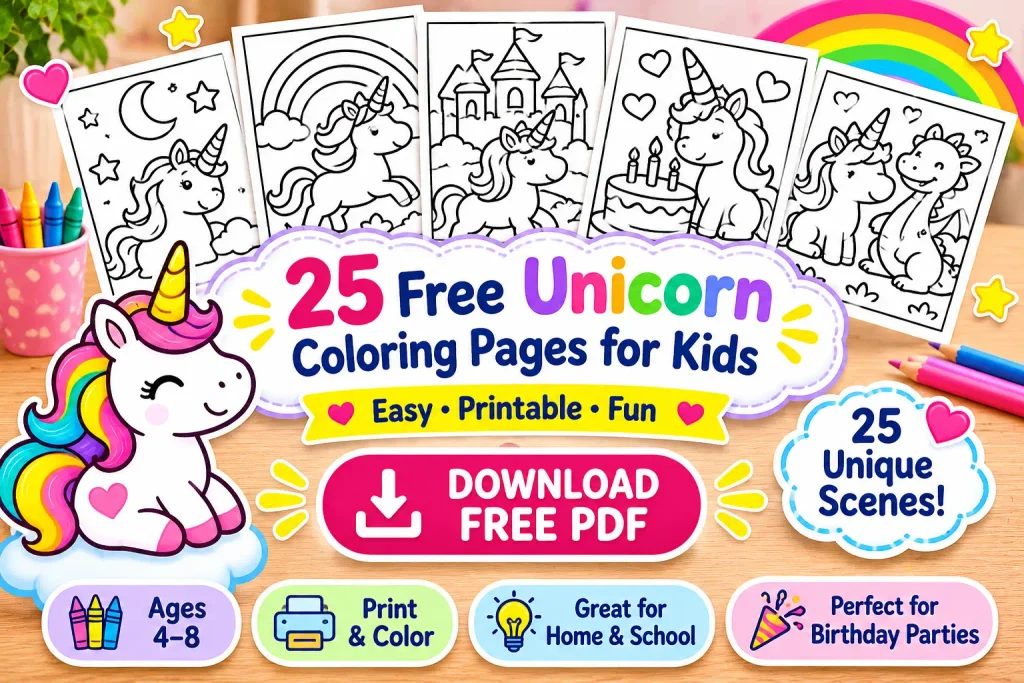
Which Ages Are These Unicorn Coloring Sheets For?
Short answer: These easy unicorn coloring pages are designed mainly for children ages 4–8, including preschoolers, kindergarteners, and young elementary students.
Children’s coloring skills vary a lot at the same age, so treat age as a loose guide:
- Younger preschoolers may scribble, fill in part of a shape, or choose one favorite color. Chunky crayons and one or two large areas are plenty.
- Older preschoolers often begin coloring more deliberately, trying to stay near the lines and choosing colors on purpose.
- Kindergarteners can add backgrounds, patterns, and small details, and they can tell a story about what they colored.
- Older children may enjoy the more detailed garden, forest, or castle scenes as a calm, low-pressure activity.
For children who are just beginning to color, start with the simpler pictures, such as the baby unicorn with stars on page 2 or the sleeping unicorn on a cloud on page 5.
The goal is not perfect work. It is enjoyable, confident time with a coloring tool.
The 25 Unicorn Scenes, Grouped by Theme
Grouping the scenes helps you pick a page quickly. You might choose a calm one for quiet time or a celebration one for a party.
The page numbers below match the actual pages in the downloadable PDF.
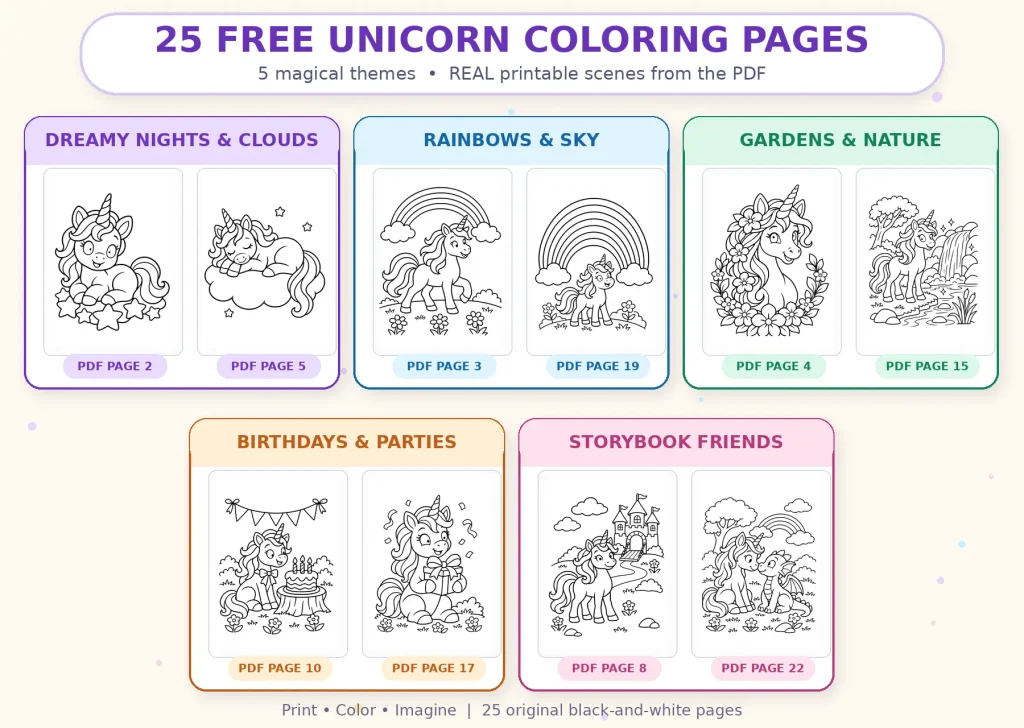
Dreamy Night and Sleepy-Time Scenes (5 Pages)
These work well when you want a quieter mood:
- Baby unicorn with stars — PDF Page 2. A cute baby unicorn resting among stars, with large areas that are beginner-friendly.
- Unicorn sleeping on a cloud — PDF Page 5. A peaceful unicorn taking a nap on a fluffy cloud.
- Unicorn with a crescent moon — PDF Page 11. A unicorn resting beneath a crescent moon and stars.
- Unicorn looking at stars — PDF Page 21. A standing unicorn gazing at stars in the sky.
- Unicorn in a dreamy forest — PDF Page 18. A magical woodland scene with trees and mushrooms, offering smaller details to color.
These printable unicorn coloring pages are especially useful for quiet-time activities or relaxed coloring sessions.
Rainbows and Sky Scenes (5 Pages)
These bright pages invite lots of color choices:
- Unicorn under a rainbow — PDF Page 3. A friendly unicorn standing beneath a rainbow and fluffy clouds.
- Unicorn jumping over clouds — PDF Page 12. A playful unicorn leaping above the clouds.
- Unicorn with a large rainbow — PDF Page 19. A cheerful unicorn beneath a big rainbow, surrounded by clouds and flowers.
- Unicorn with balloons — PDF Page 9. A unicorn with a bunch of floating balloons.
- Unicorn with bubbles — PDF Page 25. A happy unicorn playing with floating bubbles.
These scenes are great for rainbow color practice, recognizing shapes, and experimenting with different shades.
Gardens and Nature Scenes (6 Pages)
These give children chances to color flowers, leaves, and natural surroundings:
- Unicorn with flowers — PDF Page 4. A unicorn surrounded by flowers in a decorative floral arrangement.
- Unicorn in a magical garden — PDF Page 6. A detailed garden scene filled with flowers, plants, and magical scenery.
- Unicorn with butterflies — PDF Page 7. A unicorn sitting among butterflies and garden plants.
- Unicorn in a flower field — PDF Page 16. A unicorn enjoying a field of flowers.
- Unicorn by a magical tree — PDF Page 20. A unicorn standing beside a whimsical tree with curling branches.
- Unicorn with a waterfall — PDF Page 15. A peaceful nature scene featuring a waterfall, trees, and a unicorn.
Some of these pages have smaller coloring areas, making them good options for children who enjoy adding more detail.
Party and Celebration Scenes (5 Pages)
These suit birthdays, special days, and cheerful table activities:
- Unicorn with a birthday cake — PDF Page 10. A happy unicorn beside a birthday cake with candles and party decorations.
- Unicorn holding a gift — PDF Page 17. A unicorn with a wrapped present and festive details.
- Unicorn with hearts — PDF Page 13. A friendly unicorn surrounded by hearts.
- Unicorn with a princess crown — PDF Page 14. A unicorn wearing a royal crown in a decorated storybook setting.
- Unicorn in a candy garden — PDF Page 23. A magical candy-themed scene with lollipops and sweets.
The birthday cake and gift pages work especially well for unicorn birthday parties.
Storybook Places and Friends (4 Pages)
These scenes spark the most storytelling:
- Unicorn beside a castle — PDF Page 8. A unicorn standing near a storybook castle.
- Unicorn with a friendly dragon — PDF Page 22. A unicorn meeting a little dragon in a magical outdoor scene.
- Unicorn with a wishing well — PDF Page 24. A unicorn standing beside a decorative wishing well.
- Unicorn family portrait — PDF Page 26. Three unicorns together beneath a rainbow.
Each scene is its own design. Because the unicorns are illustrated in different poses and settings, don’t expect every unicorn to have exactly the same mane, tail, or expression.
Children can add or change details with their own colors.
Choosing the Right Coloring Tool: Crayons, Colored Pencils, or Markers
The tool changes the experience, so it is worth choosing on purpose.
Crayons are an easy choice for many preschoolers. They are forgiving, generally don’t smear, and come in chunky sizes that can be comfortable for small hands.
Pressing harder makes bolder color, which is satisfying to see. Crayons also cover large open areas well, making them useful for simpler unicorn coloring pages.
Colored pencils suit children who are ready for more control. They need a lighter touch and more patience, and they are good for details such as manes, flowers, and patterns.
Many kindergarteners enjoy them, and the colored example on page 27 shows what a softer colored-pencil look can be.
Washable markers make vivid color with very little pressure, which some children find easier.
They can bleed through thin printer paper, so slip a scrap sheet underneath, or print on slightly heavier paper if your printer allows it.
Other options include dot markers, which are fun for stars and balloons, and watercolor pencils or paints if you use heavier paper and adult supervision.
A simple rule: start with age-appropriate crayons for younger children, offer pencils to those who want more detail, and keep markers for tables where you can manage mess.
Easy Coloring Approaches and Palette Ideas
Some children love a blank page. Others freeze because there are too many choices.
A few gentle approaches can help.
Try a Limited Palette
Offer four or five colors instead of a whole box.
A small set can make a picture feel complete faster and helps a hesitant child begin.
Rotating the palette between pages keeps things fresh.
Palette Ideas to Offer
- Rainbow: A different color for each section of the rainbow scenes.
- Pastel: Soft pink, lavender, mint, and light blue for a calm feel.
- Night sky: Deep blues and purples with yellow for stars and the moon, good for the sleepy-time scenes.
- One-color challenge: Color the whole page in shades of one color, pressing lightly and then more firmly.
- Surprise palette: Let the child close their eyes and pick three crayons, then use those colors.
Simple Techniques for Beginners
- Fill the biggest space first. Starting with the largest area builds momentum.
- Outline-then-fill. Some children like tracing the edge of a shape with a crayon before filling it in.
- Patterns. Stripes, dots, zigzags, and hearts can decorate a mane, tail, or cloud.
- Layering. Older children can add a second color over the first for a blended look.
- Backgrounds count. Coloring the sky, grass, or castle is just as valid as coloring the unicorn.
None of these is required. They are options to try when a child says, “I don’t know what to do.”
How to Use the Colored Example Without Limiting Creativity
The colored example on page 27 is included so children, parents, and teachers can see one possible finished page.
It is a colored-pencil-style example based on the baby unicorn with stars design on page 2.
It is not a rulebook.
Here are some ways to use it well:
- Show it before coloring, briefly. Say, “Here is one way someone colored a unicorn page. What colors would you pick?”
- Talk about techniques instead of colors. You might notice how color was layered or how a pattern was added, then invite children to try it their own way.
- Encourage differences. Ask, “What could you change?” A blue mane, a rainbow tail, and a purple sky are all welcome.
- Use it for hesitant children. Some children relax once they see that a finished page can look many ways.
- Put it away if it causes copying. If a child keeps trying to match it exactly, take it out of sight and let them work from imagination.
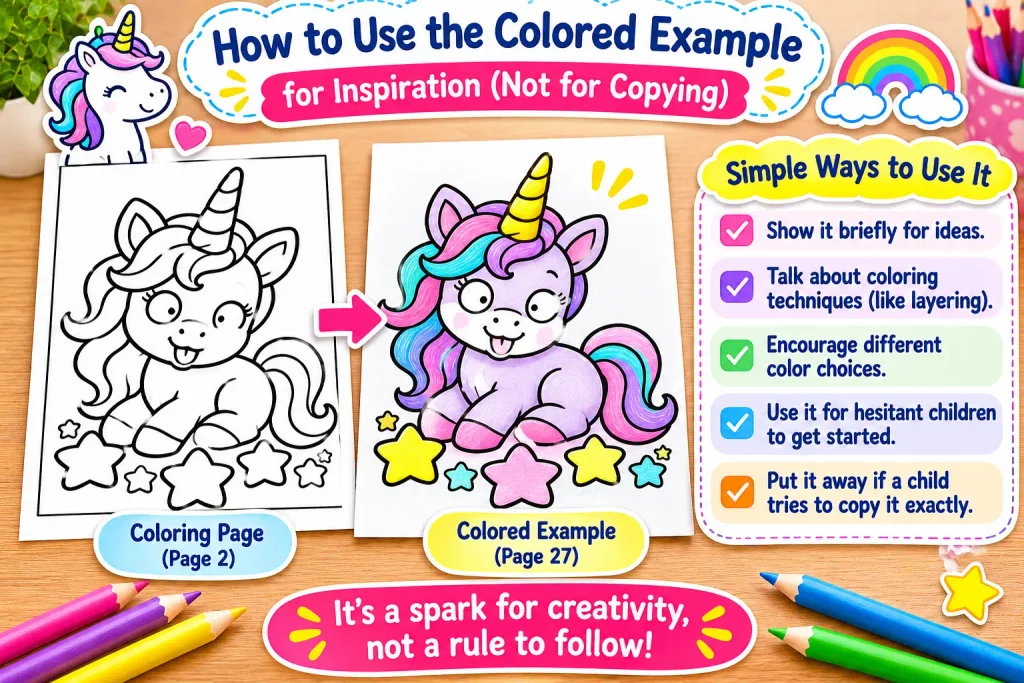
The point of the example is to inspire. A child’s page doesn’t need to resemble it.
The National Association for the Education of Young Children (NAEYC) also recommends giving children opportunities to explore art materials and make their own creative choices rather than focusing only on copying a finished example.
Step-by-Step: Using the Pages in a Preschool or Kindergarten Classroom
Skill level: Beginner-friendly, with some more detailed scenes available.
No cutting or special preparation is needed.
Materials: Printed pages, crayons or colored pencils, a small container of tools for each table, and optional scrap paper.
Setup
- Print a few copies of each page you plan to use, or print one set of all 25 for a choice basket.
- Place a small selection of pages at each table so children can choose.
- Put out limited palettes for younger children, or the full box for older ones.
Steps
- Gather the group and look at two or three scenes together. Ask what the unicorn might be doing.
- Let each child choose a page. Choice supports interest and focus.
- Remind children that any colors are fine.
- Walk around and comment on effort and ideas, for example, “You added so many stars,” rather than rating the neatness.
- Invite children to share a page with a friend or tell a short story about it.
- Collect finished pages for a display, take-home folder, or classroom book.
Easier adaptations: Offer fewer pages, choose designs with larger spaces, use chunky crayons, color only one part of the page, or work beside a helper.
Harder adaptations: Ask for a background, a pattern, or a more limited color palette, or have kindergarteners write a title or caption on the page.
Quiet-Time and At-Home Uses
A stack of free printable unicorn coloring pages is handy when a calm activity is needed.
- Quiet-time basket. Keep a few pages, crayons, and a clipboard in a basket. Children can color on a mat or at a table.
- Waiting-time activity. Folded pages in a bag can help during appointments or travel, though a hard surface helps for coloring.
- After-school wind-down. Coloring can be a relaxed way to settle after a busy day. Try the sleepy-time scenes for this.
- Parent-and-child time. Sit together with your own page and color side by side. Talking about the picture often happens naturally.
- Sibling activity. Older children can color alongside younger ones, each at their own level.
Coloring is not a cure for restlessness, and some days a child won’t want to sit. That is normal.
Keep the pages available and low-pressure.
Birthday Party Coloring Station
Unicorn coloring pages make an easy party activity because guests can start as they arrive and stop whenever they like.
Setup
- Choose 8 to 10 scenes, favoring the party and celebration group, such as the birthday cake (page 10), gift (page 17), hearts (page 13), and princess crown (page 14).
- Print one copy per guest, plus a few extras.
- Lay out crayons, colored pencils, and washable markers with a scrap sheet underneath.
- Add a simple sign so guests know they can take their page home.
Ideas for the Station
- Name and decorate. Guests write their name at the top and decorate the page.
- Gift to the birthday child. Guests color a page as a card for the guest of honor.
- Take-home art. Slip finished pages into a bag or folder.
- Display wall. Tape completed pages along a wall for a quick, colorful decoration.
Because these pages offer a range of details and open-ended coloring choices, children of different ages can join at their own level.
Storytelling Prompts to Go With the Pages
A finished page can lead to oral language practice. Try asking:
- “What is your unicorn’s name?”
- “Where is the unicorn going next?”
- “What does the unicorn see from the cloud?”
- “Who does the unicorn meet by the castle or the wishing well?”
- “What would the unicorn say to the friendly dragon?”
- “What is happening at the party in your picture?”
Older children might dictate or write a few sentences.
Younger children can simply tell you the story while you listen.
You can also set several pages together to build a longer story, with each child adding a scene.
Fine-Motor Practice: What to Expect
Coloring gives children repeated chances to hold a tool, control their hand, and decide where to place color.
Many educators include coloring among simple fine-motor activities.
The American Academy of Pediatrics’ HealthyChildren.org guide to preschool hand and finger skills discusses how young children’s hand coordination develops through everyday activities such as drawing, coloring, and manipulating art materials.
Progress varies from child to child, and coloring alone is not a treatment or a guaranteed way to build skills.
If you have concerns about a child’s hand control or development, speak with their teacher, pediatrician, or an occupational therapist.
To make the most of everyday practice:
- Offer age-appropriate chunky or triangular crayons for younger children, or comfortable colored pencils for children ready for more detail.
- Tape the page to the table so it doesn’t slide.
- Encourage children to rest their arm on the table.
- Keep sessions short and stop when interest fades.
Printing Tips for the Unicorn Coloring Pages
- Paper: Standard US Letter printer paper works for crayons and pencils. Slightly heavier paper helps with markers.
- Scale: Print at “100%” or “Actual Size” so the pages stay at their intended size.
- Black-and-white mode: Choose black-and-white or grayscale to save color ink.
- Pages to print: The 25 coloring designs are on PDF pages 2–26. Select only the pages you need rather than printing all 27.
- Instruction page: Print page 1 once for the adult, not for every child.
- Colored example: Print page 27 in color only if you want to show it, or view it on screen.
Storage and reuse: Keep the PDF saved on your computer so you can print more copies later.
For classrooms, a folder or binder with the pages sorted by theme makes it easy to grab one.
Finished pages can be stored in a child’s portfolio or taped into a class book.
Common Mistakes to Avoid
- Expecting realistic colors. Unicorns are made up, so any color is correct.
- Overloading the table. Too many choices can overwhelm younger children.
- Correcting staying in the lines. Control develops at different speeds. Encourage effort.
- Using one tool for everyone. Different children need different crayons, pencils, or markers.
- Skipping the scrap sheet with markers. Bleed-through can ruin table surfaces.
- Making the colored example the target. It is a spark, not a model to copy.
- Choosing a very detailed design for a beginner. Start with simpler pages, then offer more intricate scenes when children are interested.
Frequently Asked Questions About Unicorn Coloring Pages
How many unicorn coloring pages are in the free PDF?
The PDF has 27 pages in total: 25 unique black-and-white unicorn coloring pages, 1 short parent/teacher instruction page, and 1 colored example based on a matching original design.
Are these unicorn coloring pages good for preschoolers?
Yes. The set is designed mainly for ages 4–8, with a mixture of simple and more detailed scenes.
Younger preschoolers may only color part of a page, which is fine. Start with one of the designs featuring larger spaces.
What is the best coloring tool for easy unicorn coloring pages?
Crayons are a simple choice for many preschoolers.
Colored pencils suit children who want more detail, and washable markers give bright color with little pressure, though they may bleed through thin paper.
Do the unicorns look the same on every page?
No. Each of the 25 scenes is a different design, with unicorns in different poses, settings, and activities.
Children are welcome to change colors and add details to make each one their own.
Can I use the pages for a birthday party?
Yes. The party and celebration scenes, such as the birthday cake, gift, hearts, and princess crown pages, work well at a coloring station.
Print one page per guest and keep extras handy.
Is the colored example something children must copy?
No. It shows one possible way to color the baby unicorn with stars design from page 2, and it is meant as inspiration.
Children can choose any colors they like, and you can put it away if copying becomes a distraction.
Can I print the pages more than once?
Yes. Save the PDF and print the pages you want whenever you need them.
Check the terms on the download page if you are unsure how you may share the file.