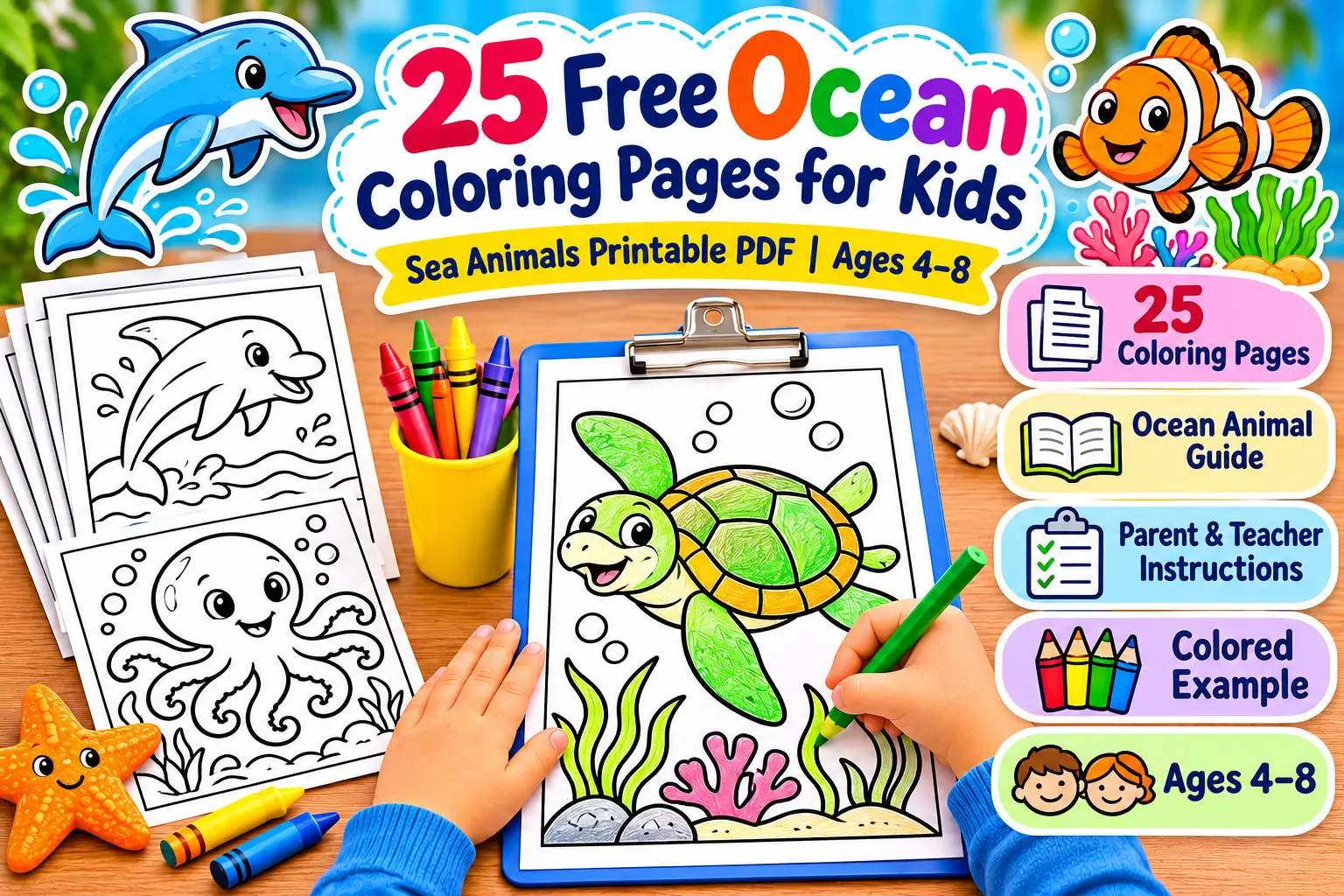
Kids love the ocean, and these free ocean coloring pages put dolphins, turtles, octopuses, and more on paper where small hands can color them.
Our printable PDF is designed for children ages 4–8, including preschoolers, kindergarteners, and the grown-ups who guide them. It combines coloring practice with ocean vocabulary and easy conversation starters, all in one free download for home or classroom use.
This 28-page printable PDF includes 25 different black-and-white ocean scenes, an ocean animal identification guide, parent and teacher instructions, and a beautiful colored-pencil example.
This page walks you through what’s in the printable, how the 25 scenes are organized, and how to turn a quiet coloring session into a meaningful learning activity.
It also covers eight simple add-on activities, coloring-material ideas, printing tips, and answers to common questions.
What’s Included in the Free Ocean Coloring Pages PDF
Our free printable PDF is titled “25 Free Ocean Coloring Pages for Kids – Sea Animals Printable PDF.”
It contains exactly 28 pages:
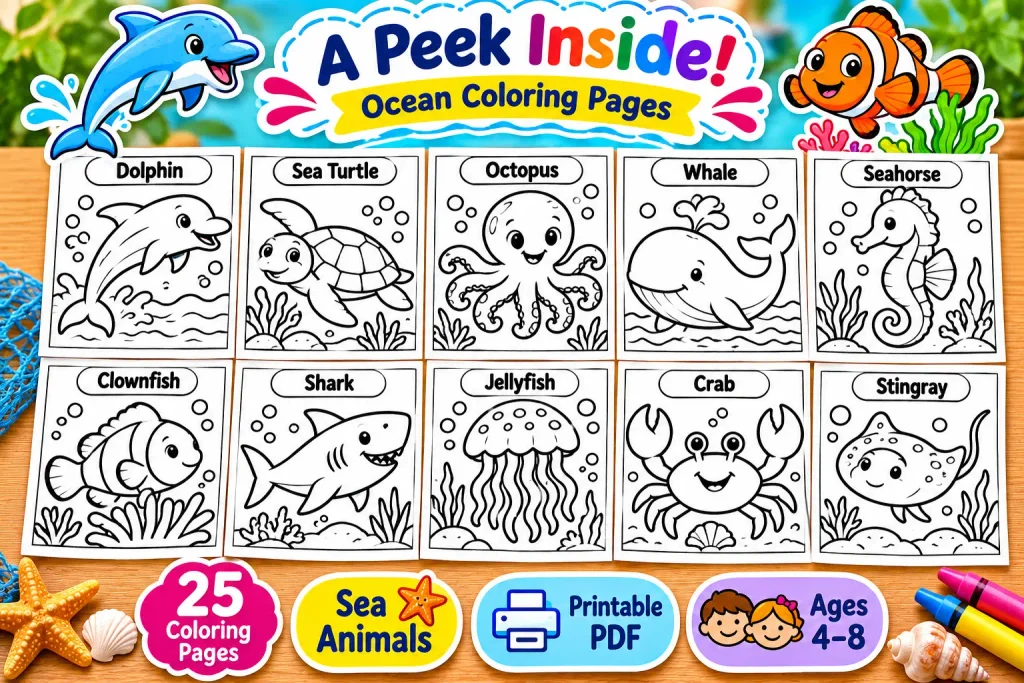
- 25 black-and-white ocean coloring illustrations (pages 3–27), featuring sea animals, underwater habitats, ocean families, and reef adventures.
- 1 parent/teacher instruction page (page 1) to help you get started.
- 1 ocean animal identification guide (page 2) for naming and recognizing the animals.
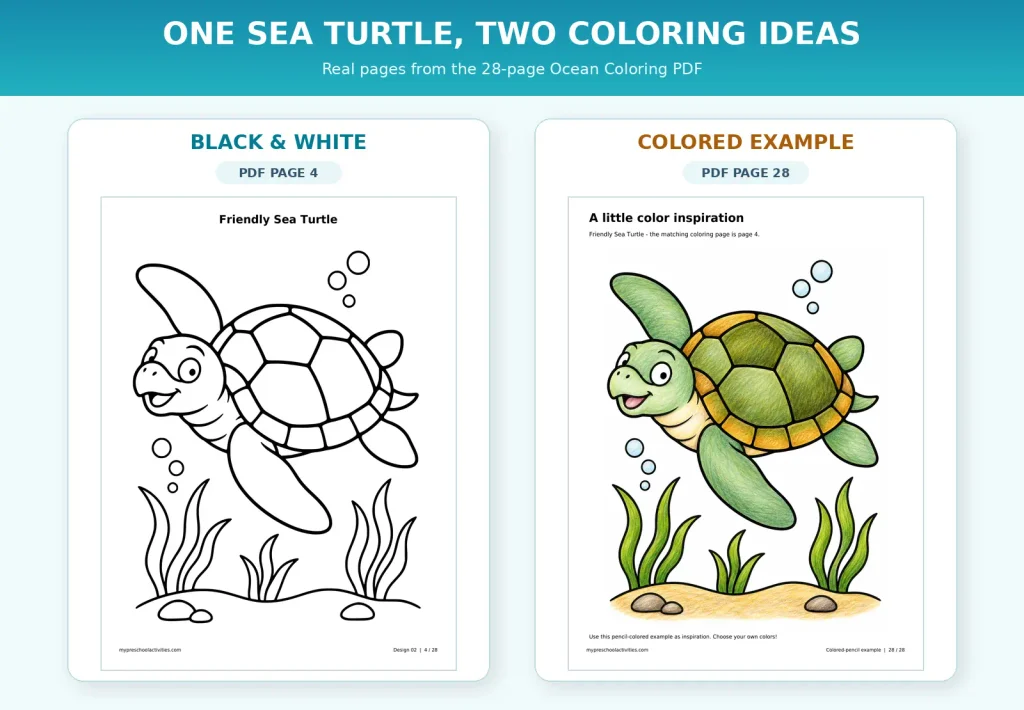
- 1 matching colored-pencil example (page 28) featuring the Friendly Sea Turtle from coloring page 4.
The artwork is designed with children in mind. It includes clear, thick outlines and a mixture of large, beginner-friendly coloring spaces and more detailed underwater scenes.
Some pages focus on individual sea animals, while others feature coral reefs, underwater plants, rocks, bubbles, and multiple sea creatures.
The illustrations are simplified and playful rather than scientific scale drawings, making them approachable for young children while still introducing recognizable ocean animals.
Because everything is in one PDF, you can print a single page for a quiet moment, a handful for a small group, or the whole set for an ocean-themed learning unit.
Who These Sea Animal Coloring Pages Are For
These printable ocean coloring sheets suit several settings:
- Parents at home who want a screen-free activity for a rainy afternoon, a quiet-time routine, or a trip to the aquarium followed by a coloring session.
- Preschool teachers who need a flexible center activity that connects to a water, animal, or ocean theme.
- Kindergarten teachers who want an easy early-finisher option or a calm activity that pairs with science vocabulary.
- Homeschool families looking for a low-prep addition to a sea life unit.
- Librarians and program leaders who run story-time crafts and need something simple to print.
The collection is intended mainly for children ages 4–8, but younger children can enjoy selected designs with appropriate adult assistance.
The simpler animal pages feature large coloring areas, making them friendly for children who are just beginning to hold crayons with purpose.
Older children can explore the more detailed reef and tide-pool scenes, add their own backgrounds, or label animal features.
Many of the scenes work well for mixed-age groups since each child can color at their own level.
The 25 Ocean Coloring Pages, Organized by Group
The easiest way to plan with a set this size is to think of it in groups.
Here is how the 25 ocean scenes break down, with their exact page numbers from the printable PDF.
Featured Sea Animals (15 Coloring Scenes)
These pages focus on recognizable ocean animal types. Some include additional fish, plants, bubbles, or underwater details.
They are a friendly starting point for children who prefer one main subject.
- Smiling Dolphin — Page 3: A friendly dolphin swimming through the open ocean.
- Friendly Sea Turtle — Page 4: A cheerful sea turtle swimming among seagrass and bubbles.
- Cute Octopus — Page 5: An adorable octopus with curling arms and an underwater setting.
- Whale in the Open Ocean — Page 6: A large whale swimming through the sea.
- Seahorse in the Seagrass — Page 7: A delicate seahorse surrounded by underwater plants.
- Sea Star on the Seabed — Page 8: A sea star resting on the ocean floor.
- Clownfish and Anemone — Page 9: A clownfish swimming beside a sea anemone.
- Gentle Shark — Page 10: A friendly shark swimming underwater.
- Floating Jellyfish — Page 11: A jellyfish drifting through the ocean.
- Crab on the Sand — Page 12: A crab exploring the sandy seabed.
- Lobster by the Rocks — Page 13: A lobster surrounded by rocks and underwater scenery.
- Swimming Stingray — Page 14: A stingray gliding through the water.
- Seal Underwater — Page 15: A seal swimming beneath the surface.
- Sea Lion on the Coast — Page 16: A sea lion resting near a rocky coastline.
- Tropical Fish — Page 17: A colorful reef-fish scene featuring different tropical fish.
With one main animal type or focal subject per scene, children can concentrate on color choices and recognizing different sea creatures.
The Tropical Fish page includes more than one fish, making it a useful starting point for comparing shapes and patterns.
Animal Families and Groups (4 Pages)
These scenes feature more than one animal, making them useful for counting, comparing sizes, and storytelling.
- Whale and Calf — Page 18: A mother whale and her calf swimming together.
- Seahorse Family — Page 22: Seahorses gathered in an underwater scene.
- School of Fish — Page 23: Several fish swimming together.
- Dolphin Family — Page 27: A group of dolphins swimming through the ocean.
These pages invite conversations about big and small, more and fewer, and how animals interact in a picture.
Children can count the fish, compare the whales, or give each dolphin a name.
They are also good for storytelling since children naturally want to decide who the characters are and what they might be doing.
Habitat and Reef Scenes (5 Pages)
These scenes feature additional underwater surroundings and offer more background elements to color.
- Dolphin over the Reef — Page 19: A dolphin swimming above an underwater reef.
- Sea Turtle and Fish — Page 20: A sea turtle sharing an underwater scene with fish.
- Octopus in a Reef Den — Page 21: An octopus exploring a rocky underwater hiding place.
- Ocean Reef Adventure — Page 24: A lively reef scene with sea creatures and underwater details.
- Underwater Treasure — Page 25: A playful ocean scene featuring a treasure chest.
These pages are a good fit for children who finish single-animal pages quickly and want a bigger challenge.
They can color rocks, plants, coral, bubbles, and other details.
The underwater treasure scene is imaginative rather than a representation of a real ocean habitat.
The Big Busy Scene (1 Page)
Tide-Pool Friends — Page 26
This page features several coastal sea creatures together, including crabs and sea stars.
It is a fun “look and find” activity that encourages children to notice small details and compare different animals.
Children can count the creatures, identify their shapes, and describe where each animal appears in the picture.
It works well as a longer coloring project, a group activity, or the finale to an ocean-themed learning week.
A note on the scenes: Each illustration is designed to show recognizable ocean animals in friendly, child-appropriate compositions.
The pictures are illustrative and not drawn to scale. When discussing them, treat the scenes as opportunities to explore and imagine rather than proof that certain animals always live together in the wild.
Ocean Animal Vocabulary and Simple Sea Life Facts
Coloring is a natural moment to build language.
As children work, you can name animals, describe their parts, and ask questions.
Here are a few accurate, preschool-friendly ideas to share.
Keep them short and let curiosity lead.
Not Every Sea Animal Is a Fish
This is one of the most useful ideas to introduce gently.
- Dolphins and whales are mammals. They breathe air at the surface and do not have gills.
- Seals and sea lions are also mammals that spend much of their time in the water.
- Sea turtles are reptiles and breathe air.
- Sharks, stingrays, seahorses, clownfish, and tropical reef fish are fish.
- Crabs and lobsters are crustaceans with hard outer coverings called exoskeletons.
- Octopuses are soft-bodied animals with eight arms.
- Jellyfish and sea stars are not fish despite their common names. They belong to other animal groups.
With preschoolers, you don’t need to teach the full classification system.
A simple sentence works:
“A dolphin is not a fish. A dolphin is a mammal that breathes air.”
That one sentence is accurate and memorable.
More Fun Ocean Animal Facts
Here are a few more conversation starters:
- An octopus has eight arms.
- A sea star is often called a starfish, but it is not a fish. Many sea stars have five arms, though some have more.
- A seahorse is a fish, even though it doesn’t look like most fish.
- Crabs have two pincers and usually eight walking legs.
- Sea turtles use their flippers to swim.
- Seals and sea lions are both mammals, but sea lions have small visible external ear flaps.
- Whales are very large animals, and children may enjoy comparing their sizes with familiar objects like buses or houses.
Are Corals and Sea Anemones Plants or Animals?
This is another interesting fact included in the ocean animal identification guide.
Corals and sea anemones are animals, even though they can look like underwater flowers or plants.
Kelp is a type of algae, while seagrasses are flowering plants that grow underwater.
These differences can surprise children and create opportunities to discuss how living things are classified.
For additional accurate information about marine animals and habitats, explore Smithsonian Ocean’s Ocean Life resources.
You can also learn more about seagrass meadows and underwater habitats.
The goal is not to memorize every fact but to encourage children to look closely, ask questions, and learn something new while coloring.
How to Use the Ocean Coloring Pages Step by Step
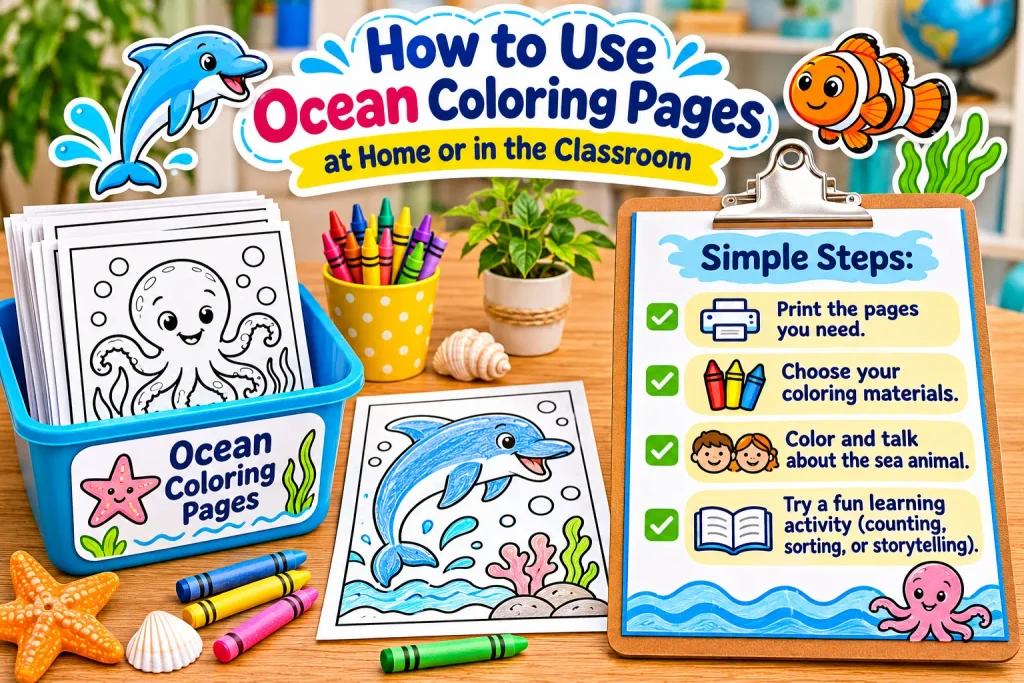
Here is a simple routine that works at home or in a classroom.
Skill level: Preschool, kindergarten, and early elementary. The collection is designed mainly for ages 4–8, with adult assistance when needed.
Materials: Printed ocean coloring pages, crayons or other coloring tools, and a flat surface.
Optional extras include the identification guide, the colored example, and a basket of sea-themed picture books.
Setup
- Decide how many pages you need and print them using the recommended settings.
- Print the parent/teacher instruction page (page 1) for your reference.
- Print the ocean animal identification guide (page 2) if you want children to match animals to names.
- Set out coloring tools in cups or trays so every child can reach them.
During the Activity
- Show the page and ask, “What animal do you see?” Let children guess before you name it.
- Name the animal clearly and share one short fact, such as “A dolphin breathes air.”
- Invite children to choose colors. Some will pick realistic colors, while others will pick rainbow ones. Both are fine.
- Walk around and ask open questions: “Tell me about this part.” “What is your octopus doing?”
- When a child finishes, ask them to share the name of their animal and one thing they know about it.
Easier options: Offer a single-animal page, use chunky crayons, and let the child color just part of the picture. Praise effort and focus rather than neatness.
Harder options: Offer a reef or tide-pool scene, ask the child to add details like bubbles or patterns, or have them label the animals using the identification guide for reference.
8 Preschool-Friendly Ocean Learning Activities
These add-on ideas turn the ocean coloring pages into a short learning unit.
Each needs only simple materials and can be adapted for preschool, kindergarten, or homeschool.
1. Sea Animal Sorting
Print a few different animal pages and ask children to sort them into groups.
Start with an easy rule, like “animals with flippers” and “animals without flippers.”
Later, try “animals that breathe air” and “animals that have gills,” with adult support.
Use the identification guide to check the animal names and introduce the differences between mammals, reptiles, fish, and other groups.
2. Match the Name
After coloring, give children name cards for a few of the animals.
They match each card to the corresponding coloring page.
This builds early reading awareness, especially for children who are beginning to recognize letters.
Let them look at the first letter and say its sound.
For example, D is for Dolphin, S is for Shark, and O is for Octopus.
3. Shape Hunt
Many sea animals have shapes that children can recognize.
A jellyfish has a rounded bell, a shark has a triangular fin, and a sea star often has five arms arranged around a center.
Ask children to point to circles, triangles, and curved lines on their pages.
This links coloring to early geometry in a gentle way.
4. Big and Small Comparison
Use the Whale and Calf (page 18), Seahorse Family (page 22), School of Fish (page 23), and Dolphin Family (page 27) scenes to talk about size words.
Ask:
“Which animal looks the biggest?”
“Which one is the smallest?”
“How do you know?”
Children can also arrange pictures from smallest-looking to largest-looking.
Remember that the drawings are not to scale, so frame this as a comparison of what appears in the illustrations.
5. Counting Page
Pick a scene with multiple animals, such as School of Fish (page 23) or Tide-Pool Friends (page 26).
Ask children to count a specific type of creature.
They can color each one as they count it, then compare totals with a friend.
This is especially helpful for children practicing one-to-one counting.
6. Ocean Story Time
Choose Ocean Reef Adventure (page 24) or Underwater Treasure (page 25) and invite a child to tell a story.
Start with a prompt like:
“One sunny morning under the sea…”
Let the story unfold naturally.
An adult can write down a sentence or two.
This encourages oral language, imagination, and sequencing skills.
The story can be silly and imaginative since the picture is a springboard rather than a science lesson.
7. Mammal or Fish?
After you’ve introduced the idea, play a simple sorting game with colored pages.
Hold one up and ask:
“Mammal, fish, or something else?”
Children can answer by pointing to labeled spots, standing in different areas of the room, or holding up cards.
Start with dolphin, whale, shark, and tropical fish.
Later, introduce sea turtles, seals, octopuses, and sea stars.
8. Ocean Care Conversation
Keep this one light and hopeful.
After coloring, ask:
“What do you think sea animals need?”
Children might say food, clean water, and safe homes.
Share one simple idea families can do, such as picking up litter and putting trash in a bin.
A short, positive conversation is better than a long lecture.
The goal is care and curiosity, not worry.
Coloring Materials and Extension Projects
You don’t need anything fancy.
Here are some options and what each one is good for.
Crayons: Easy to hold and forgiving. Chunky crayons are especially helpful for younger children.
Colored pencils: Better for fine control and details. Good for kindergarteners and older children.
Washable markers: Bold and bright. Place a scrap sheet underneath in case marker ink bleeds through.
Watercolor paints: A fun option for reef and background scenes. Use heavier paper if you plan to paint since standard printer paper can wrinkle.
Oil pastels or chalk pastels: Lovely texture for adult-supervised projects.
Stickers and collage scraps: Tissue paper, construction paper scraps, or foil can add texture to waves, coral, or treasure.

Easy Ocean Craft Extensions
- Ocean mural: Cut out colored animals and glue them onto a large blue paper background to make a class mural.
- Paper-bag puppets: Glue a colored animal to a paper bag or craft stick for pretend play.
- Ocean book: Staple several finished pages together with a simple cover for a child-made book.
- Window display: Tape colored pages to a window so light shines through the paper.
Check that all craft supplies are age-appropriate and that adults handle scissors and other tools as needed.
Printing, Storage, and Reuse Tips
These free printable ocean coloring pages are designed for standard US Letter paper.
Follow these simple tips for the best results:
- Paper: Standard US Letter (8.5 × 11 inches) printer paper works well. Heavier paper is helpful if children will use markers or paint.
- Print settings: Choose “Actual Size” or “100%” to preserve the intended size of the illustrations. Black-and-white mode saves color ink.
- Print only what you need: The 25 coloring pages are on PDF pages 3–27. You don’t have to print all 28 pages at once.
- Instruction page: Print page 1 for the adult or teacher.
- Identification guide: Print page 2 if you want children to identify and compare ocean animals.
- Colored example: Page 28 shows a colored-pencil version of the Friendly Sea Turtle from page 4. Display it on a screen or print it in color for inspiration.
- Test one page first: Print a single page to check line darkness and margins before printing a full set.
- Storage: Keep the PDF saved in a digital folder on your computer or phone. Store printed pages in a folder or binder.
- Reuse: Print pages again for your own home or classroom activities. For repeated practice, slide a page into a clear sleeve and let children use dry-erase markers.
The printable is intended for personal and individual classroom use. If you want to share it with another parent or teacher, direct them to the original download page rather than redistributing the PDF file.
You can review the website’s Terms and Conditions for more information about permitted use.
Common Mistakes to Avoid
- Handing out too many pages at once. A big stack can feel overwhelming. Offer one or two and let children return for more.
- Starting with the busiest scene. Begin with simpler animal pages to build confidence, then move to reef and tide-pool scenes.
- Correcting colors. Children can use creative colors. Save discussions about realistic animal appearances for the identification guide rather than correcting their artwork.
- Skipping the conversation. The conversation is where much of the learning happens. Even two or three questions per page can encourage observation and language.
- Teaching uncertain facts. If you aren’t sure about a fact, look it up or leave it out. Simple and accurate beats impressive and wrong.
- Treating the scenes as real habitats. The illustrations are for coloring and discussion. Avoid claiming that all animals pictured together naturally share the same habitat.
Frequently Asked Questions
How many pages are in the free ocean coloring pages PDF?
The PDF contains exactly 28 pages.
That includes 25 black-and-white ocean coloring pages, one parent/teacher instruction page, one ocean animal identification guide, and one colored-pencil example.
What age are these ocean coloring pages for?
They are designed mainly for children ages 4–8, including preschoolers, kindergarteners, and young elementary learners.
The simpler pages have larger coloring spaces, while the reef and underwater scenes offer more details for children who want an additional challenge.
Which sea animals are included?
The pages feature dolphins, sea turtles, octopuses, whales, seahorses, sea stars, clownfish, sharks, jellyfish, crabs, lobsters, stingrays, seals, sea lions, and tropical fish.
They also include animal families, reef scenes, an underwater treasure adventure, and a tide-pool scene.
Are dolphins and whales fish?
No. Dolphins and whales are mammals.
They breathe air and don’t have gills.
Seals and sea lions are mammals too.
Sharks, stingrays, seahorses, clownfish, and tropical reef fish are examples of fish included in this set.
Can I print just a few pages instead of the whole PDF?
Yes.
When your print dialog opens, choose the page range you want, such as pages for a single animal or a specific theme.
You can also print the instruction page and identification guide separately.
Is there a colored example I can show children?
Yes.
Page 28 includes a colored-pencil example of the Friendly Sea Turtle from page 4.
It can serve as inspiration for how a finished page might look, but children should feel free to choose their own colors.
What should I use to color the pages?
Crayons and colored pencils are good everyday choices.
Washable markers work well too, and watercolors are fun if you use heavier paper.
Choose the material that fits the child’s age and the setting.
How can I use these pages beyond coloring?
Try sorting, name matching, counting, size comparison, storytelling, or a mammal-or-fish game.
The eight activities above are designed to be quick and need very little preparation.
Can I use these ocean coloring pages in my classroom?
Yes.
The printable can be used for personal, homeschool, and individual classroom activities under the website’s usage terms.
Teachers can print physical copies for students in their own classrooms.
For sharing with colleagues or other families, direct them to the original resource page rather than uploading or redistributing the PDF.
Ready to Dive In?
These free ocean coloring pages are a simple way to bring the sea into your home or classroom.
With 25 different underwater scenes, a sea animal identification guide, and a colored-pencil example, this printable collection offers a fun combination of creativity and early learning.
Print a page, talk about the animal, and let children make it their own.
Whether you use one page for a quiet moment or the full set for an ocean-themed week, the goal is the same: curiosity, language, and calm, creative time.
Download your free 28-page Ocean Coloring Pages PDF and start your underwater adventure!
Looking for more printables? Browse our full collection of free coloring pages for kids for more creative activities.