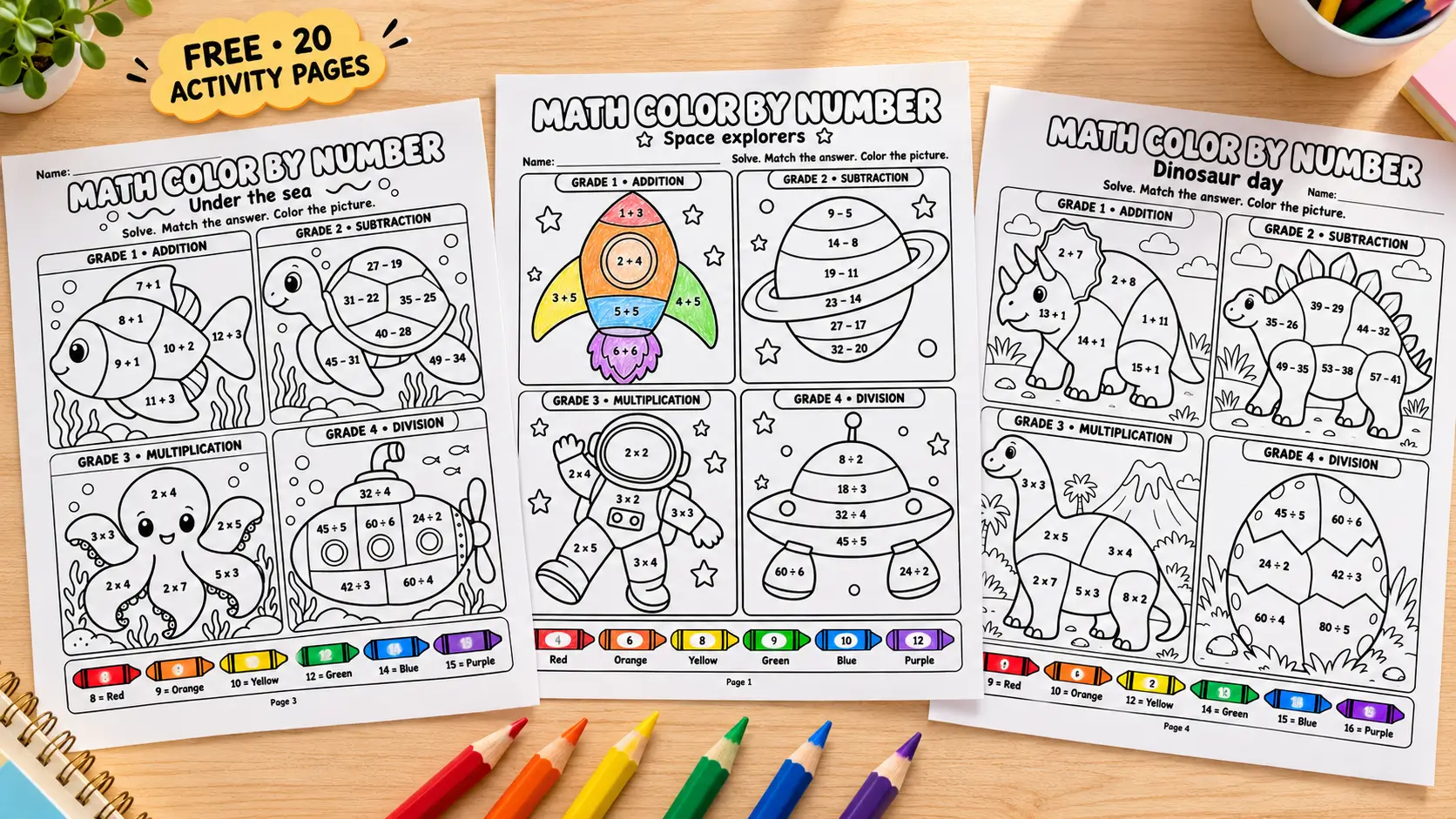
It is twenty minutes before lunch, and you need an arithmetic review that students can complete mostly on their own. Or it is a homeschool afternoon, and your third grader needs multiplication practice that feels less like drilling. A page where children solve problems and color the matching sections can fit either moment.
Table of Contents
That is the idea behind math color by number worksheets. Students solve each problem, find the answer on the page’s color key, and color the matching section. As sections fill in, the picture takes shape, which gives children a small creative reason to keep going.
This guide explains how the activity works, how to match practice to Grades 1–4, and seven ways to use it. If you want to try it as you read, there is a free 20-page printable PDF on Teachers Pay Teachers you can look over and print.
What Are Math Color by Number Worksheets?
A color-by-number math page follows a simple solve, check, color loop. The student solves a problem, checks the answer, finds it on the color key, and colors the section with the matching color. You may also see these called math coloring pages or color by number math worksheets, but the process is the same.
Here is an illustrative example. Suppose a problem reads 6 + 3, and the key assigns blue to 9. The child solves 6 + 3, gets 9, finds 9 on the key, and colors that section blue. This is only an example for explanation, not a confirmed problem or color key from the resource featured later in this article.
Because the key decides each color, math color by number worksheets also ask students to read carefully. Keys can change from page to page, so children should check the key every time. As printable math activities, the pages need little setup beyond printing and coloring tools.
What Can These Activities Help Children Practice?
Math color by number worksheets can add variety to elementary math practice in several ways. They work best as practice and review alongside appropriate teaching and feedback.
Reviewing previously taught arithmetic. Addition color by number worksheets can give younger students practice with number facts, and subtraction color by number worksheets can revisit subtraction after it has been taught.
Following a color key and written directions. Students read or listen to directions, find numbers on a key, and match them to sections. The coloring may help some learners stay engaged with practice that could otherwise feel repetitive.
Organizing independent practice. A page offers a clear set of problems and an obvious sign of when the work is done, which can make independent work easier to manage while you meet with a small group.
Giving adults chances to notice errors. An answer that does not fit the key, or a pattern in the mistakes, gives you a reason to ask, “How did you solve that?” That short conversation can reveal more than a finished picture.
Coloring also gives children some fine motor practice. If that is a goal for your learners, you can alternate these pages with our fine motor skills worksheets on other days.
Choosing Appropriate Pages and Sections for Grades 1–4
When you choose math color by number worksheets for Grades 1–4, treat the grade label as a starting point, not a rule. A student’s readiness and the actual problems on the page matter more than the grade number.
Each activity page in the featured resource includes four illustrated sections covering addition, subtraction, multiplication, and division. Adults can assign the sections that match what each learner has already been taught.
| Grade | Possible practice focus | What the adult should check |
|---|---|---|
| Grade 1 | Familiar addition; subtraction only if taught | Whether the problems match what the child has learned, and whether counters or a number line are available |
| Grade 2 | Addition and subtraction at an appropriate level; other operations only if already introduced | Whether the child is comfortable with the subtraction on the page, including two-digit problems |
| Grade 3 | Multiplication and division when taught, plus addition and subtraction review | Whether students know the facts or use a strategy, and connect multiplication with division |
| Grade 4 | Suitable multiplication, division, and mixed arithmetic review | Whether students can check division with multiplication and explain their steps |
Multiplication color by number worksheets and division color by number worksheets fit best once those operations have been taught. A first grader does not need to try every section, and a fourth grader may like a quick addition warm-up first.
Seven Practical Ways to Use Math Color by Number Worksheets
Each idea below includes a tip you can use right away.
1. Math Centers
Choose a section that matches a skill you taught recently, so students can work with little help. Before they head to the center, read the directions aloud and model finding one answer on the key. Math color by number worksheets can suit centers because the routine stays the same from page to page.
Tip: Put a card in the folder listing the steps, so students check it before interrupting a small group.
2. Independent Review
Assign one short block of problems, such as a single section, and have students solve and check before they pick up a crayon. Add a check-in so you or a parent can take a quick look before coloring.
Tip: A quick check can help catch mistakes before coloring. Adjust the amount of work to the student’s readiness and available time.
3. An Early-Finisher Choice
Offer a page as one option on a short list for students who have finished their assigned work. The word finished matters: students should complete and check the main assignment first, so the activity is a meaningful extension rather than a reason to rush.
Tip: Keep pages in a labeled folder and let students pick a section at their own level.
4. Homeschool Math Practice
Among homeschool math activities, math color by number worksheets fit neatly after a lesson. Teach the concept, let your child solve a section while you work nearby, and then spend a few minutes reviewing together.
Tip: Save the coloring until the answers are checked, and ask your child to explain one problem before finishing the page.
5. Small-Group Support
Pick three or four problems from a section and watch students solve them in a small group. You may notice who counts on fingers, who uses a known fact, and who guesses. Ask each student to explain one answer.
Tip: Jot down the strategies and misunderstandings you see, and use the notes to plan your next mini-lesson.
6. A Short Review Before a Classroom Break
A short, clearly limited task can help students settle before recess, lunch, or dismissal. Set a small goal, such as three or four problems, so the activity does not run into the break.
Tip: Use a visible timer, and tell students that unfinished coloring can wait for a calmer moment later in the day.
7. Error Analysis and Math Discussion
Ask students to explain one solution aloud. Then point out one answer that needs a second look, so they can revisit it, find the error, and correct it before coloring.
Tip: Offer sentence starters such as “I solved this by…” and “I changed my answer because…” so every student has language for the conversation.
A Simple Solve–Check–Color Routine
This routine works for a class, a small group, or one child at the kitchen table, and it applies to any set of math color by number worksheets.
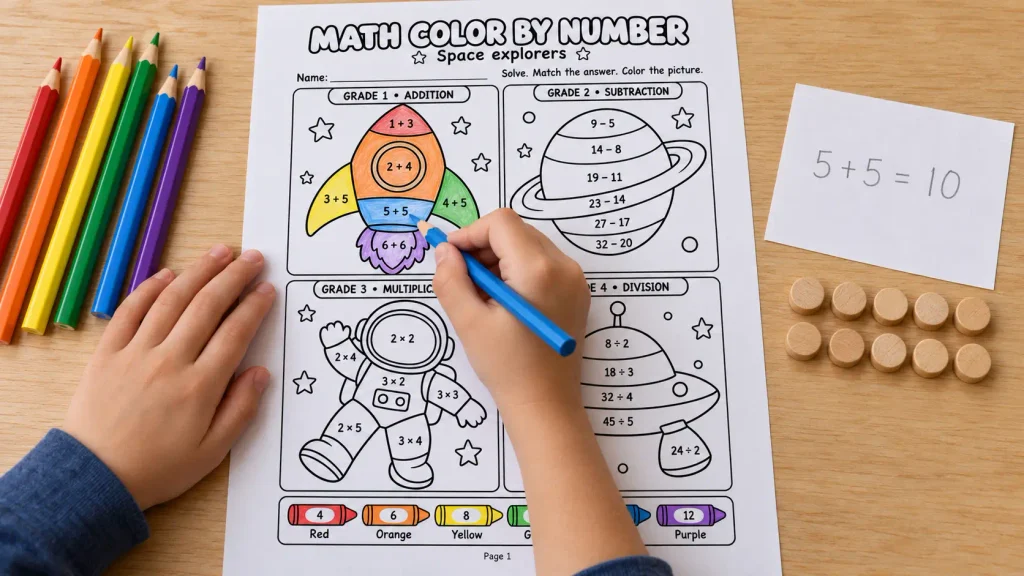
- Choose an appropriate worksheet. Look at the problems first and pick a section the student has been taught.
- Read the instructions and color key. Find the key, read the directions, and make sure the needed colors are on hand.
- Model one example. Solve one problem aloud, find the answer on the key, and show which color to use.
- Solve a manageable group of problems. A few problems or one section is easier to check than a full page.
- Check the answers. Use a method that fits the skill: counters or a number line for addition and subtraction, a multiplication chart or fact strategies for multiplication, or multiplication to verify division. Decide on your checking method before students start; this routine does not depend on an answer key.
- Color the corresponding sections. Students match each checked answer to its key color and color carefully.
- Discuss one strategy or correction. Ask one student to explain a solution or fix an error, and note any pattern that needs more teaching.
Simple Adaptations for Different Learners
Math color by number worksheets can be adjusted in small ways to suit different learners.
- Work on smaller sections. Cover part of the page, or have the student complete a few problems at a time.
- Use counters or a number line. When appropriate, let students use counters, a number line, or a multiplication chart.
- Take short breaks. Pause after a few problems or after each section.
- Check answers with an adult before coloring. Quick feedback can help students correct errors before coloring.
- Use written color labels or another system. If identifying colors is a barrier, write the color name beside each number on the key, or pair each color with a pattern or symbol.
- Offer another way to respond. If coloring creates a motor-access barrier, a student might mark sections with dot stickers, a stamp, or a check mark, or point to the section while an adult records the color.
Common Mistakes to Avoid
Math color by number worksheets work best when adults watch for a few common pitfalls.
Guessing from the developing picture. Once part of the image is colored, some children guess answers based on what the picture should look like. Remind them that the picture is a result, not a clue.
Using the wrong color key. Because keys vary by page, relying on memory can lead to a whole section colored incorrectly. Ask students to touch the number on the key before they color.
Assigning problems beyond the student’s current knowledge. A page of unfamiliar problems turns practice into frustration. Choose a section the student has been taught, and move up gradually.
Treating neat coloring as evidence of math mastery. A beautifully colored page shows careful coloring, not necessarily understanding. Look at the work and listen to the student’s explanations.
Completing a page without discussing recurring errors. If a child keeps missing the same kind of problem, another page will not fix it. Take a few minutes to talk through the error and reteach when needed.
Download the Free Math Color by Number Worksheets
Here is what the featured resource offers:
- A free printable PDF with 20 activity pages
- Four illustrated panels on each page
- Addition, subtraction, multiplication, and division sections on every activity page
- A number-to-color key on every activity page
- Black-and-white activity illustrations with a six-color reference key
- US Letter size, portrait orientation
- 20 themes, including space, dinosaurs, ocean animals, and sweet treats
- One additional page linking to more resources from SmartPrint Kids
Download the free math color by number worksheets on TPT
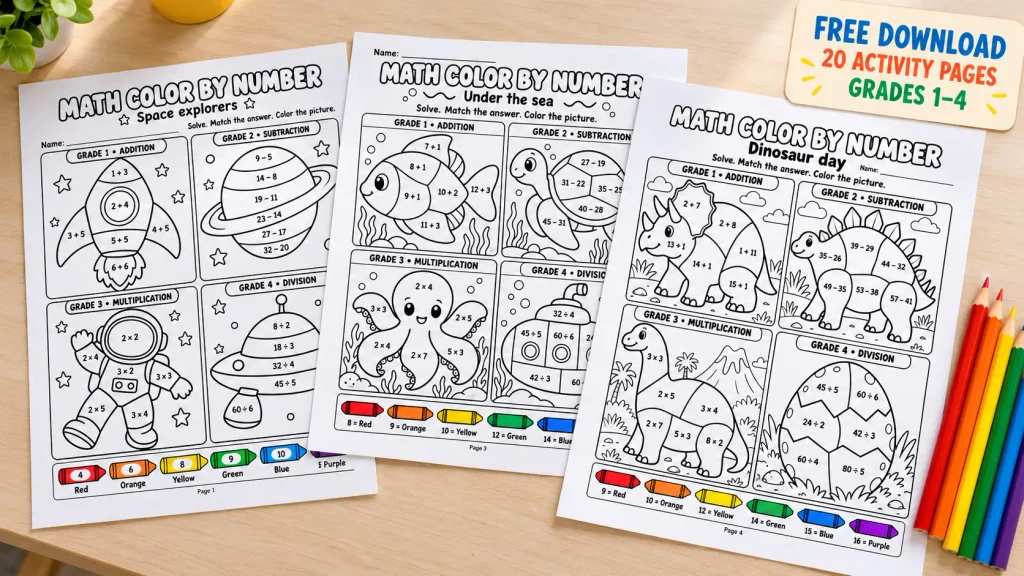
Because every activity page includes all four operations, adults can choose the section that fits each learner and set the others aside. The color keys use red, orange, yellow, green, blue, and purple. Have these colors available as colored pencils, crayons, or other suitable coloring tools. TPT may ask you to log in or sign up before downloading.
Optional Supplies for Printing and Coloring
The pages are free, and most classrooms and homes can use the printer and coloring tools they already have. If you print materials like these often, you will find more ideas in our printable learning activities.
As an Amazon Associate, I earn from qualifying purchases.
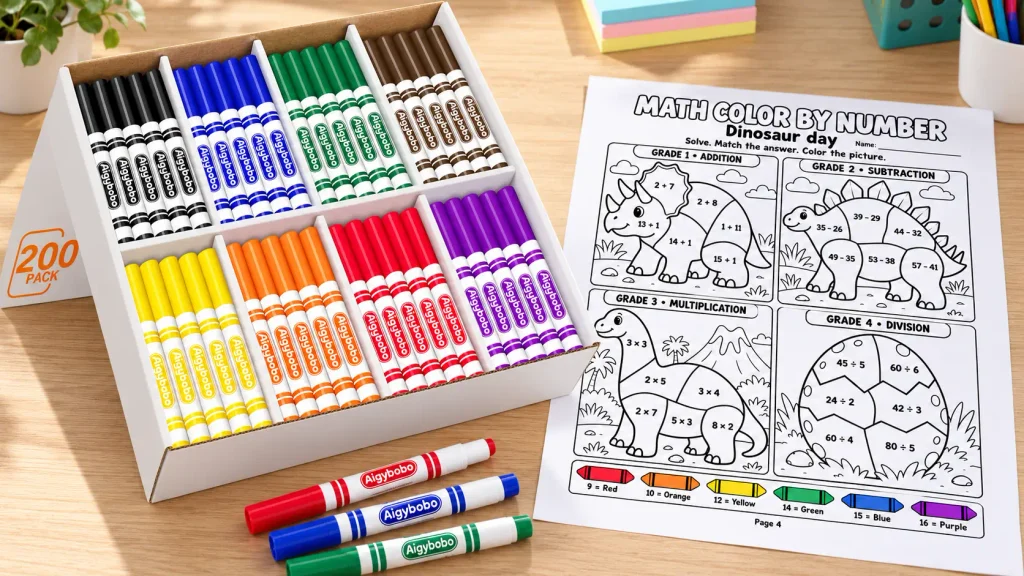
Markers for coloring. Aigybobo Washable Markers Bulk, 200 Count, 8 Colors is an optional bulk supply for classrooms that color often. The listing identifies them as washable markers with broad-line conical tips. Before buying, check that the set includes the colors your chosen pages need, and test a marker on a spare sheet to see whether it suits your paper. Colored pencils or crayons work too.
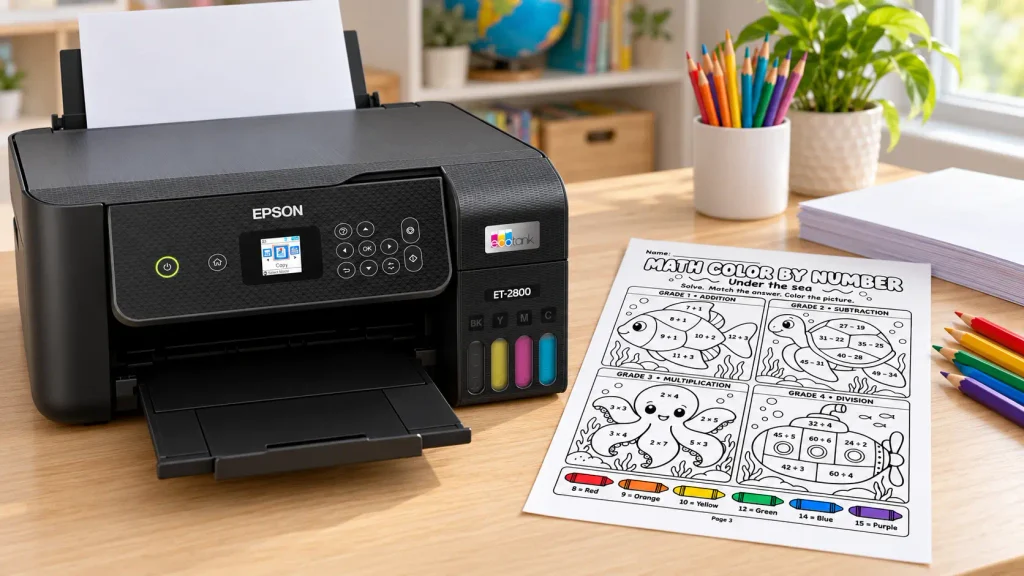
A printer for regular printing. The Epson EcoTank ET-2800 Wireless Color All-in-One Printer is an optional refillable ink-tank printer that prints, scans, and copies, which may suit people who regularly print learning materials. You do not need a new printer to use a free PDF; any suitable printer you already have will do. If you are considering this model, review the manufacturer’s specifications first to be sure it fits your needs.
Frequently Asked Questions
What are math color by number worksheets?
They are practice pages where students solve math problems, match each answer to a color key, and color the corresponding section.
Can these be used in Grades 1–4?
The featured resource is intended for Grades 1–4, but readiness matters more than the grade label. Choose sections whose problems match what each student has learned.
Does every page include all four operations?
Every activity page has addition, subtraction, multiplication, and division sections, so the activities are not divided into separate grade-level worksheets. Choose the sections that fit each student rather than assigning all four. The PDF also includes one additional page with links to more resources.
Can they be used for homeschool practice?
Yes. They fit well after a lesson as a short practice session followed by a quick check and discussion. Choose a section your child has been taught, and save the coloring for after the answers are checked.
What if a student needs help solving the problems?
Pause the coloring and return to the math. Try counters, a number line, or a multiplication chart, solve one problem together, and switch to an easier section if needed.
Where can readers access the free resource?
The resource is listed on Teachers Pay Teachers. Use the link in the download section above; you may be asked to log in or sign up.
Related reading: For a different kind of activity, try our gratitude activities for kids.
Conclusion
Good arithmetic practice starts with problems a student is ready for and a clear routine. Solve, check, then color keeps the math first and the picture second, and it gives adults a natural moment to notice errors and talk about strategies.
Used alongside direct teaching, math color by number worksheets can add variety to review time at school or at home. Pick a section that fits, model one example, check the work before coloring, and let the discussion matter as much as the finished page.