Name tracing for preschoolers means following an adult-prepared written model of a child’s own name with a finger, crayon, or pencil. It works best when the model is clear, the spelling is correct, and the task matches what the child can do right now.
This article gives you seven activities built around one running example, a child named Mia. Two are preparation games: finding the name and building it from letter cards. Three are tracing options. Two help children move toward copying the name and using it for a real purpose.
You do not need to do all seven or follow them in order. Pick the one that fits what your child is working on, gather paper and crayons, and begin.
What Children Can Practice with Their Names
A child’s name can do several different jobs, and it helps to keep them separate. Recognition means noticing which written name is theirs. Letter order means seeing that M comes first, then i, then a. Name tracing means following a letter model that an adult already made. Copying or independent writing means making letters beside a model, or without one.
Here is how that might look for Mia. She finds her own card among others. She arranges M, i, and a cards to match the model. She traces the name with a finger or crayon. Later she tries copying one letter, or the whole name, beside the model. Each step asks something different of her.
Choosing the correct card is not the same as reading the name independently, and tracing is not the same as writing it from memory. Notice whether Mia is matching the whole name, recognizing individual letters, or following a written model so you can choose a suitable next activity. Name tracing for preschoolers is most useful when it sits among these other activities rather than standing in for them.
Prepare One Clear Name Model
Good name tracing starts with a good model. Spend a few minutes on these steps before you begin:
- Confirm the spelling and the letter style used at home or school.
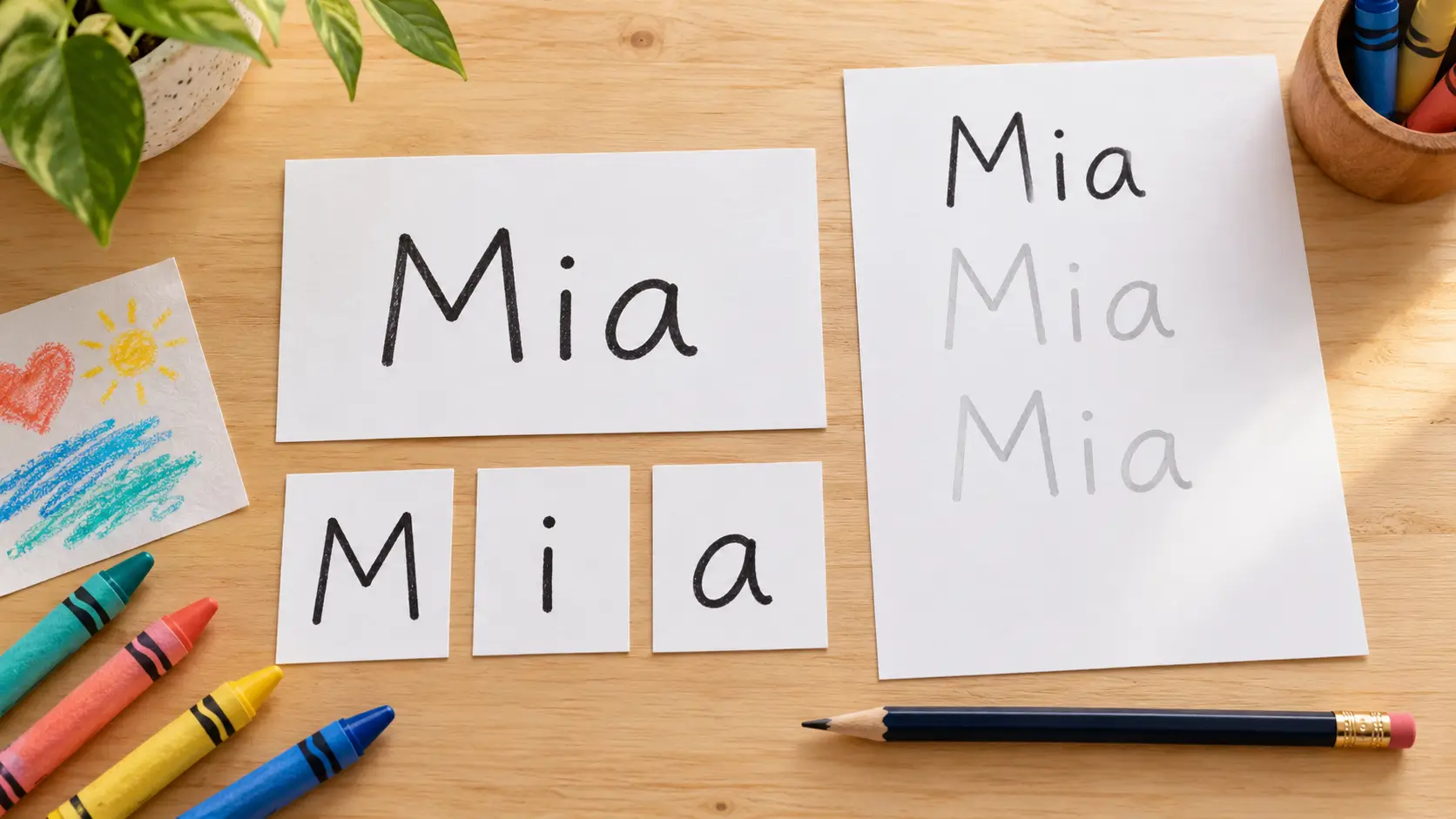
- On a plain index card or strip of paper, write Mia clearly in a dark line: a capital M followed by a lowercase i and a.
- Leave generous space around the name so each letter stays visually distinct.
- Make an identical second name card for matching.
- Make three separate paper letter cards: M, i, and a. Keep the lowercase i and its dot together on the same letter card.
- Prepare a large, faint but visible adult-written version of Mia for name tracing, or use a matching clear typed model.
- Keep the letter shapes consistent across the model, the cards, and the tracing sheet.
You need plain paper, index cards, a dark pen, a pencil, and crayons. A reusable writing sleeve is optional. No special purchase or app is required.
Choose a starting point
- Still learning to find the name: try activities 1 or 2.
- Ready to follow a model: choose one of activities 3 to 5.
- Beginning to copy or write letters: try activity 6 or 7.
These are starting suggestions, not a test. Watch what the child does and adjust.
7 Name Tracing and Name Practice Activities
Activities 1 and 2 are preparation for tracing, not tracing itself. Activities 3, 4, and 5 are tracing options. Activities 6 and 7 move toward copying and meaningful use.
1. Find and Match the Name Card
This is one of the simplest name recognition activities, and it involves no tracing at all.
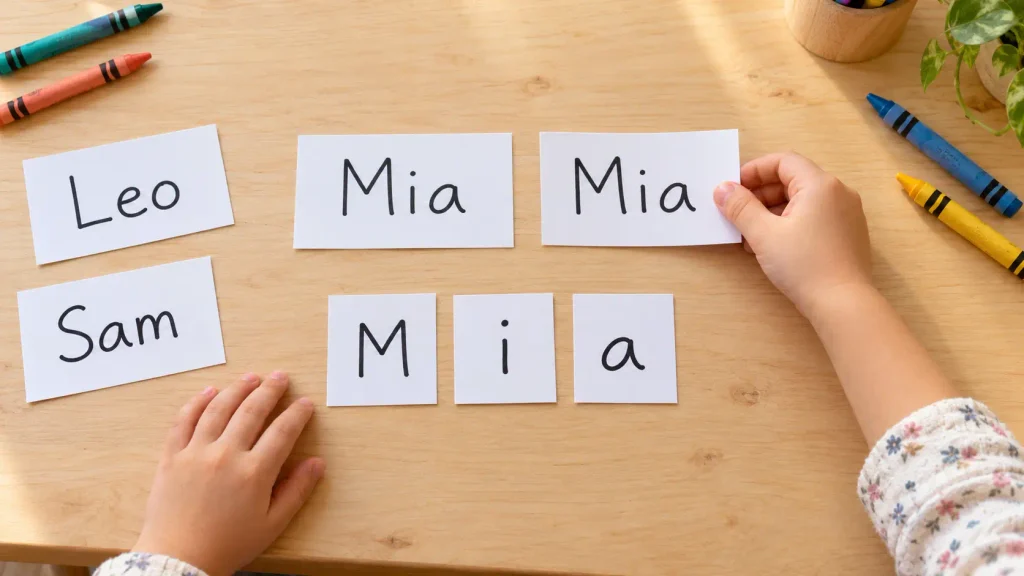
Materials: the Mia model card, a second Mia card, and cards reading Leo and Sam.
Preparation: write all the cards in the same plain lettering, with the same pen and the same card size, so that nothing but the letters gives away the answer. Do not use color alone as a clue.
Steps: show Mia the model card and say the name together. Lay out the second Mia card with the Leo and Sam cards. Ask her to find the card that matches and place it beside the model. Point out that both begin with M.
Simplify or extend: if three choices are too many, start with two, such as Mia and Leo. Once matching feels familiar, try Mia versus Max. Both begin with M, so she has to look past the first letter. Treat this as a new matching challenge, not a test of reading mastery.
2. Build the Name with Letter Cards
This builds letter order before any tracing.
Materials: the full Mia model and the three letter cards M, i, and a.
Steps: keep the complete model visible at the top of the table. Place the three letter cards below it. Mia matches each card to the letter in the same position on the model, moving left to right. That left-to-right order is for this English example. Other scripts follow their own direction.
Simplify or extend: an adult can place the first letter to get things started. If a child’s real name has repeated letters, supply duplicates. A child named Lee, for example, needs two e cards. Do not ask a child to invent the spelling or memorize it before using the model. The goal is matching what is in front of her.
3. Name Tracing with a Finger
Materials: plain paper with a large, clear adult-written Mia model for name tracing.
Steps: write Mia big across the page, using the handwriting model your family or classroom follows. Slowly show how to follow the letter shapes with your own finger, moving through the name in order. Then Mia follows the same written model with her finger. There is no need to cover the letters with glue or small objects. The paper model is enough.
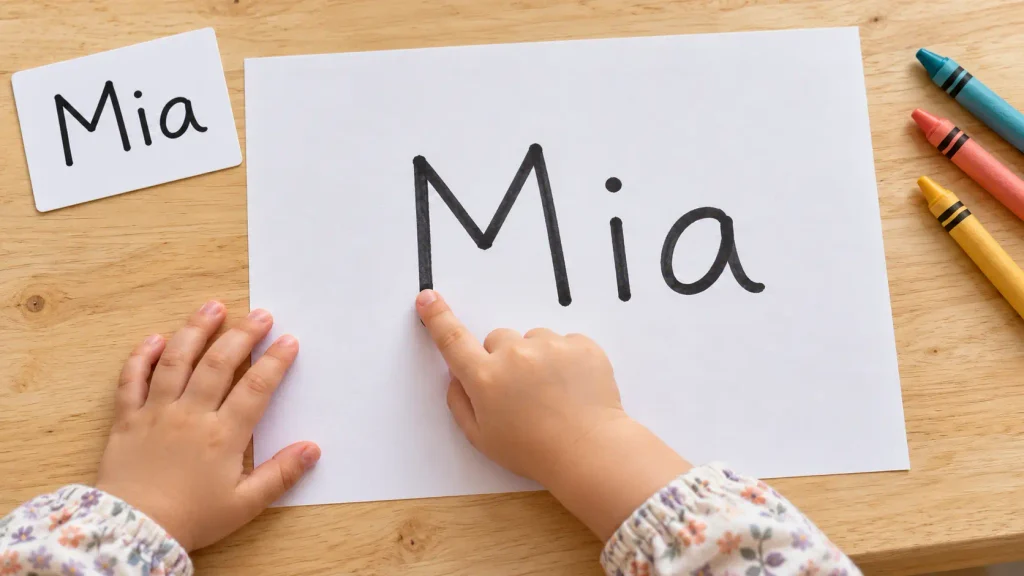
Simplify or extend: if the whole name is too much for today, trace only the M while the rest of the name stays visible. Finger tracing is a gentle way to follow shapes, but it is a different experience from writing with a pencil, so do not treat it as the same thing.
4. Name Tracing with a Light Model and Crayon
Materials: a pencil, a crayon, and plain paper.
Preparation: write Mia lightly in pencil, dark enough to follow but not so dark that it overwhelms the crayon. Make the letters roomy, and leave clear space between each repetition.
Steps: demonstrate Mia once yourself. Then offer a small number of attempts, such as two lines, with blank space left on the page. Mia traces over the pencil with the crayon.
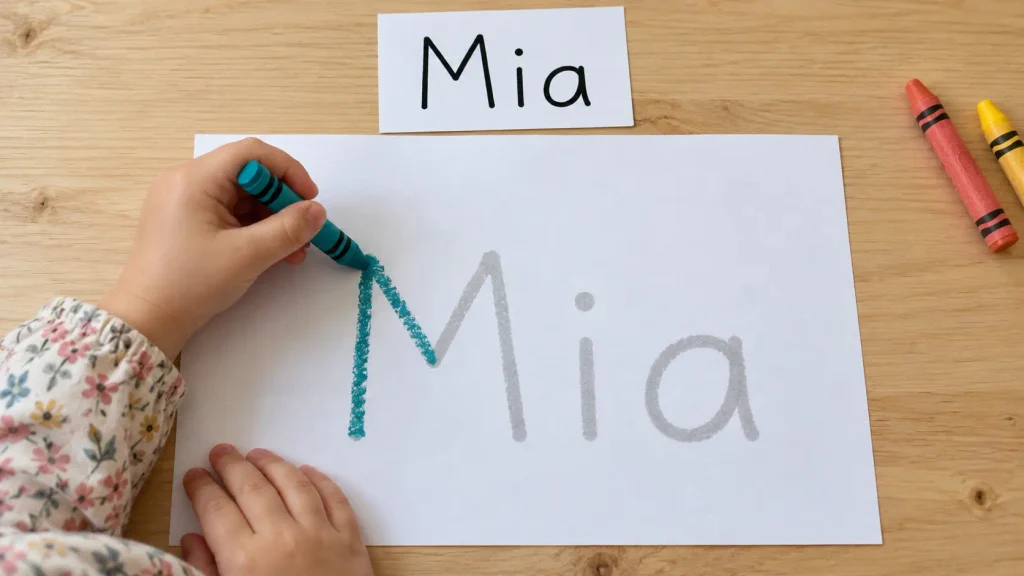
Simplify or extend: some children enjoy tracing the same name with a second color. Offer this as an optional variation; using extra colors does not show whether the child can copy the name independently. A child may trace one letter while an adult supports the rest of the name.
5. Try a Reusable Name Tracing Card
This is an optional material variation, not a purchase you need to make and not a better method for every child.
Materials: an adult-prepared paper name model, a suitable reusable writing sleeve, and a marker intended for that surface.
Steps: slide the Mia model into the sleeve. Mia traces the visible letters with the marker. The adult wipes the sleeve clean after the attempt, and Mia can try again.

Simplify or extend: if you do not have a sleeve, use plain paper as in activity 4. Check the marker’s own instructions before handing it over.
6. Name Writing Practice: Trace, Then Try Copying
Materials: one sheet of paper, a dark pen, a pencil, and a crayon.
Preparation: for this name writing practice, make a short three-part layout. At the top, write Mia in dark ink as the model. Below it, write a faint Mia for tracing. Leave a blank space beside or below.
Steps: Mia traces the faint name first. Then she tries copying the M, or the whole name, in the blank space with the model still in view. Spell it the same way each time: M, i, a.
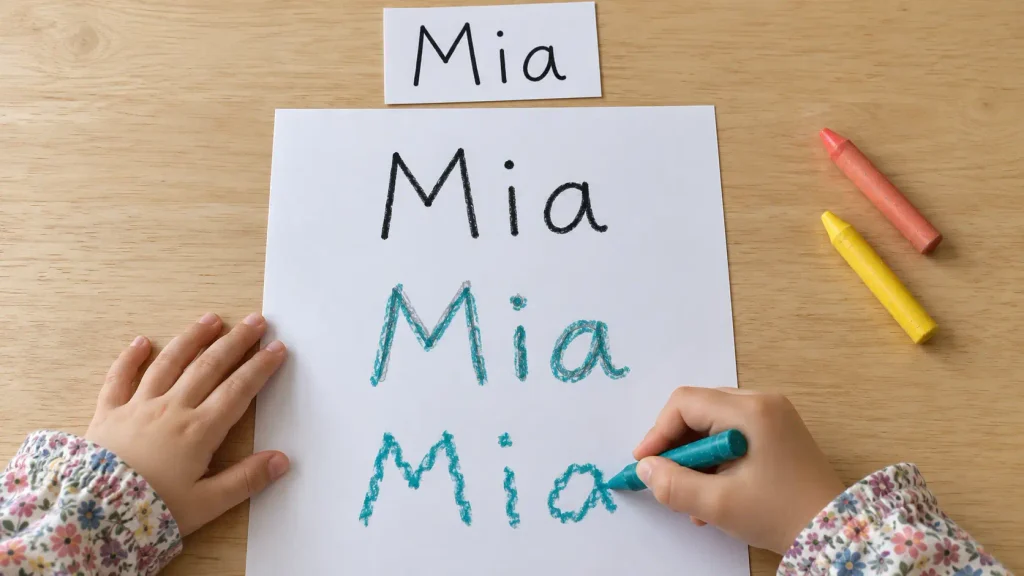
What changes: when she traces, her crayon sits on top of the letters. When she copies, she makes letters beside a model. That is a new task, and her first attempts may look different from the model. Do not require her to cover the model or write from memory.
7. Use the Name on a Drawing or Sign-In Sheet
A name on a real object gives the writing a purpose.
Materials: a clear name model and a drawing, or a simple sign-in sheet with a column for names.
Steps: set the Mia model beside her drawing or the sign-in sheet. Depending on what she can do, she may trace an adult-prepared name, copy some letters, or write the name. If writing is not part of today’s activity, you can write Mia while she points to the matching model and says it with you.
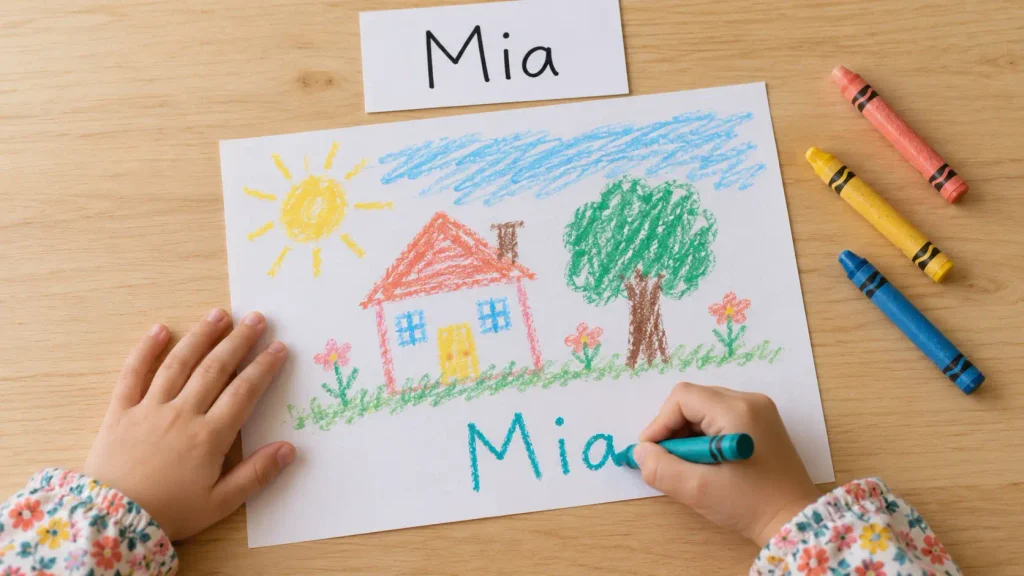
Simplify or extend: a meaningful name does not have to be perfect. HighScope’s activities with children’s names describe using names for recognition and matching and for classroom sign-in, and they note that early writing attempts can range from marks and a few letters to a complete name. Treat whatever Mia produces as a real attempt, not proof of readiness or of later reading ability.
Make Your Own Name Tracing Worksheets
You can make a simple page yourself in a few minutes.
Paper method
- Choose a plain sheet.
- Write one clear name model near the top.
- Below it, write the same name lightly for tracing.
- Leave a separate blank area for optional copying or a drawing.
- Keep the number of repetitions small and the models large enough to see clearly.
Optional typed method
- In a word processor, type the child’s name in a clear handwriting style that matches the model used by the child’s teacher or family.
- Put a dark model at the top, a few light-gray copies below, and a blank practice area.
- Preview the printed page to check that the gray letters remain visible and that no name is cropped.
- Adjust the font size to the length of the name and the space available. One size will not fit every name.
- A normal typed font does not automatically include correct handwriting arrows or starting points, so do not add them unless they match a verified model.
Long names: give the full, correct model and more room. If you practice only a short section, show where that section belongs in the complete name. Do not shorten or change a child’s name without the family’s agreement.
Keep the Practice Clear and Consistent
A few specific checks will keep the page easy to follow:
- Avoid changing fonts or letter forms between the model and the tracing line.
- Keep decorative drawings away from the letter path.
- Use letters that remain legible when printed.
- Check that repeated letters, accents, and punctuation have not disappeared.
- Focus on the actual task. Recognizing, tracing, and copying are different.
- Do not fill a page with long rows of identical names.
Related Letter and Hand Activities
Practicing a written name and exploring letter sounds are related but different activities. If you want more paper, cutting, and tracing ideas to use alongside name work, these fine motor activity ideas are a good next stop.
Frequently Asked Questions
Can a child start with name recognition before tracing?
Yes. Activities 1 and 2 offer ways to find and match a written name. You can offer name recognition activities and name tracing separately. Choose the activity that fits what the child is ready to try.
Should the name be written in capitals or lowercase letters?
Use the model agreed at home or school. In the Mia example, the name is written with a capital M followed by lowercase i and a, and that is kept the same on every card and sheet. All-uppercase work is not wrong, but the key is to keep the model consistent with what the child sees elsewhere.
What if the name is long or has repeated letters?
Give the full correct model and plenty of space. For repeated letters, make a duplicate letter card for each time the letter appears. If you practice only part of the name, show where it fits in the whole.
How do I make name tracing worksheets at home?
Write one clear model at the top of a plain sheet, add a lightly written copy below for tracing, and leave a blank area for copying or drawing. You can also type the name in a word processor, using a dark model, light-gray copies, and a blank practice space. See the section above for the full method.
Does tracing a name mean a child can write it independently?
No. Tracing means following a model that is already there. Independent writing means making the letters without one. Tracing can be a useful step along the way, but it does not show that a child can write the name alone. Copying beside a model, as in activity 6, sits in between.
Start with One Clear Name Model
Choose one clear name model and one activity that matches what your child is working on today. If she is still finding her name, begin with matching. If she is ready to follow letters, try name tracing with a finger or crayon. Keep the spelling and letter style the same each time, and let the task grow slowly from there.