
A robot’s buttons, a butterfly’s wing patterns, and a castle’s roofs give children something specific to investigate. These free shape tracing worksheets pair dotted outlines with picture searches, matching, counting, patterns, and drawing, so you can explore shapes in several ways.
The Little Shape Detectives! PDF includes 20 activity pages featuring circles, squares, triangles, rectangles, ovals, and diamond-shaped rhombuses. An adult guide, two answer-guidance pages, and a completed example bring the download to 24 pages in total.
Choose one page, name a shape together, and invite your child to trace, point, or draw. The guide below explains each activity, how to introduce the shape vocabulary accurately, and how to extend the practice with everyday materials.
Download the Free Shape Tracing Worksheets PDF
The free download contains:
- 20 student activity pages, arranged in four groups of five.
- 1 teacher instruction page with printing and teaching notes.
- 2 answer-guidance pages covering activities 1 through 20.
- 1 completed circle-tracing example showing traced outlines and an independent drawing.
All pages are black and white and sized for US Letter paper, 8.5 × 11 inches. The answer pages provide specific solutions where appropriate and explain when children’s drawings can vary.
Download the Free Shape Tracing Worksheets PDF
There are 20 worksheets within the 24-page file. Keep the adult guide, answers, and example separate when printing blank pages for children.
What Can Children Explore with Shape Tracing Worksheets?
Tracing, naming, and recognizing a shape are different tasks. A child may follow a dotted triangle without remembering its name. Another may recognize a circle but prefer pointing to it rather than drawing around it.
These preschool shape worksheets offer several ways to participate:
- Tracing: moving a drawing tool around an outline.
- Describing: noticing straight sides, curves, and corners.
- Recognizing: finding a shape within a picture or mixed group.
- Matching: connecting shapes with the same form.
- Drawing: making a shape or using it within an original picture.
Use what the child does and says to choose the next task. A carefully traced outline alone does not show whether a child can recognize that shape elsewhere.
For additional practice with lines, paper, and drawing tools, explore these fine motor skills worksheets. They provide different activities to try alongside the geometry pages.
Six Shapes to Introduce with the Printable
Start with the outline on the page, then compare it with a cut-paper shape or a suitable flat surface nearby. Use simple language while keeping the shape’s defining features accurate.
Circle
A circle is a round, closed shape with no straight sides or corners. Compare the outline with the circular rim of a plate or the face of a round clock.
On the first worksheet, follow the large dotted circle and then try one of the smaller circles. Ask, “Where do you turn a corner?” Notice that the route curves all the way around.
Square
A square has four equal straight sides and four right angles, which you can describe as square corners. Compare a paper square with the corner of a sheet of paper.
Turn the paper square and count its sides again. It remains a square when one corner points upward; its position does not change its properties.
Triangle
A triangle has three straight sides and three corners. Trace each side and pause where two sides meet.
Add other paper triangles beside the worksheet model. Try a tall triangle, a wide triangle, and one turned sideways, so the child can notice the shared features beyond a single example.
Rectangle
A rectangle has four straight sides and four right angles. Opposite sides are equal in length. The flat front cover of a typical book provides a useful comparison.
A square also meets the definition of a rectangle. You can say, “A square is a special rectangle with all four sides equal.” Rectangles do not always need one pair of long sides and one pair of short sides.
NAEYC’s guidance on teaching shape properties explains why accurate definitions matter from the beginning, including the relationship between squares and rectangles. Children can explore these ideas with paper shapes without memorizing formal definitions. NAEYC
Oval
The oval models in this pack are smooth, stretched-looking closed curves with no corners. Put the printed oval beside a circle and compare their outlines.
Use the actual models rather than assuming every rounded object is an oval. A leaf, for example, may have a pointed end and an irregular edge.
Diamond-Shaped Rhombus
The pointed diamond models in these shape tracing worksheets are rhombuses: four-sided shapes with all four sides equal. “Diamond” describes their familiar appearance; rhombus is the mathematical name.
A square is also a rhombus because its four sides are equal. In the pack’s diamond-search activity, children match the specific pointed models shown below the choices. The task does not ask them to classify every possible kind of rhombus.
Shape Tracing Worksheets: PDF Page Guide
The adult guide is the first page, so each activity appears one PDF page after its activity number.
| PDF pages | Activities | Main focus |
|---|---|---|
| 1 | Adult guide | Printing and teaching notes |
| 2–6 | 1–5 | Large outlines, smaller outlines, and drawing |
| 7–11 | 6–10 | Shapes within illustrated objects |
| 12–16 | 11–15 | Matching, coloring, counting, and searching |
| 17–21 | 16–20 | Patterns, repeated shapes, and picture drawing |
| 22–23 | Answer guidance | Solutions and notes for all 20 activities |
| 24 | Completed example | Circle tracing and four independently drawn circles |
The tracing pages use dotted outlines, not wide road-like tracing corridors. An adult can demonstrate a starting place and direction; the pages do not provide numbered stroke arrows.
Activities 1–5: Trace and Draw the Shapes
The first five shape tracing worksheets introduce the six featured forms. Each page includes large dotted models, a row of smaller models, and an open drawing area.
Activity 1: Trace Circle. Explore a large circle and five smaller circles. Begin with a finger trace, then offer a pencil or crayon. Invite the child to draw their own circles in the space below.
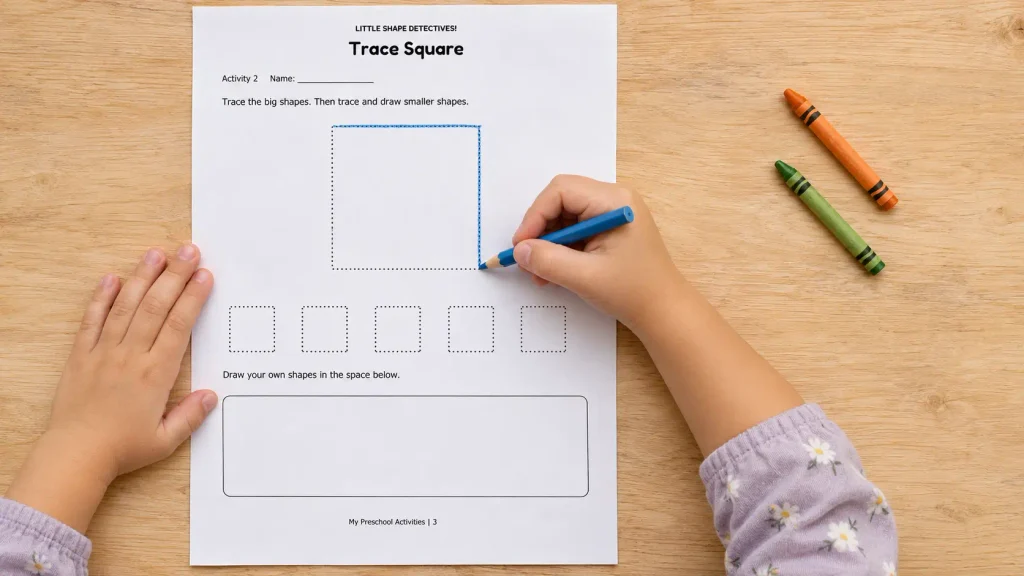
Activity 2: Trace Square. Follow the four sides and notice each corner. You can demonstrate a brief pause before changing direction, then let the child try a smaller square or an original drawing.
Activity 3: Trace Triangle. Count three sides while moving around the outline. After tracing, compare the printed triangle with a differently shaped paper triangle.
Activity 4: Trace Rectangle. Follow the four sides and compare the square corners with those on the square page. If useful, place the two sheets side by side.
Activity 5: Trace Oval and Diamond. This page combines two forms. Offer one at a time if the full page feels busy. The smaller models alternate between ovals and diamonds.
The final drawing box is for exploration. A child’s drawing may differ from the printed model while still giving you something useful to discuss.
Activities 6–10: Find Shapes in the Pictures
These shape recognition activities connect a dotted model with a feature inside a larger illustration. Each page also includes smaller shapes to trace and a box for drawing one more.
Activity 6: Shapes in the Robot. Trace a square and find the three square buttons across the robot’s torso. Focus on those buttons rather than assuming every robot part is a square.
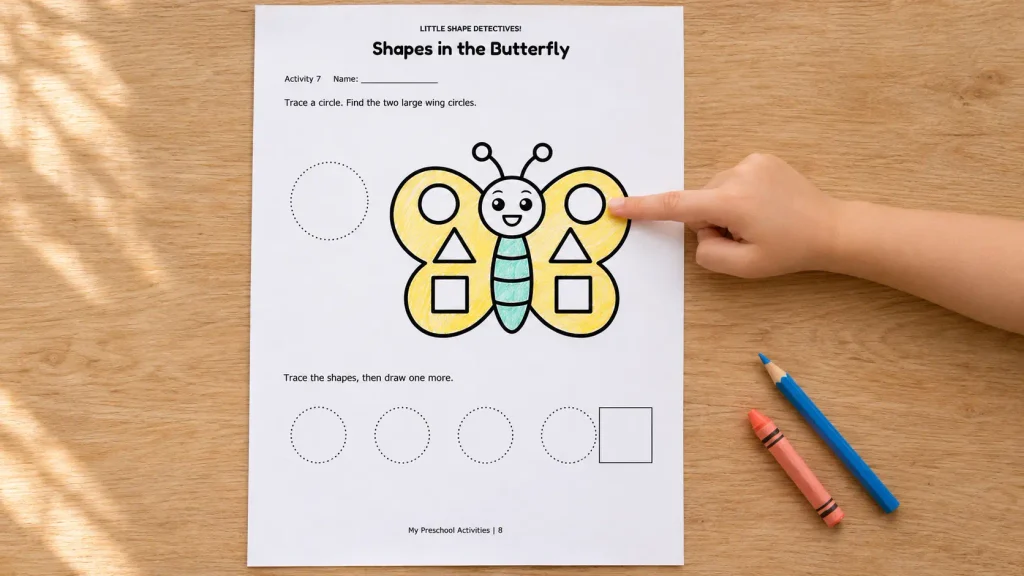
Activity 7: Shapes in the Butterfly. Trace a circle and find the two large circles inside the upper wings. Point to the complete circular outlines within the wing design.
Activity 8: Shapes in the Castle. Trace a triangle, then identify the three triangular roofs. Count their sides together or compare their different sizes.
Activity 9: Shapes in the Rocket. Trace a rectangle and point to the rocket’s central rectangular body. The nose and side fins have different outlines, giving you contrasting features to discuss.
Activity 10: Shapes in the Garden. Trace an oval and look at the rounded flower petals. Describe them as oval-like features within the drawing rather than treating every decorative curve as an exact geometric model.
Let children point before asking them to trace. Recognizing a shape in a picture and controlling a pencil are separate parts of the activity.
Activities 11–15: Match, Color, Count, and Search
This group of shape tracing worksheets adds choices and simple checks. Read each instruction aloud and introduce one task at a time.
Activity 11: Match the Shapes
Connect each shape on the left with the identical shape on the right. The right-hand order is triangle, circle, diamond, oval, square, rectangle.
A child can point to a match first, then draw the connecting line. Crossing lines are expected when the matching shapes are in different rows.
Activity 12: Color by Shape
Follow the printed code: circles yellow, squares blue, triangles red. There are three rows of these shapes.
Place the three matching crayons beside the sheet. You can begin with one row or one shape type rather than coloring the whole page at once.
Activity 13: Butterfly Shape Search
Circle the two large circles in the upper wings and color the two squares in the lower wings. The bottom of the page also provides a circle and a square to trace.
The wing outlines and antenna tips add other curves to the picture. Use the instruction’s wording to identify the specific features requested.
Activity 14: Count the Shape Clues
Count the shapes to the left of each answer box and write the total. From top to bottom, the answers are 3 circles, 4 squares, and 2 triangles.
Show that the empty box is a place for writing the answer. It is not another item to include in the count.
Activity 15: Find Every Diamond
Match the pointed shapes in the choices to the dotted diamond models below, then trace those models. The matches are the first shape in the top row and the first and fourth shapes in the bottom row.
Keep this as a visual matching task. If a child notices that a square also has four equal sides, acknowledge the observation and explain that this instruction asks for matches to the particular model.
Activities 16–20: Patterns, Shape Trails, and Drawing
The last five printable shape tracing pages combine familiar outlines with new tasks. They are options to explore, not a required final test.
Activity 16: Finish the Shape Patterns. Look at each alternating sequence and draw the next shape. The answers, from top to bottom, are circle, triangle, diamond. Read the sequence together before drawing.
Activity 17: Build a Shape House. Study the illustrated house and draw an original house using shapes. Despite the word “build,” this worksheet is a drawing activity; it does not include cut-out construction pieces.
Activity 18: Trace the Shape Trail. Trace the separate repeated shapes from left to right and draw one more in each end box. Add a circle, triangle, and diamond, from top to bottom. This is not a maze or one continuous tracing path.
Activity 19: Shape Robot Designer. Draw a robot with a rectangular body, round eyes, and rectangular legs, matching the instruction and small example. Children can choose their own extra details.
Activity 20: My Shape Discovery. Use the six labeled spaces to draw something that uses each featured shape. Ask the child to explain the connection rather than expecting one predetermined picture.
A Flexible 10-Minute Routine for Shape Tracing Worksheets
Use this as a sample routine and shorten or extend it according to the activity.
- Look and describe, about two minutes. Choose one shape. Notice whether its outline curves, has straight sides, or changes direction at corners.
- Demonstrate, about one minute. Show where you will begin tracing and follow a short part of the outline.
- Try the worksheet, about four minutes. Offer one model, picture search, or matching task. The child can trace, point, or draw.
- Make a connection, about two minutes. Compare the model with a paper shape, dough outline, or flat surface nearby.
- Share, about one minute. Ask, “What did you notice?” or invite the child to show a favorite part.
For tracing shapes for kindergarten, you can add a description task: explain why a shape belongs to its group or show how the same shape looks after turning.
8 Shape Games to Try Beyond the Worksheets
These optional extensions use extra materials. The PDF does not include separate game cards, collage pieces, or floor templates.
1. Find a Matching Flat Surface
Compare a paper rectangle with a book’s front cover or a paper circle with a circular lid. Name the surface or outline you are comparing instead of calling the whole three-dimensional object a flat shape.
2. Turn and Check
Rotate a cut-paper square or triangle. Ask what changed and what stayed the same. Count sides and corners again to check its identity.
3. Make Dough Outlines
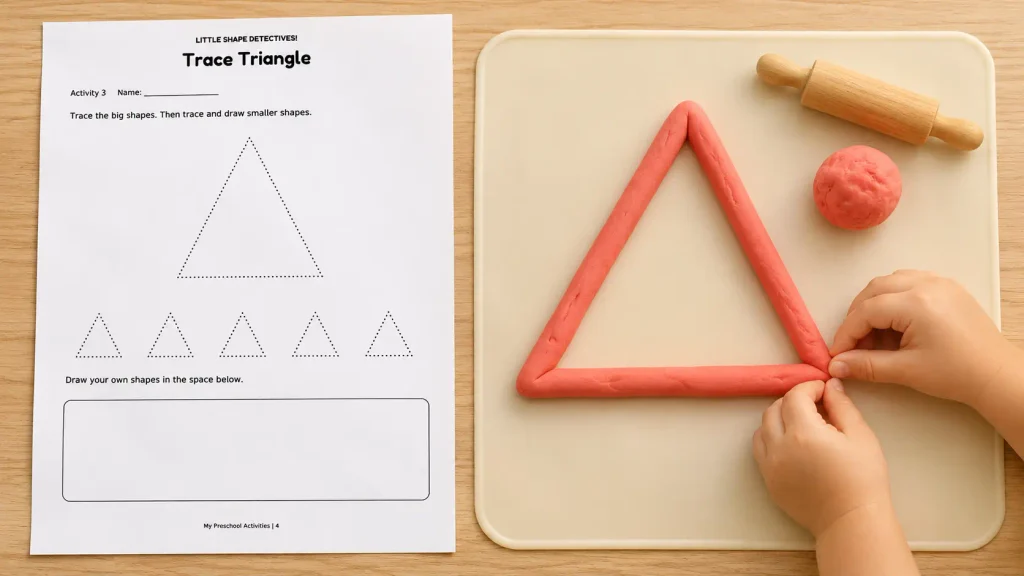
Roll dough into ropes on a separate mat and arrange them into a circle or triangle. Compare the finished outline with the model on the worksheet.
4. Design a Paper Picture
Offer prepared paper shapes and glue for an original robot, house, or garden. This is an additional collage activity, separate from the pack’s drawing pages.
5. Feel and Match
Place a few large cardboard shapes in a bag. Invite the child to feel one, describe a feature, and then take it out to compare with a visible model.
6. Follow a Floor Outline
Make a large triangle or square on a clear floor using suitable removable tape. Walk beside the outline and pause at the corners. Keep the area free of slipping and tripping hazards.
7. Sort Different Examples
Mix paper shapes in different sizes, colors, and orientations. Sort by shape, then explain a choice using sides, corners, or curves.
8. Take a Shape Hunt
Choose one shape to look for around the room. Point to a matching outline and explain which features resemble the model. A rough resemblance can begin a useful conversation without being an exact match.
NAEYC’s Everyday Shapes ideas offer further ways to explore shapes during daily routines, including comparing objects and making forms with playdough. NAEYC
Adjusting the Shape Tracing Worksheets
For an easier start, show one model and demonstrate beside the child. Cover unused parts of a page, offer a comfortable drawing tool, or let the child point to a match while an adult draws the line.
For an extension, compare different triangles, rotate paper models, or ask children to explain their shape choices. Keep the challenge connected to geometry rather than simply adding more tracing repetitions.
If a pencil line drifts or corners become rounded, return to a larger model and demonstrate the change of direction. Naming the shape correctly and drawing an accurate outline do not have to develop at the same pace.
Printing and Reusing Your Shape Tracing Worksheets
Print the PDF on US Letter paper at Actual Size or 100% scale. Test one page first and check that the complete outline and instructions are visible.
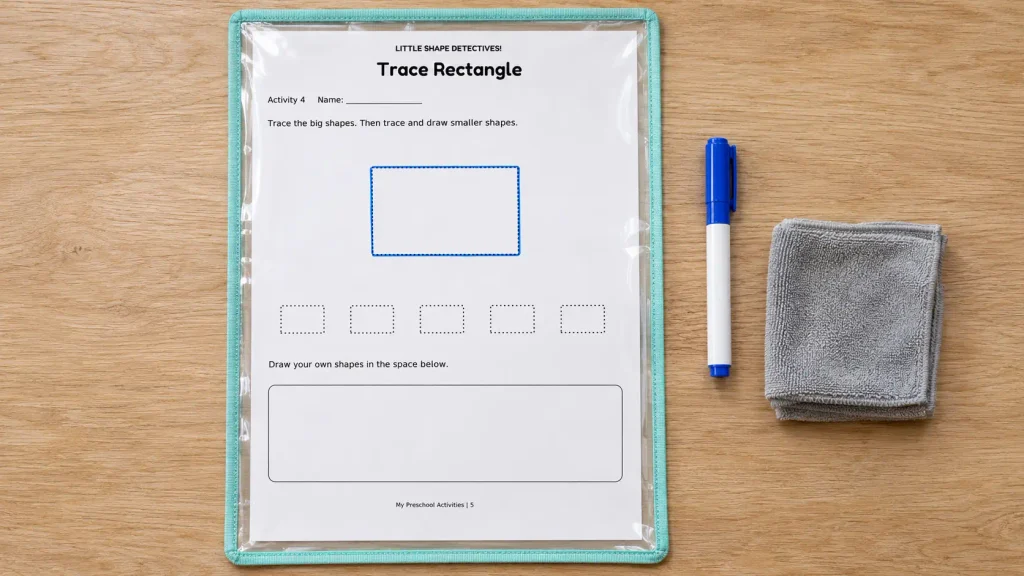
For repeated tracing, place suitable pages in a wipe-clean sleeve and use a compatible dry-erase marker. Test that it erases cleanly. Ordinary paper works well for coloring and drawings children want to keep.
Store the four activity groups separately if that helps preparation. Keep PDF pages 22 and 23 with the adult guide, and use page 24 when you want to show a completed tracing example.
Frequently Asked Questions
Are these shape tracing worksheets free?
Yes. The free PDF includes 20 activity pages plus an adult guide, two answer-guidance pages, and a completed example.
Which shapes are included?
The pack features circles, squares, triangles, rectangles, ovals, and pointed diamond-shaped rhombuses. Activity 5 combines ovals and diamonds on one page.
Are there 20 pages or 24 pages?
There are 20 student worksheets within a 24-page PDF. The other four pages provide adult guidance, answers, and an example.
Does the download include answer keys?
Yes. Two pages cover activities 1 through 20. They give definite answers for tasks such as counting and patterns, plus checking notes for tracing and open-ended drawings.
Can children use the pages without knowing every shape name?
Yes. Introduce a name while looking at its model. Children can point, match, and describe features with adult support before naming shapes independently.
Is the robot activity a cut-and-paste craft?
No. Shape Robot Designer asks children to draw a robot using specified features. You can offer a separate paper collage as an optional extension.
What can we try after this pack?
Continue with shape hunts, picture drawing, sorting, or other preschool learning activities. Choose the next activity according to what the child wants to explore.
Choose a Shape and Start Exploring
Begin with one dotted outline or a picture that interests your learner. Find the robot’s square buttons, count the castle’s triangular roofs, or make a new picture from familiar forms.
These shape tracing worksheets give you a reusable starting point for tracing, describing, matching, and drawing. Pair a selected page with a simple hands-on comparison and let the child’s observations guide the conversation.