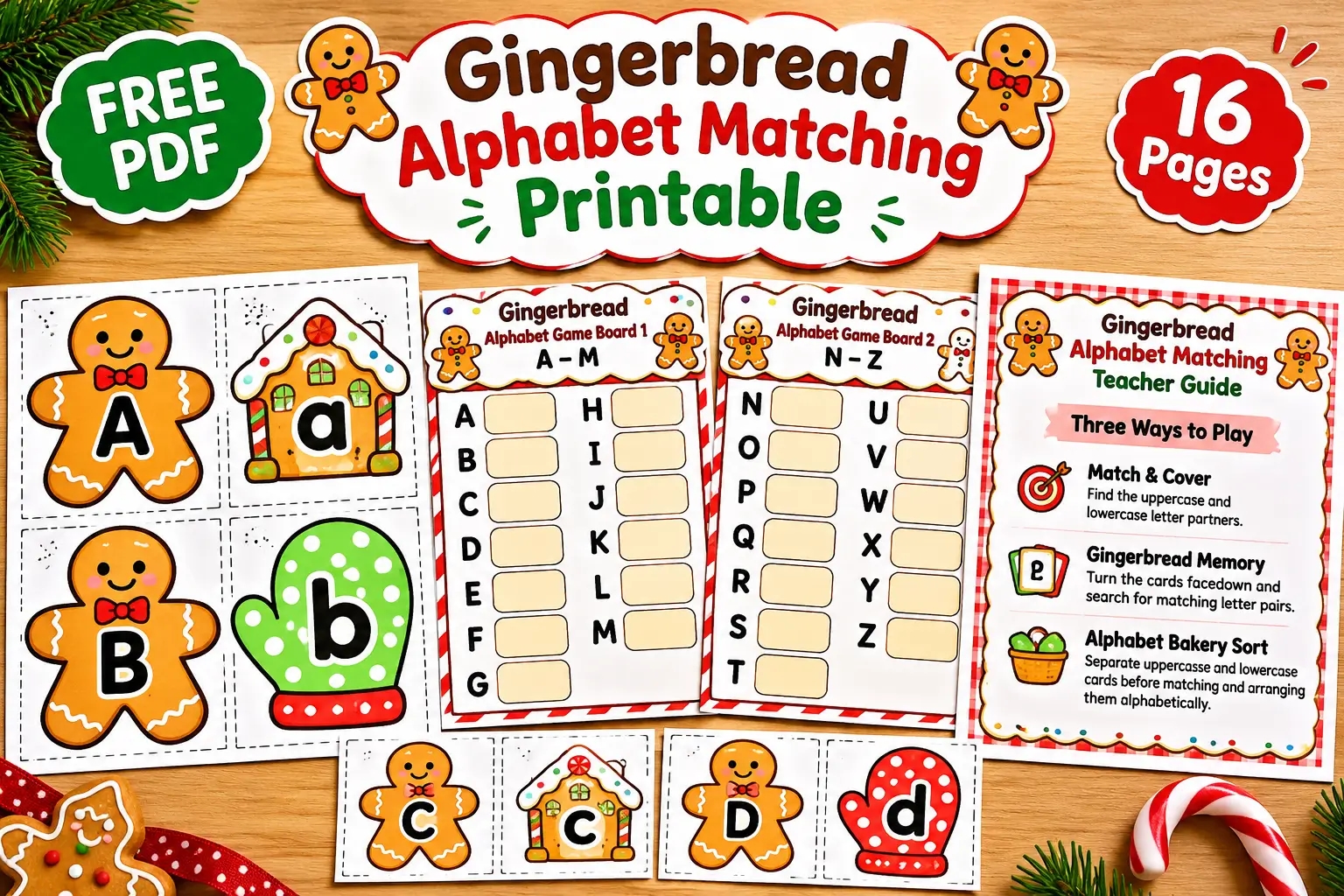
Looking for a fun way to practice letter recognition during the holiday season? This free gingerbread alphabet matching printable turns uppercase and lowercase letter practice into a hands-on bakery game that preschoolers and kindergarteners can enjoy.
Instead of memorizing letters from a worksheet, children match smiling gingerbread cookies with colorful gingerbread houses, oven mitts, and icing cards. Every uppercase letter has a lowercase partner, giving children a playful reason to look carefully at letter shapes.
This free 16-page printable includes all 26 letter pairs, two alphabet game boards, and a teacher guide with three easy ways to play.
Whether you’re planning December literacy centers, preschool morning activities, kindergarten small groups, or a quiet learning game at home, this gingerbread letter matching activity is easy to prepare and reuse.
Best of all, you only need a printer, scissors, and a little space to start matching!
Download the Free Gingerbread Alphabet Matching Printable PDF
The printable is designed for US Letter paper (8.5 × 11 inches) and includes colorful, cut-apart alphabet cards, two matching boards, and a teacher guide.
You can print the entire set or begin with just a few letter pairs.
For younger preschoolers, I recommend starting with three to five familiar letters rather than introducing the whole alphabet at once.
Quick activity details:
- Recommended ages: 3–6 years
- Learning focus: Uppercase and lowercase letter recognition
- Number of letter pairs: 26 (A–Z)
- Printable format: 16-page color PDF
- Paper size: US Letter, 8.5 × 11 inches
- Preparation: Print and cut apart the cards
- Best for: Preschool, Pre-K, kindergarten, homeschool, and literacy centers
What’s Included in the Gingerbread Alphabet Matching Printable?
This gingerbread alphabet matching printable contains four types of learning materials across 16 pages.
1. Thirteen Cut-Apart Alphabet Matching Sheets
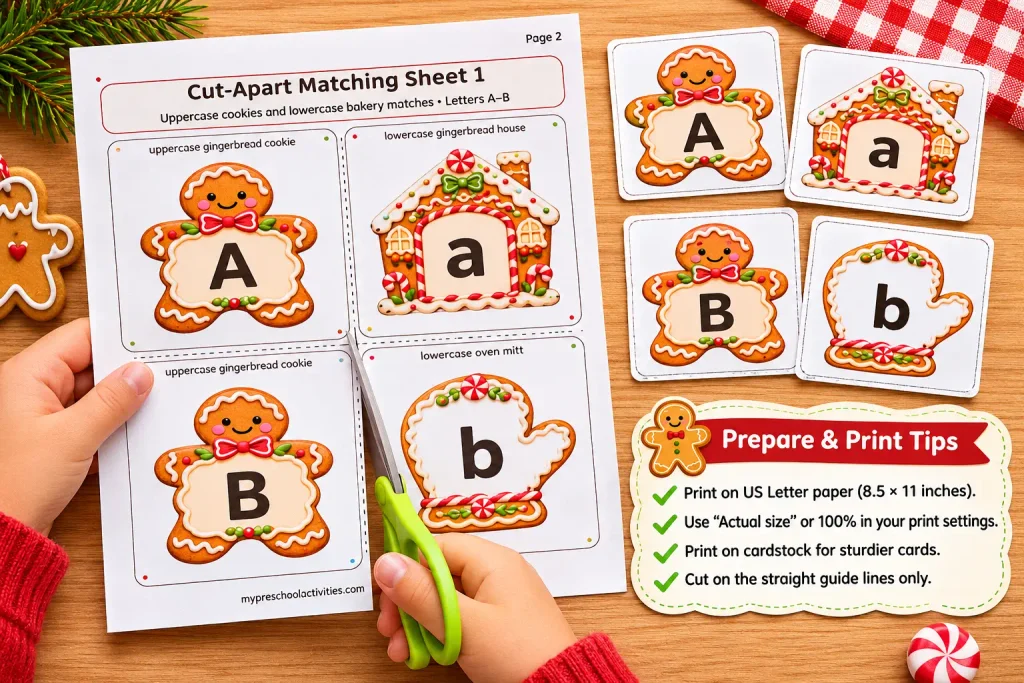
Pages 2–14 contain 13 printable matching sheets, with two letter pairs on each page.
Each sheet includes four illustrated cards: two uppercase gingerbread cookies and their corresponding lowercase bakery-themed cards.
For example, the first matching sheet contains A/a and B/b, while the final sheet contains Y/y and Z/z.
The cards follow the alphabet in order, making it easy to select the letters you want children to practice.
The uppercase letters appear on smiling gingerbread people decorated with icing and bows.
The lowercase letters are displayed inside three different bakery designs:
- Gingerbread houses with candy decorations
- Festive oven mitts
- Decorative icing tiles
These large, colorful illustrations help create a playful bakery theme without distracting from the letters.
Teaching tip: You don’t need to print every page for one lesson. If your child is learning A, B, C, and D, simply print the first two matching sheets.
2. Two Gingerbread Alphabet Game Boards
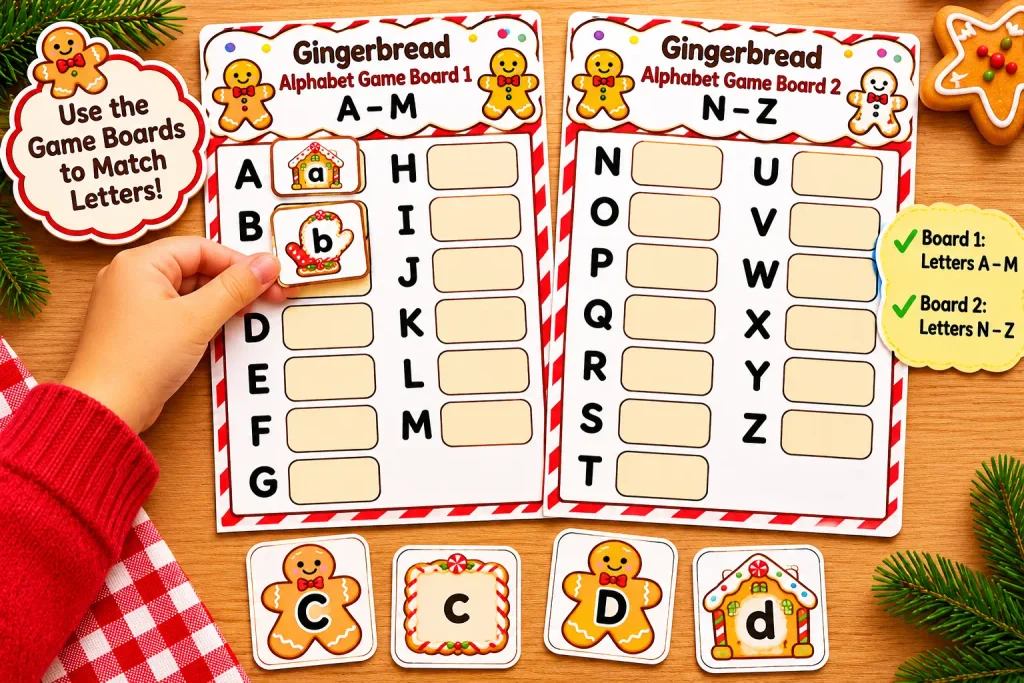
The PDF also includes two alphabet game boards designed to help children organize and check their matches.
Game Board 1 — Letters A–M
This board shows uppercase letters A through M, with a matching space beside each letter.
Game Board 2 — Letters N–Z
The second board continues the alphabet from N through Z.
Together, the boards cover all 26 letters.
These boards are particularly useful for small-group instruction, alphabet review, and classroom literacy centers.
The cut-apart cards are larger than the spaces printed on the boards, so children can place their matching cards alongside the corresponding board row or use the boards as visual references while arranging the cards on the table.
3. A Teacher Guide With Three Ways to Play
Page 1 includes a teacher guide explaining three activities:
Match & Cover: Find the uppercase and lowercase letter partners.
Gingerbread Memory: Turn the cards facedown and search for matching letter pairs.
Alphabet Bakery Sort: Separate uppercase and lowercase cards before matching and arranging them alphabetically.
The guide provides a simple starting point, while the additional activities below offer more ways to adapt the same printable for different learners.
4. All 26 Uppercase and Lowercase Letter Pairs
The complete card set contains 52 individual letter cards, representing:
Uppercase: A through Z
Lowercase: a through z
Children can begin with familiar letters, gradually add new ones, and eventually work toward matching the entire alphabet.
Because the set includes both forms of every letter, it can also support alphabet ordering, letter naming, and introductory letter-sound activities with adult guidance.
Why Uppercase and Lowercase Matching Is Important
Before children begin reading words independently, they need opportunities to recognize the letters that appear in books, signs, labels, and everyday print.
An uppercase A and a lowercase a represent the same letter, but their shapes are different. The same is true for many other pairs.
Learning these connections is an important part of developing alphabet knowledge.
According to Reading Rockets’ guide to alphabet matching, matching uppercase and lowercase letters is a useful early literacy activity for helping young children recognize and identify letter forms.
A hands-on game gives children repeated opportunities to practice these skills in an enjoyable way.
Letter Recognition
Children learn to notice the distinctive shapes of letters.
As they explore the gingerbread alphabet cards, they begin recognizing familiar letters without needing to follow the alphabet in order.
For example, a child may recognize the uppercase M on a gingerbread cookie and then search for its lowercase partner, m.
This encourages careful observation rather than simply reciting the ABC song.
Uppercase and Lowercase Letter Correspondence
Recognizing that A and a represent the same letter is different from recognizing A on its own.
Matching activities make this relationship visible.
Children can place the two cards side by side, compare their shapes, and say the letter name aloud.
Some pairs, such as S/s and O/o, look similar. Others, including A/a and G/g, may require more practice.
Visual Discrimination
Visual discrimination means noticing differences and similarities between shapes.
When children compare b and d or p and q, they need to pay attention to the direction and position of each letter’s parts.
Matching games provide a natural opportunity to examine these details without turning the activity into a formal test.
Fine Motor Practice
Preparing the cards can also offer cutting practice for children who are ready to use safety scissors.
The printable includes straight card boundaries, making the cards suitable for adult preparation or supervised cutting practice.
Younger children can focus entirely on the letter activity while an adult prepares the cards.
The goal is to make the matching game accessible, not to require every child to master cutting first.
How to Print and Prepare Your Gingerbread Alphabet Cards
A few minutes of preparation can make the activity easier to manage, especially when working with several children.
Step 1: Download the Printable
Download the 16-page gingerbread alphabet matching printable PDF using the download link above.
Save the file to your computer or device so you can print additional copies whenever you need them.
Step 2: Choose the Pages You Need
You can print the entire alphabet set or select individual matching sheets.
For a first preschool session, choose two or three sheets containing letters your child already recognizes, plus one or two new letters.
For kindergarten review, you might print the full set and divide the cards into smaller groups.
If you plan to use the game boards, remember that they are on pages 15 and 16.
Step 3: Check Your Printer Settings
The pages are designed for US Letter paper, measuring 8.5 × 11 inches.
Use these printing tips:
- Select US Letter as the paper size.
- Start with the Actual Size or 100% setting.
- Check the print preview to ensure nothing falls outside your printer’s printable area.
- If the border is clipped, adjust the scaling slightly to fit the printable area.
- Print one test page before printing the full set.
Regular printer paper works for occasional play, while cardstock can make the cards sturdier.
The printable contains colored illustrations, so a color printer gives the closest result to the original design.
Step 4: Cut Apart the Letter Cards
Each matching sheet contains four rectangular cards.
Cut along the guide lines separating the cards.
There is no need to cut around the detailed outlines of the gingerbread characters or bakery illustrations. Keeping the rectangular cards intact makes preparation easier and helps them last longer.
For younger children, adults can cut the cards ahead of time.
Older preschoolers and kindergarteners who are comfortable with scissors may enjoy helping with the straight cuts under supervision.
Step 5: Organize and Store the Cards
Separate the uppercase gingerbread cookies from the lowercase bakery cards.
You can store them in two envelopes, labeled containers, or small zip bags.
If you are preparing classroom centers, consider dividing the alphabet into smaller sets such as A–F, G–M, and N–Z.
Laminating the cards is optional but useful when they will be handled repeatedly.
How to Play the Gingerbread Alphabet Matching Game
One of the best things about this free gingerbread alphabet matching printable is that you can use the same cards in several ways.
Begin with the easiest activity and introduce new games when children become more confident.
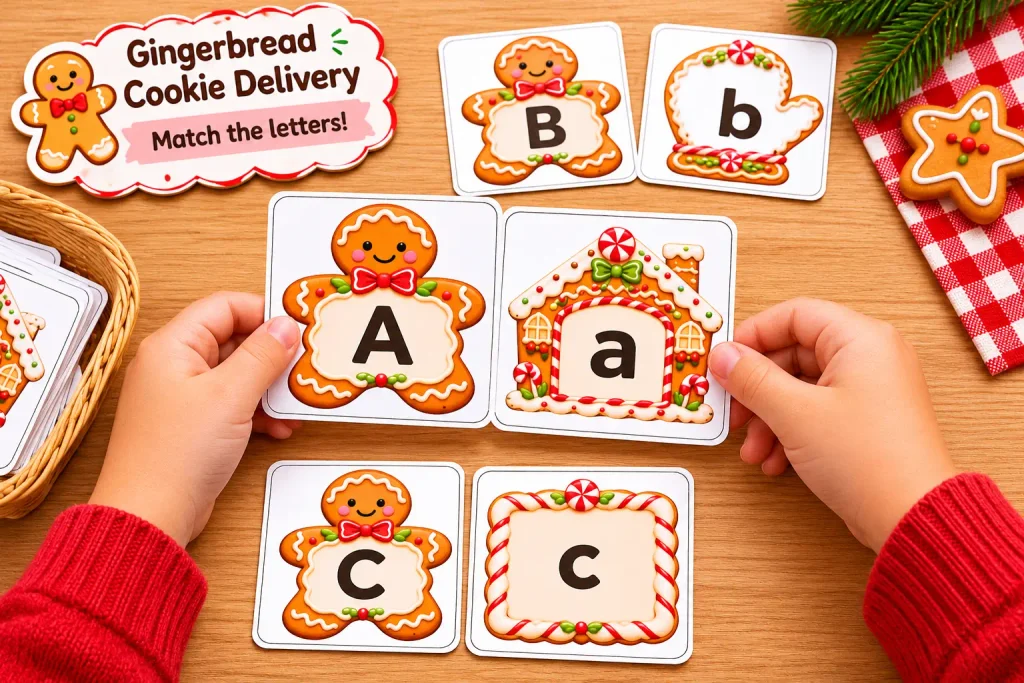
Game 1: Gingerbread Cookie Delivery
Best for: Ages 3–5, beginning letter recognition
Imagine a gingerbread bakery where every cookie must be delivered to the correct matching letter.
The gingerbread people represent uppercase letters, and the other bakery cards represent lowercase letters.
How to play:
- Choose three to six letter pairs.
- Place the lowercase bakery cards face up on the table.
- Give the child the matching uppercase gingerbread cookies.
- Invite the child to pick a cookie and find its lowercase partner.
- Place the matching cards side by side.
- Say the letter name together before moving to the next cookie.
For example, the child picks up a gingerbread cookie showing M.
They search the table for m and deliver the cookie to its matching lowercase card.
Try saying: “Our gingerbread cookie has a big M. Can you find the little m?”
Keep the game light and playful.
When children feel confident with a few pairs, add two or three more cards.
Preschool tip: Start with letters that have similar uppercase and lowercase shapes, such as O/o, S/s, or X/x.
Game 2: Alphabet Bakery Sorting
Best for: Ages 4–6, uppercase and lowercase identification
This activity encourages children to sort their cards before matching them.
How to play:
- Mix a small group of uppercase and lowercase cards.
- Spread them face up on the table.
- Ask children to create two groups.
- Place the uppercase gingerbread cookies in one group.
- Place the lowercase bakery cards in another group.
- Match the corresponding letters.
- For an extra challenge, arrange the completed pairs in alphabetical order.
This game encourages children to recognize which letters are capital letters and which are lowercase.
It also provides opportunities to use language such as same, different, first, next, and last.
Classroom idea: Give two children a shared collection of cards. One child sorts uppercase letters while the other sorts lowercase letters. Then they work together to find the pairs.
Game 3: Gingerbread Letter Memory
Best for: Ages 4–6, visual memory and letter recognition
Turn this gingerbread alphabet printable into a simple memory-matching game.
How to play:
- Select four to six uppercase and lowercase letter pairs.
- Mix the cards and arrange them facedown in rows.
- Ask the first player to turn over two cards.
- If the cards show matching uppercase and lowercase forms, the player keeps the pair.
- If they do not match, turn both cards facedown again.
- Continue until every matching pair has been found.
Because the two cards in a pair do not look identical, children must recognize the relationship between uppercase and lowercase letters.
For children who are new to this game, begin with only three pairs.
You can also play cooperatively, allowing everyone to help locate the matches.
Important: Use paper thick enough that the letters cannot be seen through the backs of the facedown cards.
How to Use the Two Gingerbread Alphabet Game Boards
The printable’s two game boards give children an additional way to review and organize their alphabet matches.
They are especially helpful when you want a more structured activity after children have explored the loose cards.
Game Board 1: Match Letters A–M
Start with the first game board, which displays uppercase letters A through M.
Place the board in front of the child and select the corresponding lowercase cards.
Ask the child to identify an uppercase letter on the board and find the lowercase card that matches.
For example:
Find A on the board.
Look through the lowercase cards.
Select the card displaying a.
Place it beside the A row or in a matching pile next to the board.
Repeat with the remaining letters.
Since the printable cards are larger than the matching spaces shown on the board, using the spaces as visual prompts rather than physical card holders works best.
For children who need more support, focus on only three to five rows at a time.
Game Board 2: Match Letters N–Z
The second game board continues the activity with letters N through Z.
Use it after children have practiced the first half of the alphabet or when working with students who already know many letter pairs.
You can also introduce both game boards during a kindergarten alphabet review.
Ask children to select a lowercase card, find its uppercase letter on either board, and identify the matching pair.
A Simple Way to Check Progress
After a child completes a matching activity, invite them to review their matches with you.
Point to a letter on the game board and ask them to find or name its lowercase partner.
If they are unsure, show both cards together and explain the relationship.
Avoid treating the board as a timed assessment for beginning learners.
The goal is to help children recognize letters more confidently through repeated practice.
Five More Ways to Use the Gingerbread Alphabet Cards
Once children understand the basic matching game, try these additional activities.
1. Gingerbread Letter Hunt
Hide five or six uppercase gingerbread cards around the classroom or learning area.
Give children the corresponding lowercase cards.
As they find each cookie, ask them to match it with the correct lowercase letter.
This adds movement to the activity and works well as a short literacy center.
For indoor use, place the cards somewhere visible and easy to reach rather than hiding them in difficult locations.
2. Build Your Name With Gingerbread Letters
Choose the letters in a child’s name.
Write the name clearly on a separate piece of paper, using the letter forms you want the child to practice.
Ask the child to find the corresponding gingerbread cards and arrange them in order.
For a name such as SAM, children can match S/s, A/a, and M/m.
The printable includes one card for each letter, so names containing repeated letters will need additional printed copies of those letters.
For another activity that connects letter recognition with early writing, explore these name tracing activities for preschoolers.
3. Alphabet Order Challenge
Mix a small group of uppercase gingerbread cookies.
Ask children to arrange them in alphabetical order.
Once the uppercase letters are arranged, invite them to place the matching lowercase cards beside each cookie.
Begin with five or six consecutive letters before working toward the complete alphabet.
4. Beginning Sound Bakery
Turn the matching cards into a simple oral phonics activity.
Choose an uppercase gingerbread card, say its name, and model a common sound associated with it.
For example:
M — /m/ — moon
S — /s/ — sun
T — /t/ — turtle
Ask the child to repeat the sound or think of another word beginning with it.
Some letters represent more than one sound, so begin with familiar, straightforward examples.
This extension is most useful for children who are already comfortable identifying the printed letters.
5. Gingerbread Letter Detective
Place three or four lowercase cards on the table.
Hold up one uppercase gingerbread cookie.
Ask: “Which lowercase letter matches this cookie?”
Encourage the child to look carefully before choosing.
If a child selects the wrong card, compare the two shapes together and give them another opportunity.
For older children, mix similar-looking lowercase letters to make the challenge more interesting.
Helping Children With Tricky Letter Pairs
Some uppercase and lowercase letters look very different, while other lowercase letters can be confused with one another.
The letters b/d and p/q are common examples.
Children may reverse or confuse these shapes while developing letter knowledge.
Rather than requiring them to memorize every difficult pair at once, work with one letter at a time.
Teaching b and d
Begin by showing B and b together.
Explain that both cards represent the letter B, even though the shapes are different.
Allow children to trace the lowercase b with a finger.
You might say, “For lowercase b, the tall line comes first, then the round part.”
During another session, introduce D and d.
For lowercase d, explain that the round part comes before the tall line when looking from left to right.
Keep the matching cards visible while children compare the shapes.
Teaching p and q
Use the same approach for P/p and Q/q.
Start with P/p and help children notice where the vertical line appears.
Introduce Q/q separately when the child is ready.
Use large printed examples and allow children time to look closely.
Teacher tip: A child who confuses two letters may need more exposure, a different explanation, or a smaller group of cards. Keep practice positive and avoid making letter reversals feel like failures.
Adapting the Activity for Different Ages
Not every child needs to work with the same number of cards.
One advantage of this gingerbread alphabet matching printable is that you can adjust the amount of material without changing the activity itself.
Ages 3–4: First Letter Matches
Begin with three to five familiar uppercase and lowercase pairs.
Choose letters from the child’s name or letters that have already been introduced.
Have an adult prepare the cards before the session.
Focus on finding a matching partner rather than expecting the child to name every letter independently.
Short, playful sessions are usually more manageable than trying to complete the full alphabet.
Ages 4–5: Building Alphabet Knowledge
Introduce additional letter pairs gradually.
Encourage children to say the letter names as they make matches.
Try the cookie delivery game, alphabet bakery sorting, and simple memory activities.
When children become comfortable with smaller sets, introduce part of a game board for more structured practice.
Ages 5–6: Kindergarten Alphabet Review
Children who already recognize many letters can work with larger sets.
Use both game boards, organize matching pairs alphabetically, and introduce beginning-sound challenges.
You can also invite children to explain why two cards match, especially when the uppercase and lowercase forms look different.
Supporting Children Who Need Extra Help
For children who find the activity difficult, reduce the number of cards.
Use a clear workspace without unnecessary distractions.
Model one correct match before asking the child to try.
Allow a child to point to a card rather than pick it up if that is easier.
When cutting is challenging, provide the cards already prepared.
Children can participate meaningfully even when they need help with the physical setup.
Using the Printable in Preschool and Kindergarten Classrooms
A gingerbread-themed alphabet center can be a practical addition to December literacy activities.
Prepare a set of cards in advance and place them in a small tray with an envelope for storage.
Select the number of letter pairs that matches your students’ current skills.
For a beginner center, use three to six pairs.
For a more advanced center, introduce a larger selection and one of the printable game boards.
Small-Group Literacy Instruction
Work with three or four children.
Begin by showing one uppercase cookie card and its lowercase partner.
Say the letter name, discuss the shapes, and model a match.
Then let children practice with their own small sets.
Listen for letters that students recognize quickly and letters that require additional support.
This information can help you plan future instruction.
Independent Literacy Centers
Once children understand the game, they may be able to practice with a familiar set of cards independently.
Use a small tray or basket to keep the materials together.
Keep the instructions simple: find the matching letters, place the pairs together, and put the cards back when finished.
Check the cards regularly to make sure each set remains complete.
Partner Matching Activity
Give one student the uppercase gingerbread cookies and another student the lowercase cards.
Ask them to work together to form the correct pairs.
Partners can take turns choosing letters and checking each other’s matches.
The goal is cooperation rather than racing to finish.
A Simple 10-Minute Literacy Routine
For a quick classroom activity, try this routine:
Minutes 1–2: Review three familiar letter pairs.
Minutes 3–6: Play the gingerbread cookie delivery game.
Minutes 7–8: Introduce one new matching pair.
Minutes 9–10: Review the letters and return the cards to their container.
Adjust the timing to suit your group. Children who are engaged may want another round, while others may benefit from a shorter session.
Easy Gingerbread Literacy Activities at Home
Parents can also use these matching cards for informal learning throughout December.
You don’t need to prepare a complete classroom center.
Simply place a few cards on the kitchen table, carpet, or another comfortable surface.
Start with letters your child recognizes and introduce new ones gradually.
Try connecting the cards to familiar experiences.
For example, point out letters on food packages, holiday cards, or storybook covers.
You can also ask children to find the first letter of their name before beginning the matching game.
After a focused literacy session, a quiet coloring activity can offer a change of pace.
Our free Christmas coloring pages for kids include a gingerbread house and other seasonal designs that can complement your December activities.
Common Mistakes to Avoid
Even a simple matching game works better when the activity is matched to a child’s current skills.
Introducing too many letters at once: Start with a small number of pairs. A full set of 52 cards can be overwhelming for beginners.
Expecting letter names immediately: Some children may notice that two letters match before they can name the letter confidently. Model the name and offer repeated practice.
Using difficult pairs too early: Introduce confusing lowercase shapes gradually rather than practicing every tricky letter in one session.
Making cutting a requirement: Adult-prepared cards are completely appropriate. Matching and cutting are separate skills.
Turning the game into a test: Correct mistakes gently and encourage children to look carefully at the letter shapes.
Forgetting to check the cards: Keep each uppercase and lowercase pair together during storage so missing cards do not interrupt the next activity.
Frequently Asked Questions
Is this gingerbread alphabet matching printable free?
Yes. The 16-page gingerbread alphabet matching printable is available as a free PDF download from this article.
It includes uppercase and lowercase letter cards, two game boards, and a teacher guide.
What ages is this alphabet matching activity for?
The activity is designed primarily for children ages 3–6.
Younger preschoolers can begin with a few familiar letters, while older preschoolers and kindergarteners can use larger sets and more challenging games.
How many alphabet cards are included?
The printable includes 26 uppercase and 26 lowercase letter cards, giving you 52 individual cards and 26 matching pairs.
They are arranged across 13 cut-apart sheets.
Do I need to print all 16 pages?
No. You can select only the matching sheets you need.
Print the game boards if you want to use them for more structured alphabet review.
The teacher guide is also optional to print if you prefer to keep the instructions on your device.
Can I laminate the printable cards?
Yes. Laminating can help protect the cards for repeated use in literacy centers or at home.
For occasional play, cardstock may provide enough durability without lamination.
Can children use the game boards independently?
Children who already understand uppercase and lowercase matching may be able to use the game boards independently.
Beginning learners may need an adult to model the activity first.
Because the cards are larger than the printed matching spaces, use the boards as guides and arrange cards alongside the relevant letters.
Does this printable teach letter sounds?
The main activity focuses on matching uppercase and lowercase letters.
You can add letter-sound practice by saying a common sound associated with each letter and choosing spoken example words.
The PDF itself is not a complete phonics curriculum.
Is this suitable for December literacy centers?
Yes. The gingerbread theme makes the printable a natural fit for December preschool and kindergarten activities.
It can also be used whenever children are practicing uppercase and lowercase letter recognition.
What if my child mixes up b and d?
Begin with one letter at a time.
Compare its uppercase and lowercase forms, trace the shape together, and use the same simple explanation during repeated practice.
Keep sessions short and supportive.
Can I use the cards for activities other than matching?
Absolutely. The cards can be used for memory games, alphabetical ordering, sorting, letter hunts, name-building activities, and spoken beginning-sound practice.
Make Alphabet Learning Fun With Gingerbread Matching
Learning uppercase and lowercase letters takes time, and children benefit from opportunities to explore the alphabet in different ways.
This free gingerbread alphabet matching printable offers a simple, hands-on activity that can grow with your child’s skills.
Start with a few matching pairs, introduce more letters gradually, and use the gingerbread bakery games to keep practice enjoyable.
Whether you’re preparing a December classroom center or planning an easy learning activity at home, the 16-page printable gives you everything needed to begin.
Download the Free Gingerbread Alphabet Matching Printable PDF
Print your favorite letter sheets, cut apart the cards, and enjoy a little alphabet fun in your gingerbread bakery!