Updated for the 2026–2027 school year · 9-minute read · Best for preschool, kindergarten, elementary & homeschool
Table of Contents
Late October brings a familiar classroom moment: a child spots a marigold, a paper skeleton, or a photo on a shelf and asks, “What is Día de los Muertos?” That question is a gift. It opens the door to history, art, science, and a beautiful idea young children understand right away: we can remember the people we love with joy.
This guide gives you Day of the Dead Activities for Kids that combine real cultural context, hands-on plant science, and simple art projects for preschool, kindergarten, and elementary classrooms. Whether you lead a room of four-year-olds, a third-grade class, or a homeschool co-op, these Day of the Dead Activities for Kids are low-prep, flexible, and built to teach the holiday with respect instead of treating it like a costume theme.
First, a quick orientation. Día de los Muertos (Day of the Dead) is a Mexican tradition celebrated on November 1 and 2, when families honor and remember loved ones who have died. It grew from Indigenous Mesoamerican traditions blended with Catholic observances, and it is colorful, warm, and full of love. It is not “Mexican Halloween,” and it is not meant to be scary. In 2008, UNESCO added the tradition to its Representative List of the Intangible Cultural Heritage of Humanity.
Inside, you’ll find a kid-friendly history lesson, a marigold science investigation, four easy crafts, and a whole-class poster project that turns every student’s work into one display.
The History & Meaning of Día de los Muertos for Young Learners
Before anyone picks up a crayon, give children the “why.” Even preschoolers can grasp the heart of the holiday: we remember people we love, and remembering can be joyful. Every one of these Day of the Dead Activities for Kids works better after a short, simple story.
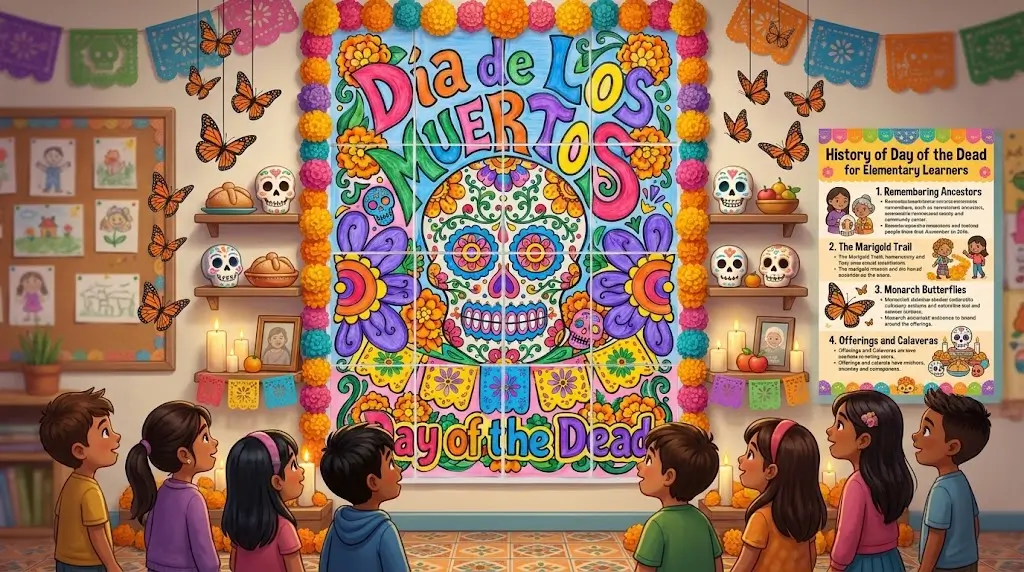
History of Day of the Dead for Elementary: A Kid-Friendly Timeline
- Ancient roots. Long before Europeans arrived, Indigenous peoples of Mesoamerica, including the Mexica (Aztec) and other Nahua peoples, honored their ancestors. They saw death as one part of the cycle of life rather than a frightening end.
- Two traditions meet. After the Spanish arrived, these practices blended with the Catholic holidays of All Saints’ Day (November 1) and All Souls’ Day (November 2).
- Today. Families in Mexico, and in many Latino communities across the U.S., celebrate on November 1 and 2. They build altars, visit cemeteries, share stories, and cook favorite foods. Traditionally, November 1 honors children who have passed (Día de los Angelitos) and November 2 honors adults. With younger students, you can simply say these days are for remembering family.
Teacher tip: Some students may have lost someone close to them. Invite sharing, never require it, and let children remember pets or loved ones from any kind of family. Keep your tone gentle and joyful.
Three Symbols Every Child Can Learn
- Ofrendas (altars). An ofrenda is a welcome-home display, not an object of worship. Families arrange photos, candles, favorite foods, pan de muerto (sweet bread), water, and marigolds to welcome loved ones home.
- Monarch butterflies. Every fall, monarchs migrate to the mountain forests of Michoacán, Mexico, arriving right around November 1 and 2. Many families see them as the returning spirits of ancestors.
- Calaveras and calacas. Skulls and skeletons in Día de los Muertos art are smiling, dancing, and playful. They celebrate life. In the early 1900s, the artist José Guadalupe Posada created the elegant skeleton known as La Catrina, which became one of the holiday’s most famous images.
Grade-by-Grade Teaching Guide
| Grade Band | Focus | Try This Question |
| Preschool | Remembering loved ones, colors, and symbols | “Who do you love and remember?” |
| K–2 | Ofrenda items, monarchs, Spanish vocabulary | “What would you put on an ofrenda?” |
| 3–5 | Origins, Posada’s art, playful rhyming calaveras literarias | “How did two traditions blend into one?” |
Teach It with Respect
Say the name properly (DEE-ah deh lohs MWEHR-tohs), avoid calling it “Mexican Halloween,” and skip costume face paint and stereotypes. Invite families who celebrate to share their own traditions, because Día de los Muertos looks different from region to region and home to home.
Bringing Science into Culture: Marigold Science for Kids (Cempasúchil)
Science is one of the most memorable Day of the Dead Activities for Kids because it answers a question children ask on their own: Why marigolds? Marigold Science for Kids turns a cultural symbol into a real investigation of color, scent, and life cycles.
Why Cempasúchil? Three Science Answers
The marigold used for Día de los Muertos is called cempasúchil (sem-pah-SOO-cheel), from the Nahuatl name cempohualxochitl, often explained as “twenty flower,” a way of saying “many flowers.” Here is the science behind the tradition:
- Pigment. The golden-orange color comes from carotenoids, the same family of pigments that colors carrots and pumpkins. Marigold petals are especially rich in a yellow-orange carotenoid called lutein. In the tradition, the bright color helps guide spirits home along a path of petals.
- Scent. Marigolds release a strong, earthy, citrus-like aroma from natural oils in the plant. Tradition says the scent guides loved ones home, and in nature, scent helps attract pollinators. Gardeners often plant marigolds near vegetables, too.
- Life cycle. Marigolds grow quickly from seed, typically blooming in about two months in warm conditions, and they flower in autumn in Mexico, right as the holiday arrives. A marigold “flower” is actually a flower head packed with many tiny florets, just like sunflowers and daisies.
Cempasúchil Flower Science Activity: Petal Detectives
- Time: 30 minutes, plus 5 days of observation | Ages: 4–10 | Prep: 5 minutes
- Materials: fresh marigolds (grocery stores and garden centers sell them in fall), hand lenses, white paper, paper plates, crayons, and science journals or folded paper.
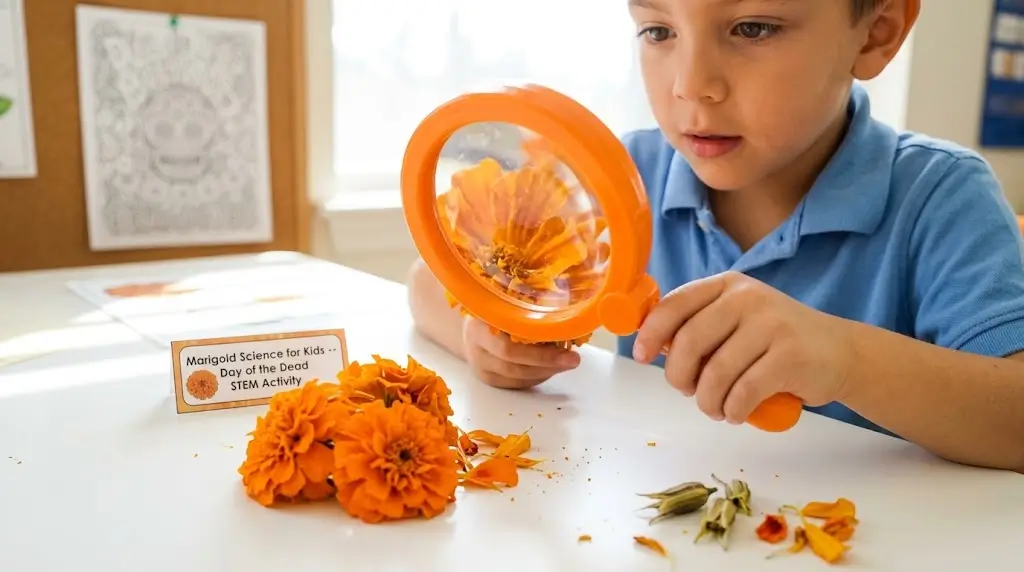
- Look closely. Give each pair of students one flower and a hand lens. Ask: What shapes, colors, and layers do you see? Students draw what they observe.
- Find the florets. Gently pull the flower apart. Older students count the tiny florets, while younger students sort petals into small and large piles.
- Smell and describe. Students share scent words (“sharp,” “earthy,” “lemony”) and build a class word chart.
- Test the color. Press a petal onto white paper to see the pigment it leaves behind. Compare a fresh petal with a dried one.
- Predict, then observe. Place petals in three spots: a sunny windowsill, a shady shelf, and a plate with a few drops of water. Students predict what will happen and record changes over five days.
Extension (grades 2–5): Plant marigold seeds in cups, measure growth weekly with linking cubes, and graph the class results. This also supports early life-science goals about what plants need to grow (for example, NGSS K-LS1-1).
Safety note: Check for plant or pollen allergies first, have students wash their hands afterward, and remind them that petals are for observing, not tasting.
This Cempasúchil Flower Science Activity belongs on any list of Day of the Dead Activities for Kids that need almost no budget, and it pairs naturally with the poster project in the next sections.
Top Día de los Muertos Preschool Crafts & Classroom Ideas
Young hands need simple, open-ended projects. These Dia de los Muertos Preschool Crafts use common supplies, take minutes to set up, and double as practice for scissor skills, patterns, and symmetry. Each of these Day of the Dead Activities for Kids also works for kindergarten and early elementary with small tweaks.
1. Tissue Paper Papel Picado Banners
Papel picado means “punched” or “perforated paper,” and families hang colorful banners over ofrendas and streets. Fold a sheet of tissue paper, let children snip shapes along the folds, then unfold the surprise and tape it to a string. It doubles as a hands-on symmetry lesson.
- Skills: scissor control, symmetry, patterns
2. Coffee Filter Marigolds
Color flat coffee filters with yellow and orange markers, spritz lightly with water so the colors blend, and let them dry. Then pinch the center and tie it with a pipe cleaner. Display them beside the real flowers from your science investigation.
- Skills: color mixing, fine motor control, cause and effect
3. Sugar Skull (Calavera) Coloring
Provide a skull outline and let children decorate it with flowers, swirls, dots, and stripes. Add a loved one’s name on the forehead, as families do on traditional sugar skulls. Talk about how the bright colors and happy designs celebrate life.
- Skills: pattern making, pencil grip, color choice
4. Clay or Salt-Dough Ofrenda Items
Mix 2 cups flour, 1 cup salt, and about 1 cup water. Children shape mini pan de muerto, candles, and marigolds. Air-dry for 24–48 hours, then paint the pieces and arrange them on a class ofrenda shelf alongside family photos. Remind children that salt dough is not food.
- Skills: hand strength, 3-D modeling, vocabulary
These crafts are wonderful on their own. For a project that brings the whole class together, add one more.
Day of the Dead Activities for Kids That Build Community: The Collaborative Art Poster
Individual crafts go home in backpacks. A collaborative poster stays in your room and shows every child that they belong to something bigger. Among all the Day of the Dead Activities for Kids in this guide, a Day of the Dead Collaborative Poster best matches the heart of the holiday: people coming together to remember.
Why a Day of the Dead Collaborative Poster Works
- Fine motor skills. Coloring small sections builds pencil grip, hand strength, and control, which are pre-writing skills for preschool and kindergarten.
- Teamwork and belonging. Every child owns one piece, and the poster isn’t complete without all of them.
- Easy differentiation. Offer crayons to younger learners, colored pencils or markers to older students, and extra detail work for early finishers.
- Instant bulletin board display. The finished poster becomes a classroom or hallway display for November 1–2 and a conversation starter for families at pickup.
- Language practice. Coloring time is the perfect moment to use words like ofrenda, calavera, cempasúchil, and mariposa.
Our Day of the Dead Collaborative Art Poster on TpT
Our Day of the Dead Collaborative Art Poster on Teachers Pay Teachers is a Día de los Muertos coloring activity made for exactly this kind of whole-class project. It is a ready-to-use way to add one of the most engaging Day of the Dead Activities for Kids to your lesson plans without hours of prep.
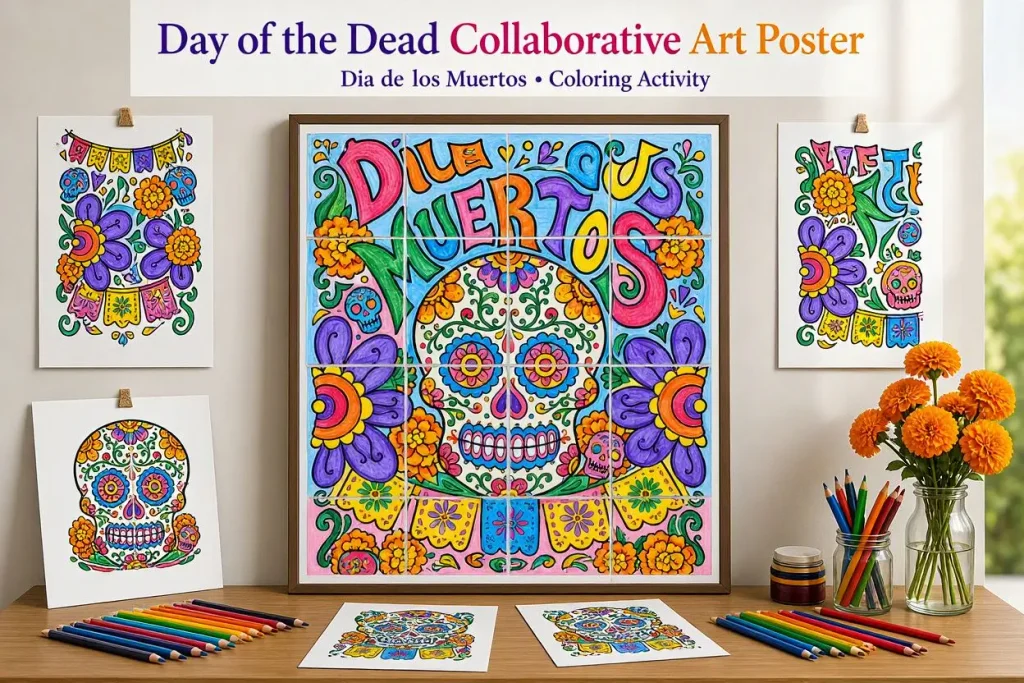
How to Use It in 5 Steps
- Introduce. Share a short read-aloud or the history mini-lesson from the first section.
- Assign. Give each student or pair one section of the poster.
- Color. Use centers, morning work, or a quiet art block.
- Match to nature. Set real marigold petals on the tables so students can match their colors to the real flower. This links your poster to your Cempasúchil Flower Science Activity.
- Assemble and reflect. Build the poster together on a bulletin board and ask: What do you notice? Which part is yours? How does it look when we work together?
👉 Download the Day of the Dead Collaborative Art Poster on Teachers Pay Teachers →
More Day of the Dead Activities for Kids: Internal & External Learning Resources
These trusted sources give you background knowledge to share with students and families. They also help you support your Day of the Dead Activities for Kids with accurate, respectful context.
Trusted External Resources
- National Geographic Education: What Is the Day of the Dead? A short video and background on how the holiday started and the traditions that make it unique.
- Smithsonian Latino Center Educator Resources Educator resources such as lesson plans, a glossary, and altar-building ideas for Día de los Muertos.
- UNESCO: Indigenous Festivity Dedicated to the Dead Official background on the tradition’s recognition as Intangible Cultural Heritage of Humanity.
More from Our Blog
- Explore our kindness coloring cards for the classroom to extend the theme of love and remembrance into everyday kindness.
- Planning a full fall calendar? Check out our Red Ribbon Week crafts to keep your late October activities organized in one place.
Final Thoughts: Day of the Dead Activities for Kids That Teach, Honor & Connect
The best Day of the Dead Activities for Kids do more than fill a calendar slot. They teach real history, spark real science curiosity, and give children a joyful way to talk about remembering the people they love. Start with a gentle story, investigate marigolds with a hand lens, add one or two easy crafts, and finish with a whole-class poster.
Your 5-Day Mini-Unit at a Glance
| Day | Activity | Focus |
| 1 | Story and ofrenda symbols | History and vocabulary |
| 2 | Petal Detectives | Marigold Science for Kids |
| 3 | Papel picado or coffee filter marigolds | Fine motor skills and symmetry |
| 4 | Collaborative poster coloring | Teamwork |
| 5 | Assemble, reflect, and share with families | Community |
Final classroom tip: Invite families to send in a photo or a drawing of someone they remember. Display them beside your Day of the Dead Collaborative Poster, make participation optional, and welcome all kinds of loved ones, including pets. That small step turns a unit into a community moment.
Ready to bring it all together? Download our Day of the Dead Collaborative Art Poster on Teachers Pay Teachers and make this year’s Día de los Muertos unit hands-on, respectful, and unforgettable. With the right Day of the Dead Activities for Kids, your students won’t just color a calavera. They’ll understand what it means.