Once a phonics display is on the wall, what do you actually do with it? Phonics posters need to be used during instruction to become useful references. It helps when an adult points to it during a lesson, uses it to model a pattern, and sends children back to it while they read and write.
This guide explains how to match a chart to the skill a child is learning. It gives seven activities you can try with plain paper and a handful of written words, plus a worked mini lesson on the sh digraph. It also covers common mistakes and answers a few practical questions. Everything here works with any set of phonics posters, or with a pattern you write on a sheet of paper yourself.
What Are Phonics Posters?
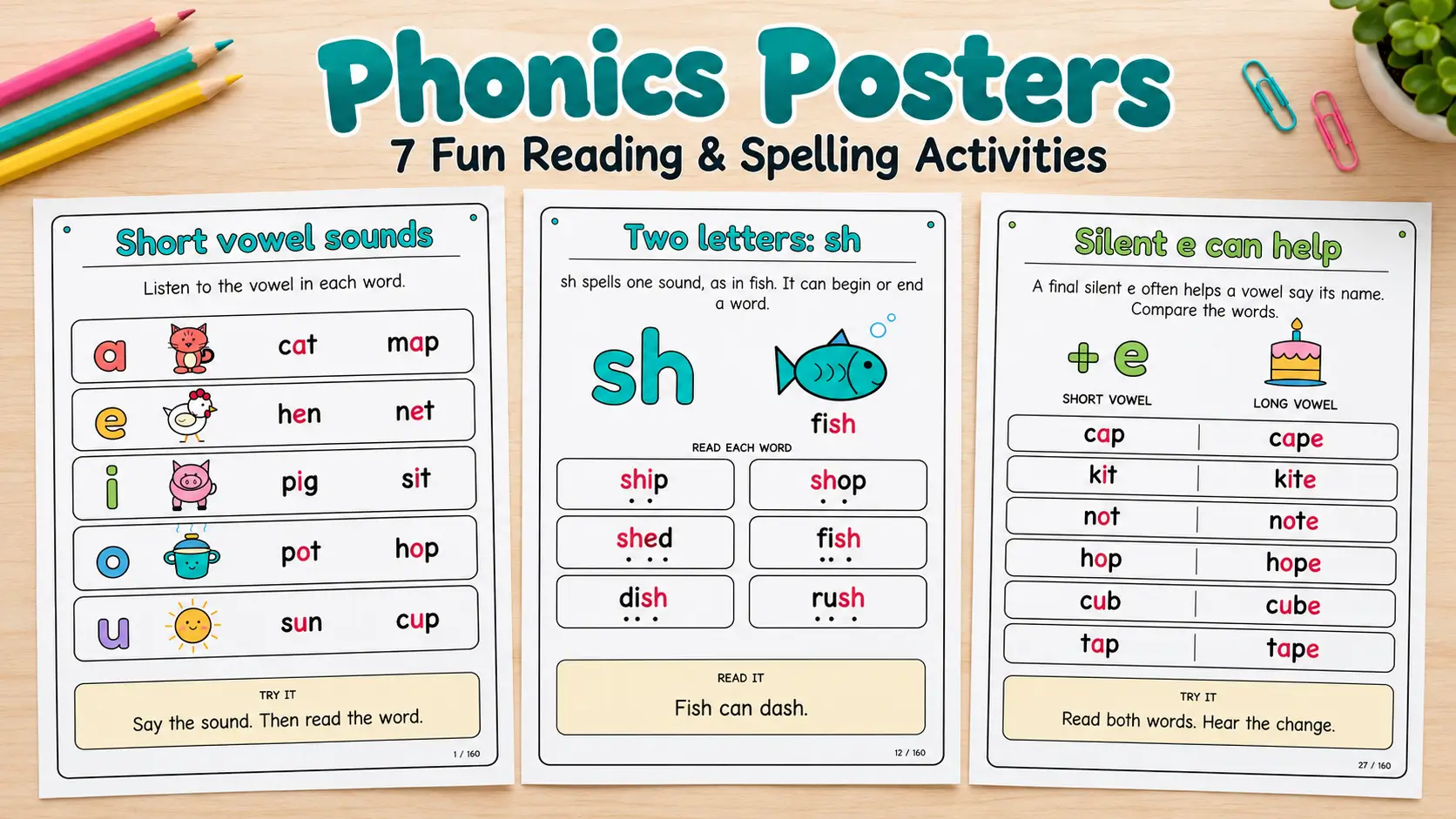
Phonics posters, often called phonics anchor charts, are visual references for how spoken sounds connect to written letters. A typical chart names a pattern, shows example words, and highlights the letters that make the sound. Some cover broader word-study topics, such as prefixes, plurals, or contractions, which are about word parts and meaning rather than sound-spelling alone.
A few terms help when planning:
- Phonemic awareness is working with individual sounds in spoken words, with no letters involved.
- Phonics is connecting those sounds to letters and spelling patterns.
- Decoding is using that knowledge to read a word.
- Encoding is using it to spell a word.
Phonics posters support decoding and encoding when an adult connects the chart to reading and spelling practice. They do not replace explicit teaching or practice. The IES practice guide on foundational skills for kindergarten through 3rd grade is a useful source for the broader approach. Its recommendations cover linking speech sounds to letters, decoding and writing words, and reading connected text. A poster can serve the first two when an adult uses it actively, and the third when children go on to read sentences. This article is not connected to IES, and IES has not reviewed any product mentioned here.
Choose a Poster That Matches the Current Lesson
Choose phonics posters for the pattern the child is learning now. Then work through a short routine:
- Name the pattern in one sentence, such as “These two letters make one sound.”
- Read the chart’s examples and wording yourself. Confirm they match how you teach the pattern.
- Choose three to six words, and make sure every other letter in them is already familiar.
- Display only the phonics posters that relate to the lesson.
- Follow the scope and sequence you already use. Grade labels are a rough guide, and previously taught skills should decide what you pick.
The table below shows example words and a teaching action for four common patterns. These examples were written for this article and are not claims about any specific poster.
| Pattern | Example words | One teaching action |
|---|---|---|
| Short vowels and CVC words | cat, sit, hop, cup, bed | Tap out /k/ /a/ /t/ on three fingers, then slide the sounds together to read the word. |
| Consonant blends versus digraphs | Blends: stop, frog. Digraphs: ship, chat | Tap each sound. In stop, the /s/ and /t/ stay distinct (four sounds). In ship, sh is one sound (three sounds). |
| Silent e contrasts | cap and cape, hop and hope, kit and kite | Read each pair and ask what changed. Often the final e signals a long vowel, though words like have and give are exceptions. |
| A common vowel team | rain, mail, tail, wait | Underline ai and explain that the two letters often stand for one long a sound. Said is one exception to teach separately. |
For help preparing pages and word cards, see this guide to choosing and preparing printable activities.
Seven Practical Ways to Use Phonics Posters
The activities below show how to use phonics posters with simple word cards, paper, and writing tasks. Adjust the word lists to patterns your children already know.
1. Introduce One Spelling Pattern
Materials: one of your phonics posters, or the pattern written large on plain paper.
Skill: noticing a pattern and decoding words that contain it. Example pattern: ck, commonly found at the end of one-syllable words after a short vowel.
Point to the chart and read three or four words aloud: back, pick, sock, duck. Then guide children’s attention. For example: “Listen to the end of each word. Same sound every time. Look at the letters that make it. C and k work together here to make /k/.” Have children read each word after you.
Simpler: use two words only. More advanced: ask children to find other words that end this way.
2. Sort Words by a Taught Pattern
Materials: six small paper cards and two column headings.
Skill: reading and discriminating between two similar digraphs.
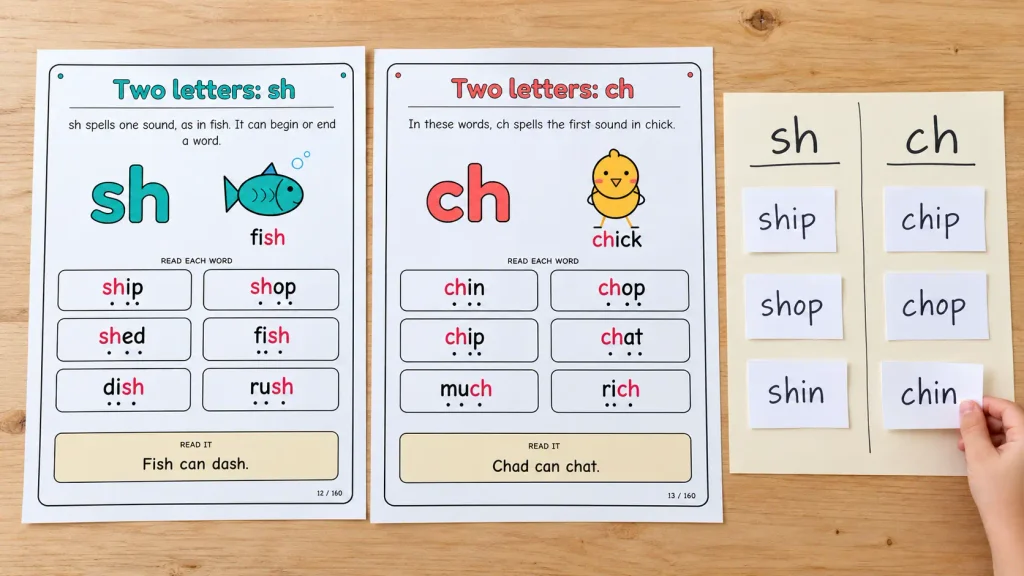
Write sh and ch as headings. Make cards: ship, chip, shop, chop, shin, chin. Show one card at a time. Ask the child to read it before placing it. If a child places a word incorrectly, have them reread it and check the first two letters against the heading.
Simpler: begin with only sh words and non-sh words. More advanced: add a third group such as th, with words like thin and thud.
3. Build a Word Chain
Materials: paper and a pencil, or letter tiles.
Skill: attending to every sound in a word, both for reading and for spelling.
Write cat and read it together. Change only one letter at each step: cat, cap, cop, hop, hot, hat. At each step, ask: “What changed? What stayed the same?” From cat to cap, the last sound changes. From cap to cop, the middle vowel changes. From cop to hop, the first sound changes.
Simpler: keep the first letters fixed and only change the vowel. More advanced: have children suggest the next word.
4. Say, Segment, and Spell
Materials: paper divided into three boxes.
Skill: encoding, which combines segmenting sounds with writing letters.
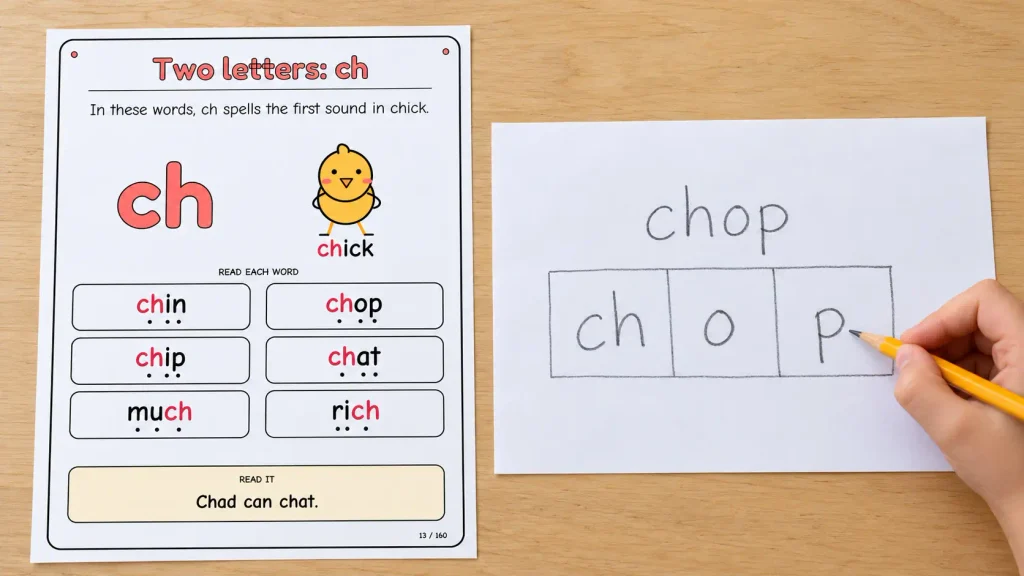
Say the word chop. Have the child repeat it. Then say each sound separately: /ch/ /o/ /p/. That is three sounds. Have the child write one grapheme in each box: ch in the first, o in the second, and p in the third. Point out that chop has three sounds but four letters, because ch stands for one sound. Then have the child read the written word back.
Simpler: use a word with no digraph, such as map. More advanced: dictate a short phrase.
5. Read a Short Sentence
Materials: a sentence you write on plain paper. This is your own sentence, not a worksheet included with any poster.
Skill: moving from isolated words to connected text.
Write: The chick sat on a rock. Before the lesson, check that the child knows the consonant and short vowel sounds in the sentence, as well as ch, ck, and the words the and a. If a sentence contains an untaught word or pattern, teach it first or write a different sentence. Have the child point to each word while reading, then reread for smoothness.
Simpler: use three-word sentences. More advanced: have the child write a sentence of their own using the pattern.
6. Refer to the Chart During Writing
Materials: the relevant phonics posters and the child’s writing.
Skill: using a reference while spelling.
When a child is writing duck and unsure how to end it, avoid giving the letters directly. Try prompting: “Say it slowly. What sound do you hear at the end? Is there a word on the chart that ends the same way?” Help them look at pick or sock. Remind children that a chart shows examples of a pattern. It does not list every possible spelling, so you may still need to help with words it does not show.
Simpler: point to the right chart yourself. More advanced: ask children to find the right chart on their own.
7. Review a Previously Taught Pattern
Materials: eight word cards and a sticky note.
Skill: retention of earlier patterns across a mixed set.
Put the phonics posters aside for a first reading of ship, chat, thin, rock, shed, chin, math, and duck. Have the child read them in any order. Notice where the child hesitates or substitutes. If chin comes out as shin, tally it on the sticky note and revisit ch. This is an informal teaching check that tells you what to practice next. It is not a standardized assessment.
Simpler: use four cards. More advanced: add a spelling dictation of two words.
One Worked Mini Lesson: The sh Digraph
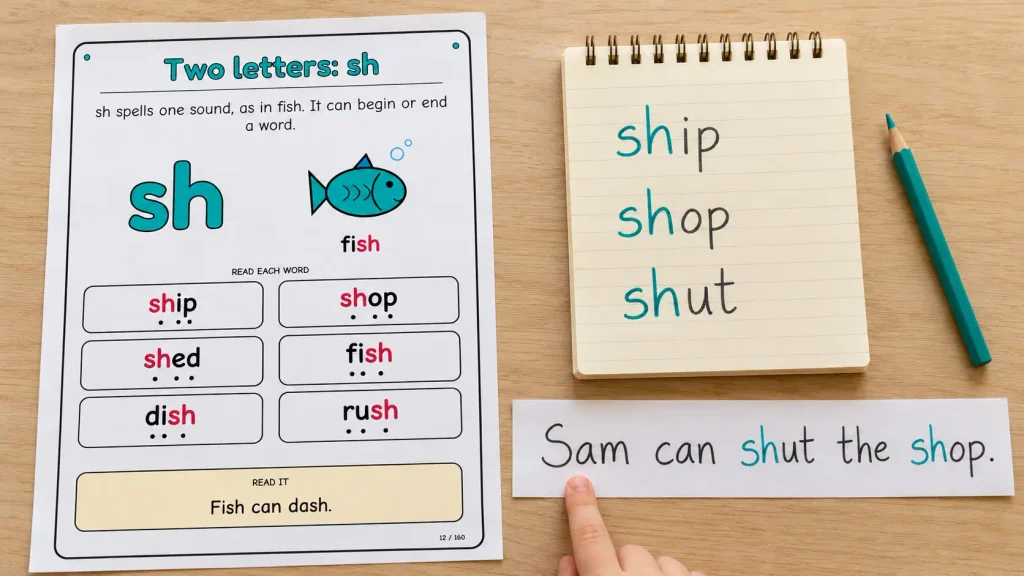
For the word practice, the child should already know short i, o, and u and the consonant sounds for p and t. Introduce sh as the new pattern. Before adding the sentence “Sam can shut the shop,” also check that the child knows short a, s, c representing /k/, m, n, and the word the. You can teach the words first and return to the sentence in a later session.
Introduce. Choose one of your phonics posters for sh, or write the digraph on paper. Say: “These two letters work together to make one quiet sound, /sh/.” Have the child say it a few times.
Model one word. Write ship. Cover everything except sh and say the sound. Then add i: “/sh/ /i/.” Add p: “/sh/ /i/ /p/. Ship.” Point out that the word has three sounds even though it has four letters.
Guided practice. Write shop. Have the child do the reading while you help. Prompt: “What does sh say? What does o say? Now put it together.” Add shut, and have the child read it with less support.
Spell one word. Say shop. Have the child repeat it and count the sounds on their fingers: /sh/ /o/ /p/. Ask for three sounds, then have them write sh, o, and p. They should write sh as one unit.
Read a sentence. Write: Sam can shut the shop. Check beforehand that the child knows the word the. Read it together, then have the child read it alone.
If the child splits sh into /s/ and /h/: underline sh with one line so it looks like one unit. Have the child say /sh/ and compare it to /s/ and /h/ said separately. Then reread ship.
Adapt the Practice
Phonics posters can support different practice tasks as children learn new patterns.
- Children learning foundational letter-sound relationships: use one or two simple patterns, three words at a time, and more modeling than independent reading.
- Children practicing familiar patterns: use sorting, word chains, and sentence reading, with the chart as a quick check.
- Children ready for longer words or word parts: use charts for syllable types, prefixes, and suffixes. Have them read a longer word in parts, then put the parts together.
Choose by what the child can already do, not by age or grade. For more reading and writing ideas, browse these alphabet and literacy activity guides.
Common Mistakes
Displaying many unfamiliar charts before teaching them. Choose a small set of phonics posters that matches current lessons, and rotate the display as new patterns are taught.
Teaching a spelling generalization as an absolute rule. English has exceptions, and a flat rule sets children up for confusion. Use words such as “often” or “commonly” and name exceptions when they come up.
Choosing example words with several untaught patterns. If a child has learned only short vowels and sh, a word such as shout adds a vowel team they may not know. Select words where only the target pattern is new.
Expecting the display to replace reading, spelling, and feedback. Phonics posters are references. Children still need to read words, spell them, and get quick corrections from an adult.
The SmartPrint Kids Poster Collection
I create printable learning resources under the name SmartPrint Kids. The poster collection below is my own product. The activities in this guide are separate teaching suggestions, rather than worksheets or lessons included in the PDF.
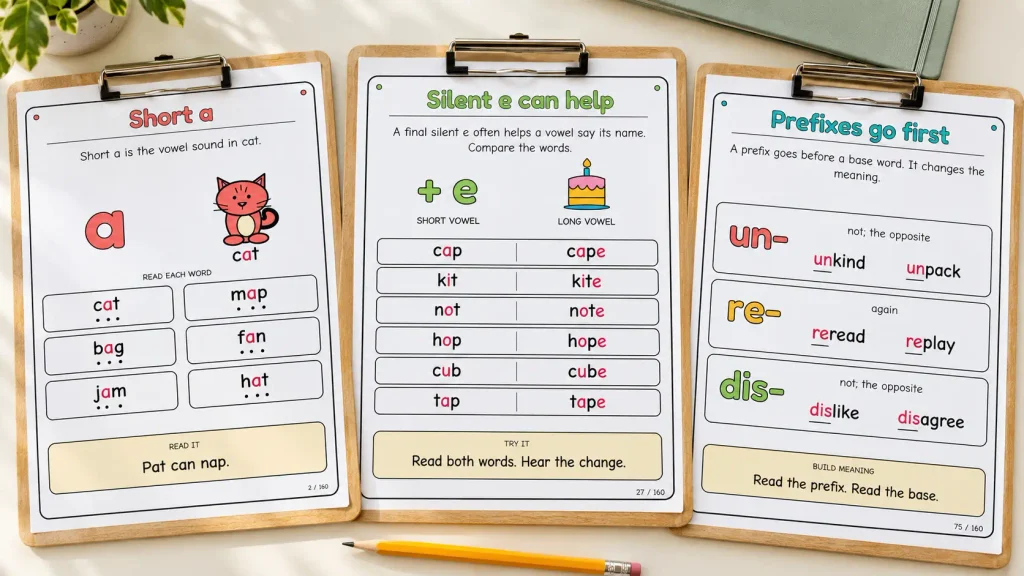
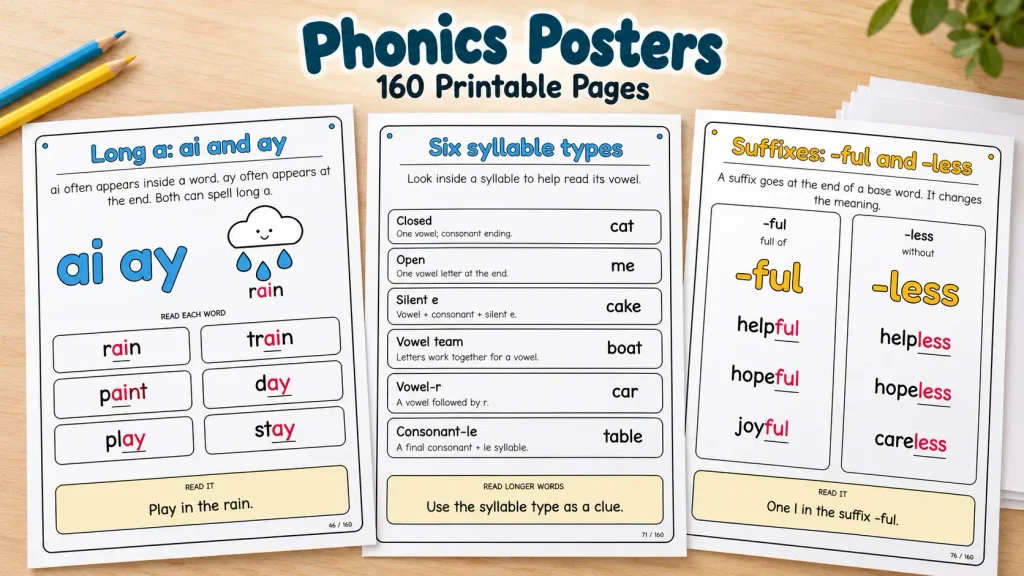
The Phonics Spelling Rules Posters listing on Teachers Pay Teachers describes one digital PDF with 160 full-page color posters and anchor charts. Pages are US Letter size, 8.5 x 11 inches, in portrait orientation. The listing says the topics range from short and long vowels through syllable types, prefixes, suffixes, and homophones, and the pages include example words, highlighted patterns, and short practice prompts.
Print only the phonics posters you plan to use in current lessons. Check the listing for details about contents and permitted use before you decide.
FAQ
Which phonics posters should I start with?
Start with the pattern you are teaching this week. For many beginners, that means short vowels and CVC words, then simple digraphs. Follow your own teaching sequence.
Are phonics posters a complete reading curriculum?
No. Phonics posters are references that support instruction. Children also need explicit teaching, practice reading and spelling, and feedback.
Should I display all 160 charts?
No. Keep most of the phonics posters in a folder and display the few charts that match current lessons.
Can I use them for homeschool reading practice?
Yes. Use phonics posters after an adult introduces the pattern and models how to read the example words. Use one chart, a few written words, and one activity from this guide. Posters do not replace specialist instruction for children who struggle with reading.
What should I do if a word does not follow the pattern?
First, check whether the word follows a different spelling pattern the child has not learned yet. Teach the unfamiliar pattern when appropriate. If the word contains an irregular spelling, identify that part and practice it separately. For example, said does not use the common long a pronunciation of ai.
Try One Activity This Week
Choose phonics posters for one familiar pattern, write four or five words, and try a sorting or word chain activity. Notice which words need extra help, then adjust the next set.nd try the sorting or word chain activity. Notice which words need extra help, then adjust the next set.