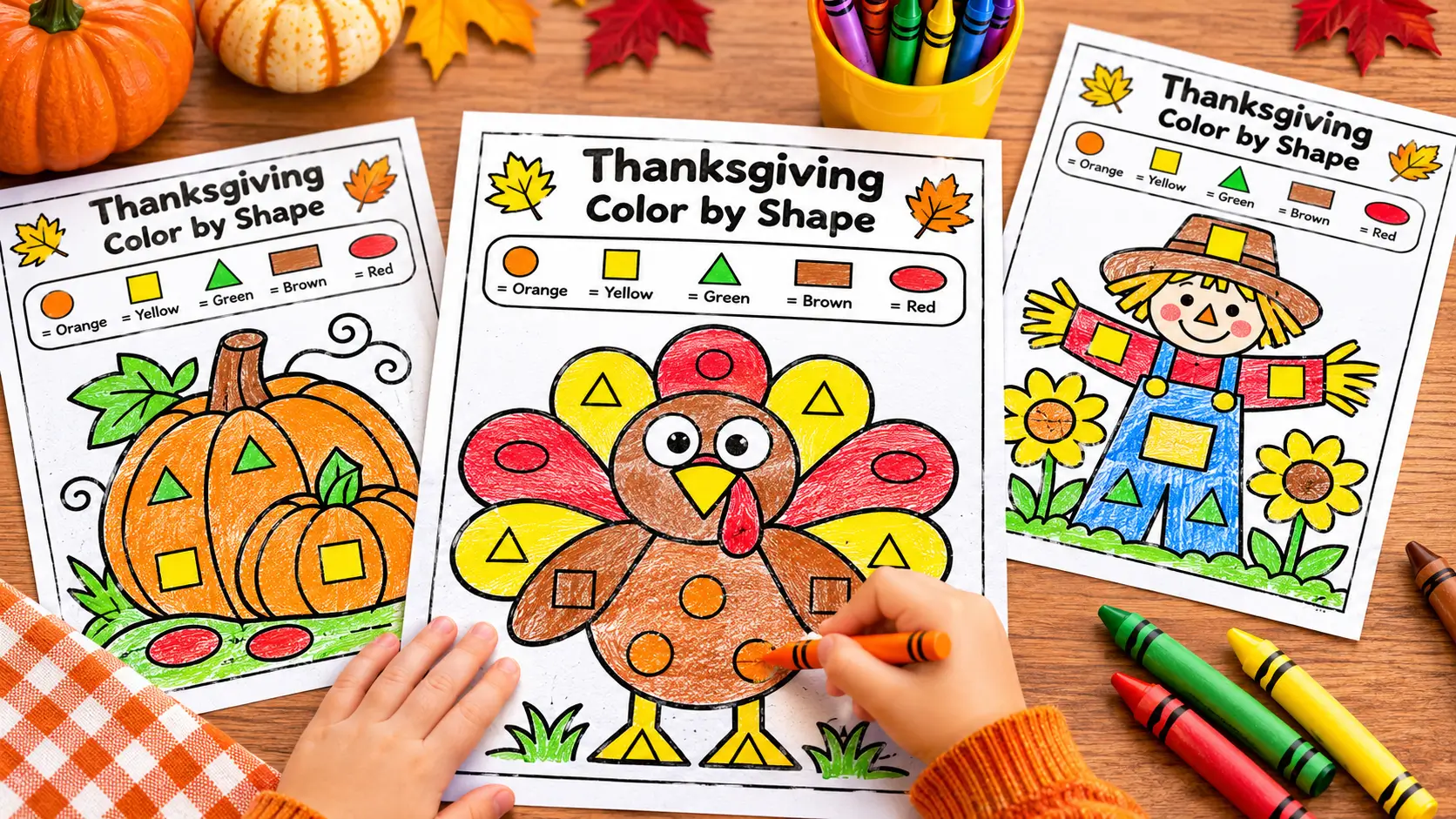
Looking for fun, hands-on Thanksgiving color by shape worksheets that help preschoolers learn their shapes while enjoying a little holiday creativity? This free printable pack turns early geometry practice into a colorful Thanksgiving activity filled with turkeys, pumpkins, harvest baskets, autumn trees, and more.
Children follow a simple shape-color key to find and color circles, squares, triangles, rectangles, and ovals hidden inside festive fall illustrations. Instead of coloring every section however they like, they look carefully at each shape and choose the matching color.
It’s a playful way to combine shape recognition, color identification, visual discrimination, and fine motor practice in one easy activity.
This free 31-page Thanksgiving printable PDF includes 15 different black-and-white worksheets, 15 full-color answer keys, and a teacher instruction page.
Designed for children ages 3–6, these Thanksgiving shape coloring pages are ideal for preschool, Pre-K, kindergarten, November math centers, homeschool lessons, and quiet learning time at home.
Best of all, the worksheets are easy to prepare. Simply download the PDF, choose a page, grab a few crayons, and start discovering shapes!
What’s Included in Your Free Download?
The printable pack includes:
- 15 black-and-white Thanksgiving color by shape worksheets
- 15 matching full-color answer keys
- 1 teacher instruction page
- Five basic shapes: circles, squares, triangles, rectangles, and ovals
- An easy-to-follow shape-color legend
- Thanksgiving and autumn-themed illustrations
- US Letter pages suitable for home and classroom printing

Printable Details
| Feature | Details |
|---|---|
| Recommended ages | 3–6 years |
| Grade levels | Preschool, Pre-K, Kindergarten |
| Total PDF pages | 31 |
| Activity worksheets | 15 |
| Colored answer keys | 15 |
| Teacher guide | 1 page |
| Paper size | US Letter (8.5 × 11 inches) |
| Main skills | Shape recognition, color matching, visual scanning, fine motor practice |
All activity worksheets are black and white, helping save printer ink while giving children plenty of space to add their own colors.
The answer keys show the intended color combinations, making it easier for parents and teachers to check completed activities.
You can print the entire set or choose just a few pages depending on your child’s interests and current learning level.
What’s Included in These Thanksgiving Color by Shape Worksheets?
These Thanksgiving color by shape worksheets for preschool are organized around 15 different fall-themed illustrations.
Each activity combines familiar holiday pictures with recognizable geometric shapes.
Some designs have larger areas that are easier for younger children to color, while others contain additional shapes that encourage more careful looking.
Thanksgiving Turkeys and Fall Characters
Several worksheets feature cheerful Thanksgiving characters created from simple shapes.
Children can explore pictures of turkeys and a scarecrow while identifying the circles, ovals, triangles, squares, and rectangles used to create their features.
A turkey’s round body can help children recognize a circle, while its feathers may include oval shapes.
Triangle shapes appear in features such as beaks and feet.
These illustrations are especially useful for introducing the idea that a larger picture can be made from smaller geometric shapes.
For younger preschoolers, start by identifying the turkey’s body and feathers before looking for smaller details.
Pumpkin and Harvest Worksheets
Pumpkins are a familiar part of fall, making them a natural choice for seasonal shape recognition.
The pack includes pumpkin-themed scenes as well as other harvest illustrations featuring produce and autumn decorations.
Children will notice how different shapes can work together to form pumpkins, plants, baskets, and other seasonal objects.
Encourage them to look at the outline of each section rather than guessing its color based on the real-world object.
For example, the printable follows its shape-color key, so a pumpkin section might not always be colored orange.
The goal is recognizing the shape correctly, not creating a realistic picture.
Harvest Baskets, Autumn Trees, and Farm Scenes
Other worksheets feature harvest baskets, an autumn tree, a barn with pumpkins, and scenes inspired by the fall season.
These pictures provide opportunities to identify shapes in different positions.
A rectangle might appear vertically as a tree trunk or horizontally as part of a table.
Triangles may form decorative details, while circles and ovals appear in fruit, leaves, and other objects.
This helps children notice that a shape remains the same type even when it appears in a different location or orientation.
Thanksgiving Food and Table Activities
The collection also includes pictures inspired by Thanksgiving food and mealtime.
Children can explore a pie slice, a harvest cornucopia, a Thanksgiving table, and other scenes featuring food and seasonal decorations.
These activities offer an opportunity to discuss the geometric shapes found in familiar objects.
A plate might look circular, while the edge of a table may appear rectangular.
A slice of pie may include triangular sections.
Children can also practice the difference between a shape’s actual outline and the larger object it helps create.
Apple Carts and Additional Fall Illustrations
The remaining worksheets include playful autumn scenes such as an apple cart and a pumpkin patch.
These designs combine several shape types into one larger picture.
Children may need to scan the page carefully to find every matching shape.
Once they understand the activity, encourage them to complete the worksheet independently and compare the result with the matching answer key.
With 15 different pages, you can rotate the activities throughout November rather than completing the entire pack in one sitting.
Thanksgiving Color by Shape Worksheets: The Five Shapes and Their Colors
One of the most important features of this printable pack is its consistent shape-color key.
The same color is assigned to each shape throughout the corrected worksheet collection.
This helps children learn the activity routine without memorizing a different set of rules for every page.
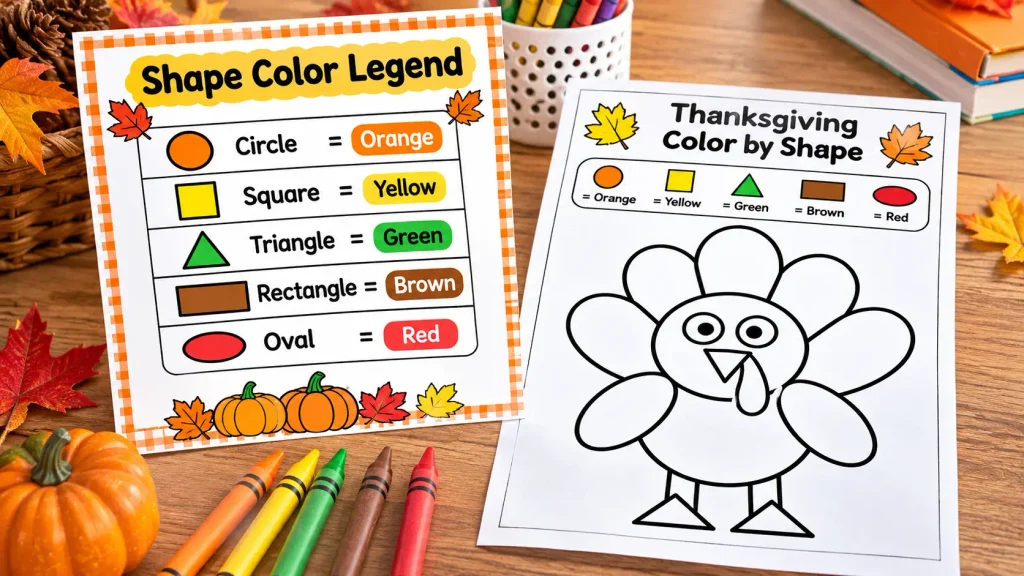
The Shape-Color Legend
| Shape | Color |
|---|---|
| Circle | Orange |
| Square | Yellow |
| Triangle | Green |
| Rectangle | Brown |
| Oval | Red |
Children use this key to decide how to color the outlined shape regions in each Thanksgiving picture.
For example, when a child finds a triangle, they use green.
When they find an oval, they use red.
If a particular page doesn’t contain one of the five shapes, that shape simply won’t need to be colored on that page.
For children who are still learning color names, you can place the five matching crayons beside the worksheet while reviewing the legend.
Circle – Orange
A circle is a round, closed shape with no corners.
Children may find circles in turkey bodies, decorations, produce, and other parts of the illustrations.
When they identify a circle-shaped region, they color it orange.
For beginners, start with a large, obvious circle and compare it with a real circular object such as a plate.
Square – Yellow
A square has four equal straight sides and four right-angle corners.
Squares may appear as decorative sections, small blocks, or parts of a larger illustration.
In this printable, children color square regions yellow.
You can encourage them to count the four sides and compare their lengths.
Triangle – Green
A triangle has three straight sides and three corners.
Triangle shapes may appear in turkey beaks, feet, decorations, or other parts of the fall illustrations.
Children color these shapes green.
Try asking:
“Can you count the three corners?”
“What makes this shape different from a square?”
Rectangle – Brown
A rectangle has four straight sides and four right-angle corners.
In these worksheets, the rectangle icon is shown as an elongated shape to help young children distinguish it from the square icon.
Children color rectangle regions brown.
A square is mathematically a special type of rectangle, but the activity uses separate printed square and elongated-rectangle symbols to practice recognizing both common forms.
Oval – Red
An oval is a rounded, elongated shape with no corners.
Children can look for oval-shaped regions in turkey feathers, fruit, and other seasonal details.
They color these areas red.
Compare a circle and an oval side by side.
Ask children what looks similar and what looks different.
This simple comparison can help them become more confident identifying curved shapes.
Why Color by Shape Activities Are Good for Preschoolers
Color by shape worksheets may look like ordinary coloring pages, but they offer several opportunities to practice early learning skills.
Children need to identify a symbol, remember its assigned color, locate matching shapes, and apply the correct color to the picture.
That combination encourages careful observation and mathematical language.
1. Building Shape Recognition
Shape recognition is an important part of early geometry.
Children begin by noticing familiar shapes and gradually learn to describe them using features such as sides, corners, and curved edges.
A color-by-shape worksheet gives children repeated opportunities to identify shapes within larger illustrations.
Instead of only recognizing a triangle on a flashcard, they may need to find a triangle inside a turkey or harvest scene.
For additional ideas, the National Association for the Education of Young Children explains how children can identify and compare shapes through everyday activities in its Everyday Shapes guide.
2. Practicing Visual Discrimination
Visual discrimination involves noticing similarities and differences between shapes and patterns.
Children must look carefully to distinguish circles from ovals and squares from elongated rectangles.
This encourages them to examine the actual shape instead of choosing a color based on the surrounding picture.
3. Following Visual Instructions
Every worksheet has a color key that acts as a small set of instructions.
Children learn to look at the legend, identify the shape, choose the corresponding color, and apply it consistently.
This provides practice following a visual rule.
You can reinforce the process by saying:
“First, find the shape. Next, check the color. Then, color the shape.”
4. Developing Fine Motor Control
Coloring provides opportunities to practice holding crayons and controlling small hand movements.
The thick black outlines help children see where one area ends and another begins.
Younger children may prefer larger crayons, while older children may enjoy using colored pencils for smaller sections.
Remember that the main learning objective is shape recognition, not perfectly neat coloring.
5. Encouraging Attention and Careful Looking
Some pictures contain more shapes than others.
Children need to scan different areas of the worksheet to find matching shapes.
Working through one shape type at a time can help them stay organized.
For example, they can color every circle orange before moving on to the triangles.
6. Connecting Math to Familiar Experiences
Thanksgiving scenes make the activities seasonally engaging.
Children recognize pumpkins, turkeys, farm scenes, harvest baskets, and autumn decorations.
These familiar pictures provide opportunities to discuss how shapes appear in real objects.
How to Print the Free Thanksgiving Color by Shape Worksheets
Preparing these worksheets is simple.
The printable is designed for standard US Letter paper and can be used with basic classroom supplies.
Step 1: Download the PDF
Use the free download link near the beginning of this article.
Save the PDF to your computer or device.
The complete file contains the teacher guide, worksheets, and answer keys.
Step 2: Choose the Pages You Need
The PDF is organized as follows:
- Page 1: Teacher Instructions
- Pages 2–16: 15 black-and-white worksheets
- Pages 17–31: 15 corresponding colored answer keys
You don’t need to print all 31 pages.
For a short activity, choose one or two worksheets.
If you want to check the activity afterward, locate the matching answer key in the second half of the PDF.
Step 3: Set Your Paper Size
Choose US Letter paper, measuring 8.5 × 11 inches.
Select Actual Size or 100% in your printer settings when possible.
Check the print preview before printing.
If your printer clips the page border, use a slightly reduced scale that keeps the full worksheet visible.
Step 4: Print the Worksheets in Black and White
The 15 activity pages are designed with black outlines.
You can print these using a black-and-white printer.
The answer keys are colored and can be viewed on a device if you want to save color ink.
Step 5: Prepare Five Crayon Colors
Gather orange, yellow, green, brown, and red crayons.
These correspond to the five shapes in the legend.
For younger children, placing only the required crayons on the table may help reduce distractions.
Step 6: Test One Page
Before printing a full classroom set, print one worksheet.
Check that the legend is readable, the shape outlines are clear, and the page fits within your printer’s margins.
Once everything looks right, print the selected worksheets.
How to Use Thanksgiving Color by Shape Worksheets Step by Step
Color by shape activities work best when children understand the routine before starting independently.
Use the following simple teaching sequence.
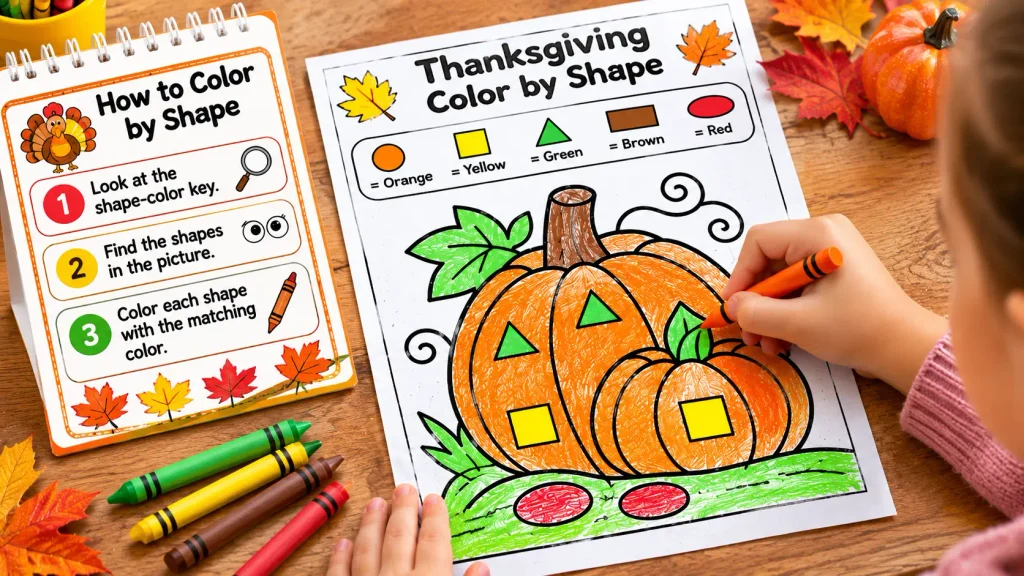
Step 1: Introduce the Five Shapes
Show children the five shape symbols.
Name each one and briefly describe its features.
For example:
“This is a triangle. It has three sides.”
“This is a circle. It has no corners.”
You can use physical shape blocks or paper cutouts for an additional demonstration.
Step 2: Explain the Color Legend
Point to the shape-color legend on the worksheet.
Tell children that each shape has its own special color.
Read the key together.
“Circle is orange.”
“Square is yellow.”
“Triangle is green.”
“Rectangle is brown.”
“Oval is red.”
Repeat the pairs once or twice before beginning.
Step 3: Find One Shape in the Picture
Ask the child to locate one shape from the legend.
Begin with an easy example, such as a large circle.
Point to the region and ask:
“What shape is this?”
“Which color should we use?”
If the child isn’t sure, guide them back to the legend.
Step 4: Color All Matching Shapes
Encourage children to work with one shape at a time.
For example, find the circles and color them orange.
Then look for triangles and color them green.
This method can make a detailed picture feel more manageable.
Step 5: Continue With the Remaining Shapes
Repeat the process for squares, rectangles, and ovals.
Children can point to each shape before coloring it.
If part of a picture contains decorative lines or details that don’t clearly belong to a shape category, use the printed outlines and the answer key to guide the activity.
Step 6: Review the Finished Picture
When children finish, ask them to name some shapes they found.
You might say:
“Show me a triangle you colored.”
“Can you find another oval?”
“Which shape was easiest to find?”
These questions encourage reflection without turning the activity into a formal test.
Step 7: Compare With the Answer Key
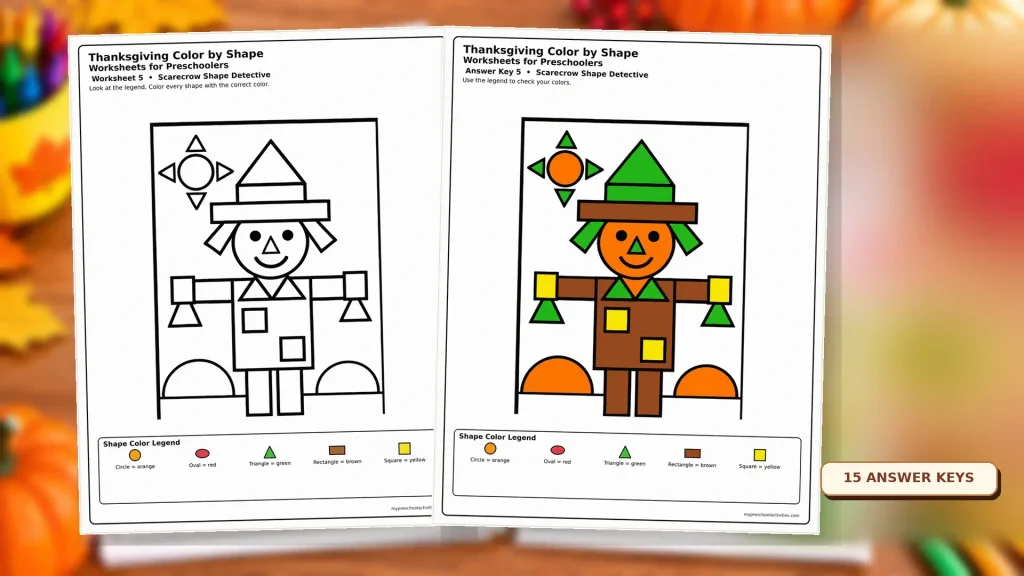
The PDF includes 15 colored answer keys.
Match each worksheet with the answer key carrying the same activity number.
Invite children to compare the color placements.
Ask:
“What looks the same?”
“Can you find an area to check again?”
Treat differences as opportunities for practice rather than as failures.
Using Thanksgiving Shape Worksheets for Ages 3–4
Younger preschoolers are still developing shape recognition and hand control.
They may not be ready to complete an entire worksheet independently.
Begin with a short activity and provide plenty of support.
Start With One Shape
Instead of introducing all five shapes at once, choose one familiar shape.
For example, ask children to find the circles.
They can point to each circle before coloring.
Once they understand the process, introduce another shape.
Use Real Objects First
Before starting the worksheet, show children familiar objects.
You could use a round plate for a circle or a square paper note for a square.
Let them compare the object with the printed symbol.
Offer Larger Coloring Tools
Chunky crayons are often easier for younger children to hold.
Allow children to color with comfortable movements rather than expecting perfect precision.
Keep Sessions Short
A short session of five to ten minutes may be enough for beginning learners.
You can return to the same worksheet later rather than expecting children to finish everything at once.
Using Thanksgiving Shape Worksheets for Ages 5–6
Older preschoolers and kindergarten students may be ready to recognize all five shapes and work more independently.
Encourage them to check the legend before choosing each color.
Complete the Whole Picture
Students can work through all five shape categories.
They may enjoy selecting one crayon at a time and searching for every matching region.
Count the Shapes
After completing the worksheet, ask children to count a particular shape.
For example:
“How many triangles can you find?”
“Are there more circles or squares?”
Counting the shapes adds another early math skill to the activity.
Compare Shapes
Ask children to describe what makes two shapes different.
For example, compare a circle and an oval.
Or compare a square and an elongated rectangle.
Encourage them to talk about corners, sides, and curved outlines.
Check Answers Independently
Once children understand the activity, they can compare completed worksheets with the colored answer keys.
This provides an opportunity to practice noticing and correcting mismatches.
Five Hands-On Thanksgiving Shape Activities to Try
After children complete the printable worksheets, extend the learning with simple activities using materials you already have.
1. Build a Turkey With Paper Shapes
Cut large circles, ovals, triangles, rectangles, and squares from colored paper.
Invite children to arrange the pieces into a turkey.
A large circle can become the body.
Ovals can form feathers.
A triangle can become the beak.
Add additional shapes however children like.
This activity helps them see how simple geometric shapes can combine to form a recognizable picture.
2. Thanksgiving Table Shape Hunt
Look around the Thanksgiving table and ask children to identify shapes.
For example:
- A round plate resembles a circle.
- A rectangular placemat resembles a rectangle.
- A square napkin resembles a square.
- A triangular folded napkin resembles a triangle.
Ask which shape appears most often.
You can also encourage children to notice how real objects sometimes have rounded corners or three-dimensional forms.
3. Fall Leaf and Shape Sorting
Collect a few safe, clean fallen leaves or use paper leaf cutouts.
Place circles, squares, and triangles cut from paper beside them.
Invite children to sort the geometric shapes and compare the leaves with them.
A leaf might resemble an oval or have a pointed tip.
The goal is observing similarities and differences, not forcing every natural object into a perfect geometric category.
4. Create a Shape Scavenger Hunt
Choose one of the five shape types.
Ask children to search for objects with similar shapes around the room.
For example:
“Find something shaped like a rectangle.”
“Can you spot something circular?”
Afterward, try our Thanksgiving scavenger hunt for kids for another seasonal activity involving picture recognition, matching, and observation.
5. Make Your Own Color by Shape Picture
Give children a blank sheet of paper.
Ask them to draw several basic shapes and combine them into a turkey, pumpkin, tree, or other simple picture.
Then let them color the shapes using the same legend from the printable.
For an additional challenge, older children can invent a new color key on a separate piece of paper and explain their choices.
Thanksgiving Color by Shape Worksheets for Classroom Math Centers
These Thanksgiving color by shape worksheets are useful for November math centers because children can practice a familiar routine with different pictures.
Once students understand how to use the legend, you can rotate through several worksheets.
Small-Group Shape Recognition
Work with three or four children.
Begin by reviewing the five shapes together.
Show the worksheet and model how to find one shape.
Then invite children to work on their own pages while you provide guidance.
Independent Math Centers
Place the selected worksheets in a tray with the five required crayons.
Use a simple instruction card:
- Read the shape-color key.
- Find the shapes.
- Color the picture.
- Check your work.
Children who understand the routine can complete the activity with less adult support.
Morning Work
Choose a shorter worksheet for morning work.
Students can color while classmates arrive.
Keep the matching answer key available for a teacher or teaching assistant to use during review.
Thanksgiving Week Review
Use several worksheets across the week instead of finishing the pack in one lesson.
You could introduce the color key on Monday, practice with a turkey picture on Tuesday, use a harvest scene on Wednesday, and finish with a student-selected page.
This gives children repeated exposure without making the activity feel identical each day.
Easy Ways to Adapt the Worksheets for Different Learners
Every preschool group includes children with different learning needs, interests, and levels of independence.
A few simple adjustments can make the activities easier to access.
For Children Who Need Extra Help
Cover part of the worksheet with another sheet of paper so only one area is visible.
Work with one shape and one crayon at a time.
Point to the matching color in the legend before coloring.
Offer additional time and adult guidance.
For Children With Developing Fine Motor Skills
Use chunky crayons or comfortable coloring tools.
Secure the worksheet to the table if it moves.
Let children color larger shapes first.
A child who identifies the correct shapes but colors outside the lines is still practicing an important part of the activity.
For Children Learning English
Practice shape and color vocabulary aloud.
Use gestures, printed symbols, and real objects.
Children can name shapes in their home language as well.
The goal is understanding the shapes and colors, not requiring every child to use identical language.
For Children With Color-Vision Differences
Some children may have difficulty distinguishing particular colors.
Label the crayons with their color names or provide a sample next to each shape symbol.
An adult can also read the legend aloud.
This allows children to focus on identifying the shapes without depending entirely on color discrimination.
For Children Ready for a Challenge
Invite them to count the different shape types.
Ask them to explain why a shape is a triangle or rectangle.
They can also create their own picture from geometric shapes and write or dictate a color key.
Common Mistakes When Using Color by Shape Worksheets
Even a straightforward worksheet can be confusing when children are learning a new routine.
Here are some common difficulties and ways to help.
Coloring Based on the Object Instead of the Shape
Children may want to color a pumpkin orange because pumpkins are usually orange.
Explain that the worksheet is a shape-matching game.
The correct color depends on the printed shape, not on the object it represents.
Confusing Circles and Ovals
Both shapes have curved outlines and no corners.
Show them side by side and compare their proportions.
Use the shape key as a visual reminder.
Mixing Up Squares and Rectangles
Both shapes have four right-angle corners.
The square symbol has four equal sides, while the worksheet’s rectangle symbol is longer in one direction.
Invite children to examine the sides before choosing a color.
Forgetting the Legend
A child may remember the wrong color or choose a favorite color instead.
Point to the legend and read the matching pair together.
Because the pack uses a consistent color key, repeated practice may help children become more familiar with the routine.
Trying to Color Everything at Once
Children may jump between colors and miss some shapes.
Encourage them to find and color one shape type at a time.
Using the Answer Key as a Test
The colored answer keys are intended to support learning.
Avoid focusing only on whether every section is perfect.
Instead, invite children to look again at any shapes that need checking.
Teacher Tips for Thanksgiving Shape Activities
Teachers can make the printable easier to manage with a few simple strategies.
Demonstrate first. Complete one example on the board before distributing the worksheets.
Prepare the crayons. Keep the five legend colors in a small container at each table.
Use the teacher guide. Page 1 provides printing and activity instructions.
Start with familiar shapes. Introduce circles and triangles before working with more confusing pairs.
Offer picture choices. Allow children to choose between two or three worksheets.
Observe rather than test. Notice which shapes children recognize and where they need additional help.
Store answer keys separately. This keeps the coloring activity independent until review time.
Display finished pictures. Create a Thanksgiving math bulletin board showing the children’s colorful artwork.
Parent Tips for Learning Shapes at Home
Parents don’t need special teaching materials to use these worksheets.
Choose a quiet time, such as after breakfast or during a relaxed afternoon.
Sit beside your child and review the shape-color legend.
Ask them to find one shape at a time.
Try saying:
“Let’s look for all the circles first.”
“Can you find a shape with three corners?”
“Which color matches the oval?”
If your child loses interest, stop and return later.
The printable should feel like an enjoyable activity rather than a task that must be completed perfectly.
Afterward, you can reinforce shape recognition during everyday routines by pointing out circles, rectangles, and triangles around your home.
A Simple 15-Minute Thanksgiving Shape Lesson
Here’s an example of how to turn one worksheet into a short preschool math lesson.
Minutes 1–3: Shape Warm-Up
Show children the five printed shape symbols.
Name each shape and count its sides or corners when appropriate.
Minutes 4–5: Review the Color Key
Introduce the five crayon colors.
Match each crayon to its shape symbol.
Minutes 6–12: Complete the Worksheet
Give children one Thanksgiving color by shape worksheet.
Encourage them to identify and color the shapes.
Offer help as needed.
Minutes 13–15: Review and Share
Use the matching answer key to check the activity.
Ask children to show one shape they found and name its color.
This simple routine can be repeated with different worksheets throughout November.
Frequently Asked Questions About Thanksgiving Color by Shape Worksheets
Are these Thanksgiving color by shape worksheets free?
Yes! The complete printable pack includes 15 free Thanksgiving color by shape worksheets, a teacher guide, and 15 colored answer keys.
You can download all 31 pages in one PDF.
What ages are these worksheets designed for?
The activities are recommended for preschool, Pre-K, and kindergarten children ages 3–6.
Younger learners may need adult support, while older children can complete many of the activities more independently.
How many worksheets are included?
The PDF includes 15 different black-and-white coloring worksheets.
It also contains 15 matching colored answer keys and one teacher instruction page.
Which shapes do children practice?
Children practice recognizing circles, squares, triangles, rectangles, and ovals.
The worksheets show these shapes as parts of different Thanksgiving and autumn illustrations.
Which colors are used for each shape?
The printable uses a consistent shape-color legend:
Circle is orange, square is yellow, triangle is green, rectangle is brown, and oval is red.
Do I need a color printer?
No.
The 15 worksheets are black and white.
You only need crayons or colored pencils to complete them.
The colored answer keys can be viewed digitally if you prefer not to print them.
Are answer keys included?
Yes.
The PDF includes 15 colored answer keys corresponding to the 15 worksheets.
They are located on PDF pages 17–31.
Can I print just one worksheet?
Absolutely.
You can select individual PDF pages instead of printing the complete pack.
This makes it easy to choose the right activity for your child’s interests and learning level.
Are the worksheets suitable for kindergarten?
Yes.
Kindergarten students can use them for shape recognition review, color matching, visual scanning, and additional counting activities.
You can increase the challenge by asking children to explain their shape choices or count how many of each shape they find.
Can I use the worksheets for November math centers?
Yes.
The activities work well for November preschool math centers, morning work, small-group instruction, and homeschool learning.
Choose a few pages each week to provide repeated practice with different pictures.
What if my child colors a shape incorrectly?
Use the legend and matching answer key to review the shape together.
Ask your child to identify its sides, corners, or curved outline.
A mistaken color can become an opportunity to practice recognizing the shape.
How long does each worksheet take?
Many children may complete a worksheet in approximately 10–15 minutes, depending on their age, confidence, and the complexity of the picture.
Younger preschoolers may prefer shorter sessions or completing a page in stages.
Can the worksheets be used outside Thanksgiving?
Yes.
Although the illustrations have a Thanksgiving and autumn theme, the shape recognition activities can be used whenever children need extra practice.
Make Thanksgiving Math Fun With These Free Color by Shape Worksheets
Thanksgiving is a great opportunity to combine early math practice with seasonal creativity.
These Thanksgiving color by shape worksheets give children a fun way to identify geometric shapes, follow visual instructions, practice color recognition, and strengthen their observation skills.
With 15 different worksheets, 15 colored answer keys, and a teacher guide, the complete 31-page printable pack offers plenty of activities for preschool, Pre-K, kindergarten, and home learning.
Start with one worksheet, review the shape-color key together, and let children gradually become more independent.
Whether you’re planning a November math center, a homeschool lesson, or a quiet Thanksgiving activity at home, this free printable makes shape practice easy to include in your day.
Print your favorite pages, gather five colorful crayons, and enjoy a little Thanksgiving shape-learning fun!