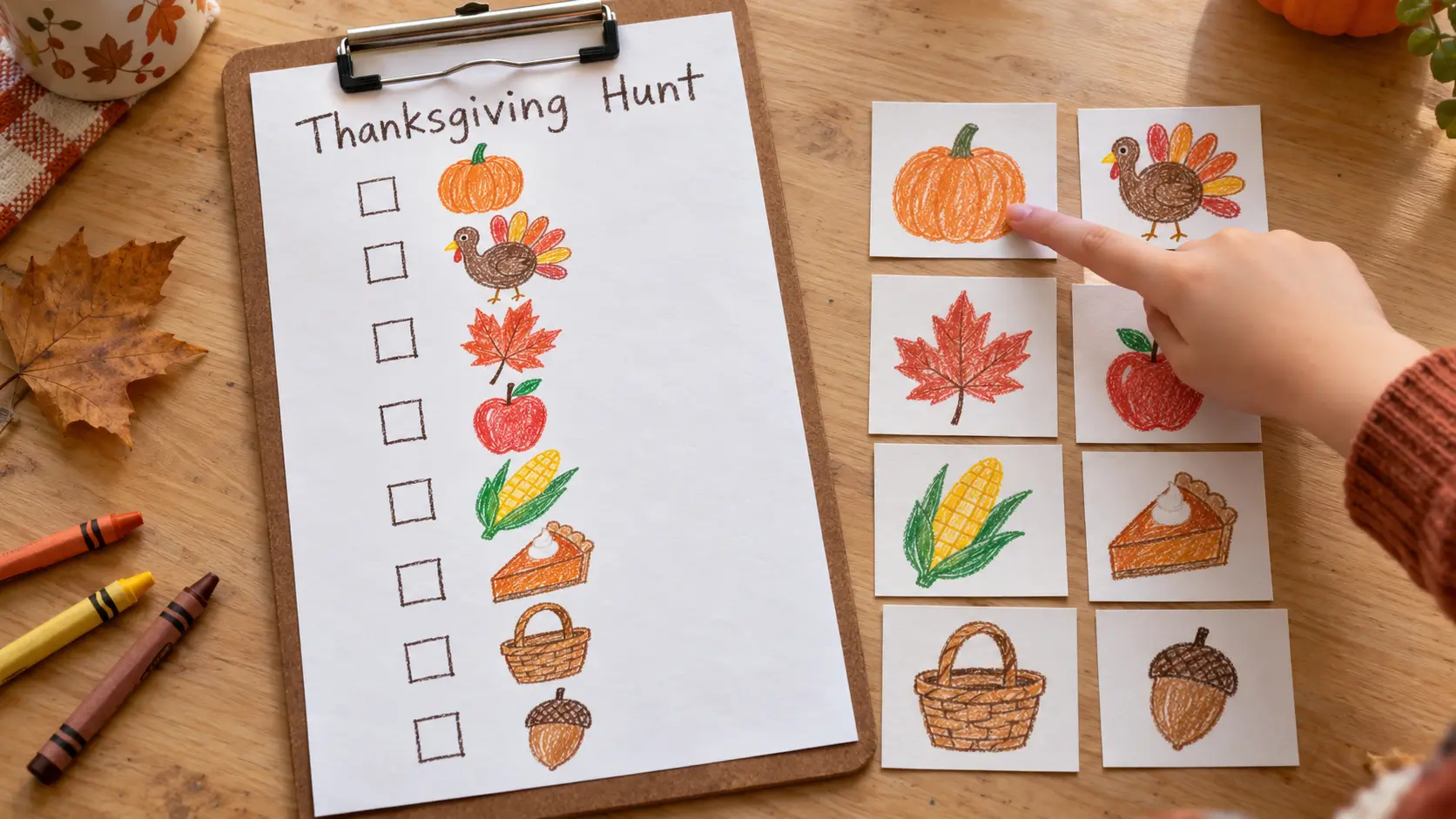
A Thanksgiving scavenger hunt is a game where children search a room or play area for hidden pictures or objects and check each one off a list. Start with paper, crayons, a homemade checklist, and eight matching picture cards. No printer or purchased kit is needed.
This guide walks through one complete setup, seven ways to adapt it, six original clues, and quick fixes for common problems. Choose the version that fits your space and group, from a family search to a cooperative classroom game.
What Is a Thanksgiving Scavenger Hunt?
In a basic Thanksgiving scavenger hunt, each child or team holds a checklist of drawings. Matching picture cards are placed around the play area. Children find a card, point to it, and mark the matching drawing on their list. The game ends when every box is marked.
A Thanksgiving picture scavenger hunt gives children something concrete to match. They compare the drawing on their checklist with a card, name what they found, and mark their progress. Add counting or clues when your group is ready.
Set Up Your Thanksgiving Scavenger Hunt: One Complete Example
Prepare this eight-picture set for the basic Thanksgiving scavenger hunt. Most variations reuse it; the counting version needs five separate quantity cards, and the household version uses objects or picture substitutes.
Draw the Eight Targets
Draw each picture large and simple, with bold outlines. Then copy all eight onto one sheet as a checklist, with a box beside each.
Use the table below as a drawing guide. It lists the targets; you will add the pictures yourself.
| Check | Target | Drawing description |
|---|---|---|
| ☐ | Pumpkin | Round orange body with curved lines and a short green stem |
| ☐ | Turkey | Brown oval body, small head, and a fan of colorful feathers |
| ☐ | Leaf | One pointed leaf in red or orange with a center vein |
| ☐ | Apple | Red circle with a small dip at the top, a stem, and one leaf |
| ☐ | Ear of corn | Yellow rows of kernels wrapped in green husks |
| ☐ | Pie slice | Triangle with a crust edge, filling lines, and a dot of cream |
| ☐ | Basket | Curved handle and crisscross woven lines |
| ☐ | Acorn | Round brown nut with a crosshatched cap |
The turkey and pie slice are drawings, so no real animals or food are involved.
Make the Matching Cards
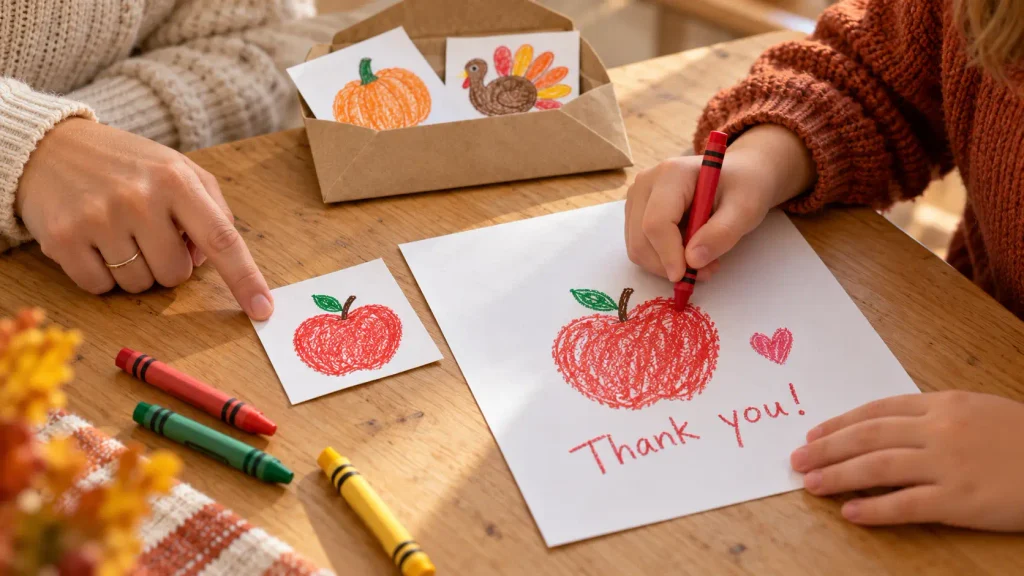
Draw each of the same eight pictures again on its own card, using the same shapes and colors as the checklist. Children who cannot read can then match picture to picture.
Words are optional; add them only if your group is ready.
Check Before You Start
Lay the checklist beside the cards and confirm that every target has exactly one card. This quick check helps prevent a Thanksgiving scavenger hunt for kids from ending with an impossible-to-find target.
Then agree on a play area, such as one room or one part of a classroom. Keep every card visible and reachable, with nothing hidden behind furniture or up high.
Cards Stay Put, Unless You Plan Otherwise
By default, children point to a card and mark their list, and the card stays where it is so every other player can find it too.
If you prefer a collect-the-cards version, prepare one separate set of eight for each child or team, with a colored dot on the back of each set. Or let the whole group share one checklist and one basket, and collect together.
Do not let individual children take cards from a single shared set, or the first finder removes everyone else’s targets.
How an Adult Runs It
- Gather the group and show the checklist. Explain the play area and the “walking feet” rule.
- Demonstrate one match: choose the pumpkin, find its card, point to it, say “pumpkin,” and mark the box.
- Let the children search. If someone misses an item, offer a hint such as “Try looking low, near the door.”
- When a child says they are done, compare their marks with the checklist. If a box is empty, search for that picture together.
- Call the end of the game, gather everyone, and name the eight pictures once together.
For safety, keep the Thanksgiving scavenger hunt in a clear walking area, keep cards away from stairs, climbing spots, and food preparation areas, and offer a seated or tabletop way to join.
Seven Ways to Play a Thanksgiving Scavenger Hunt
1. Picture-Matching Hunt for Nonreaders
Who it suits: Children who do not read yet, roughly preschool age.
Supplies: One picture-only checklist per child or pair, the eight cards, and crayons or stickers for marking.
Prepare: Leave the words off the checklist. Place cards at child eye level around the room.
Play: The child studies the first drawing, searches for the card that looks the same, points to it, and the adult names it. The child marks the box. The game ends when all eight boxes are marked.
Easy adjustment: Start with four cards and a matching four-picture checklist. Let the child hold the checklist beside each card to compare.
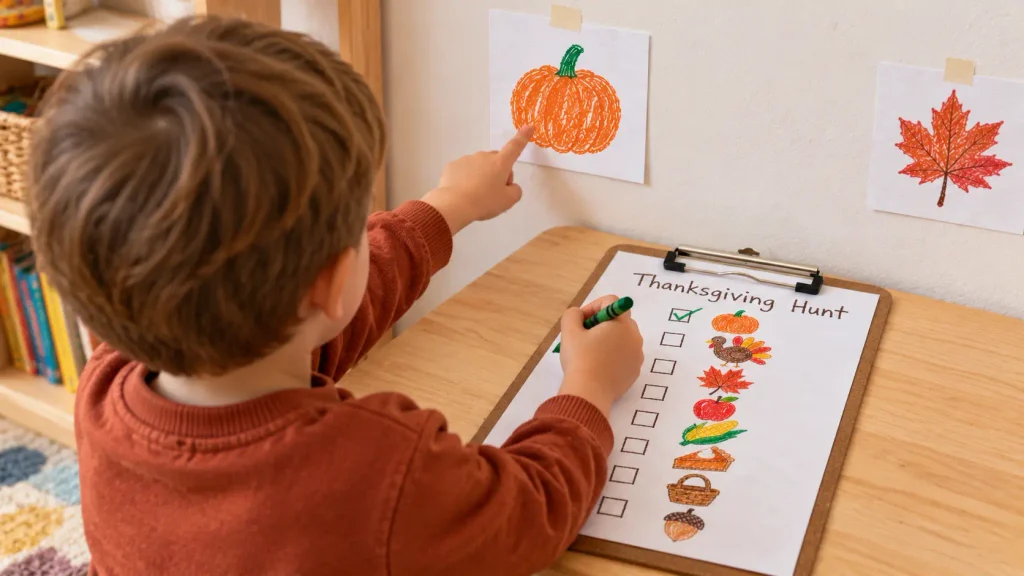
2. Cooperative Classroom Hunt
Who it suits: A class or co-op group of about 10 to 20 children, any reading level.
Supplies: One large checklist on chart paper, the eight cards, and stickers or a marker.
Prepare: Divide the room into four zones and place two cards in each. Form four teams as evenly as possible.
Rotate jobs such as searching, pointing, and marking so every child can take part. An adult can help each team confirm its matches.
Play: Each team searches its zone. When a card is found, the team points to it, then marks that picture on the class chart once.
A team that finishes early waits at the chart and names its two finds while the other teams continue. Cards stay in place throughout.
The game ends when the chart shows eight stickers and the class names them aloud together.
Easy adjustment: Let two teams search while the others complete a seated activity, then swap. Keep the four zones and give each team its own two targets. This is useful when planning Thanksgiving classroom activities in a smaller space.
3. Family Object Hunt at Home
Who it suits: Families with children of mixed ages who want something with no printing.
Supplies: A checklist, a crayon, and eight safe objects or picture substitutes.
Prepare: Check which targets you can represent at home. You might use a small basket, a paper leaf, a decorative pumpkin, a toy turkey, and drawings of an apple, corn, a pie slice, and an acorn.
Draw any missing item. Show children the objects and pictures before placing them so they know what counts as a match.
Avoid sharp, fragile, or small loose objects, and keep everything reachable.
Play: Search together with one shared checklist. When someone spots a target, point to it and mark its box, leaving the object in place.
The game ends when all eight targets are marked. Children can help put the supplies away afterward.
Easy adjustment: Leave items in plain view on a low shelf, with picture cards beside the checklist as hints.
4. Find and Count Hunt
Who it suits: Preschoolers and kindergartners working on counting from 1 to 5.
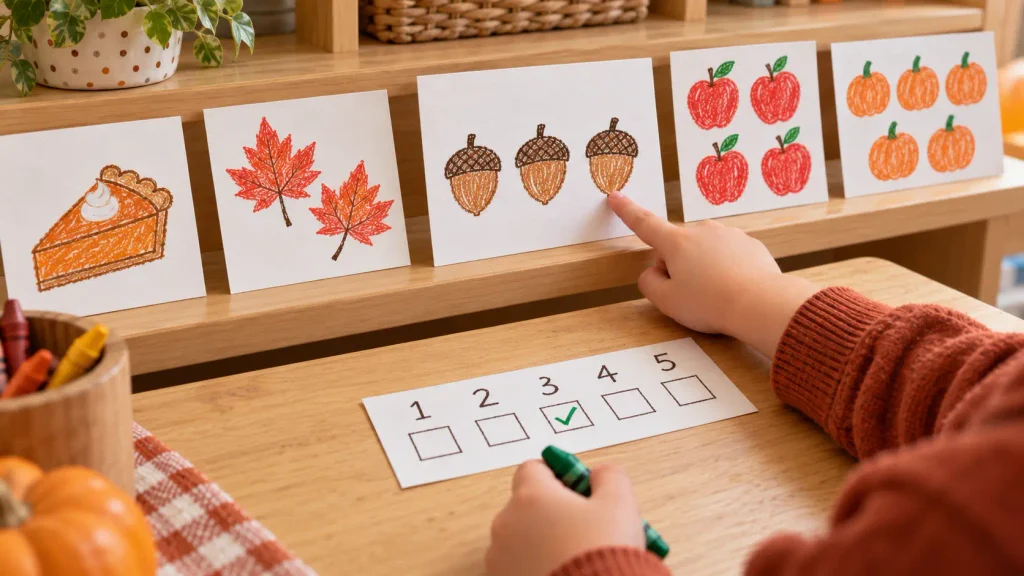
Supplies: Five cards with different quantities and a recording strip with five boxes labeled 1 to 5.
Draw these groups:
- One pie slice.
- Two leaves.
- Three acorns.
- Four apples.
- Five pumpkins.
This version uses its own cards, not the eight-picture set.
Prepare: Draw the groups neatly spaced so each item can be counted. Spread the five cards around the area.
Play: The adult says, “Find the card with three.” The child finds a card and touches each picture while counting aloud.
Confirm the quantity together, then help the child mark the box labeled 3. Call each quantity once, checking the corresponding box after a correct match.
The game ends when all five quantities are found.
Counting versus numerals: Counting a quantity means saying how many things there are. Recognizing a written numeral means linking a symbol like “3” to that quantity.
Start by speaking the numbers; later, hold up a written numeral instead.
Easy adjustment: Use only 1 to 3.
5. Simple Clue Hunt for Beginning Readers
Who it suits: Beginning readers, or any child who can listen to an adult read.
Supplies: The eight cards, the checklist, and six numbered clue slips.
Prepare: Write the six clues below. These are Thanksgiving scavenger hunt clues that describe the picture itself, not its location. Children use each clue to decide which picture they need, then search for that card.
Play: Read a clue, let the child decide the answer, find the card, and mark the box.
After six, the leaf and basket are still unmarked, so children find those two by looking at the checklist. The game ends when all eight are marked.
- I am big, round, and orange, and I grow on a vine.
- I have feathers and a fan-shaped tail, and I say “gobble.”
- I am a triangle with a crust, and I am served for dessert.
- I am a small nut with a cap, and squirrels like me.
- I have rows of yellow kernels and green husks.
- I am round and red or green, I grow on a tree, and I have a stem.
Answer key: 1 pumpkin, 2 turkey, 3 pie slice, 4 acorn, 5 ear of corn, 6 apple.
Easy adjustment: Read each clue aloud while the child holds the checklist, or show the checklist as a hint.
6. Tabletop Hunt
Who it suits: Children who prefer to sit, children with limited mobility, and small spaces.
Supplies: The eight cards, four extra picture cards showing a squash, cranberries, a mushroom, and a sunflower, a table or tray, and a checklist per child or pair.
Prepare: Spread all twelve cards face up without overlapping them. The four extra pictures are decoys and do not appear on the checklist.
Play: Nothing is hidden. Instead of moving through a room, the child scans, compares, and points. They look at a checklist drawing, point to its match on the table, and mark the box.
With a shared set, leave every card on the table for other players. If you prepare a separate set for each child, they may move their own matched cards onto a tray.
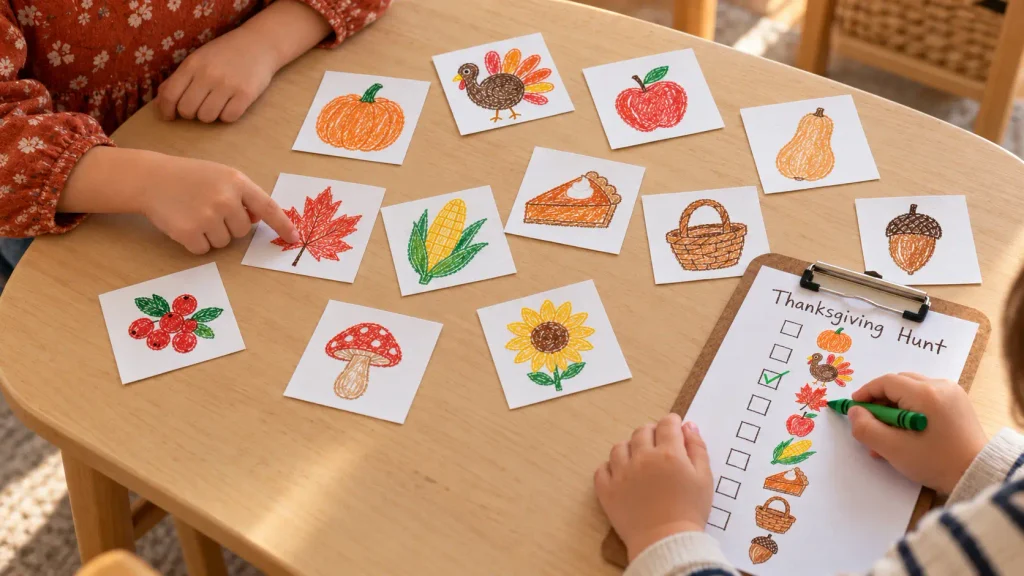
The game ends when all eight are marked.
Easy adjustment: Remove the decoys, or use four target cards with a matching four-picture checklist.
7. Gratitude Hunt and Share
Who it suits: Families or classes who want a calm ending, at any reading level.
Supplies: The materials for one version above, plus optional paper for drawing a thank-you.
Prepare: Choose one version of the Thanksgiving scavenger hunt and tell children that sharing is optional.
Play: Complete the chosen hunt first, following its usual finishing rule.
Then invite each child to choose one picture or object and share a brief thank-you connected to it, such as “I’m thankful for apples at snack time.”
Model one example, then let children speak, point, draw, or pass. Finish the sharing round after everyone has had the opportunity to participate.
Find more ways to continue in these gratitude activities for kids.
Easy adjustment: Share in pairs rather than with the whole group.
Compare the Seven Versions
| Version | Reading needed | Space | Preparation |
|---|---|---|---|
| Picture-matching | None | Room or area | Picture-only checklist and eight cards |
| Cooperative classroom | None, or mixed | Larger room with zones | Chart, cards, team labels |
| Family object hunt | None, or mixed | Home rooms | Gathering safe household items |
| Find and count | None | Small to medium | Five quantity cards, recording strip |
| Clue hunt | Beginning reading or listening | Room or area | Six clue slips and eight cards |
| Tabletop | None | One table | Eight cards plus a few decoys |
| Gratitude and share | None | Any | One base version, optional slips |
Troubleshooting Your Thanksgiving Scavenger Hunt
Even a well-planned Thanksgiving scavenger hunt hits a snag now and then. These quick fixes keep the game moving.
A target is missing. Pause the game and draw a quick replacement card together. Next time, run the checklist comparison first, and keep one spare drawing of each target ready.
A child finds the same picture repeatedly. Point to an unmarked box on the checklist and ask, “Can you find this one?” Offer a location hint for that specific target, such as “Look beside the bookshelf.” Keep the same cards and checklist throughout the round.
Several children crowd one location. Spread cards across more of the area, or use the zone method from Version 2. Another fix is a “one pointer, one marker” rule, so only two children are at a card at a time.
Players have different reading or mobility needs. Use the tabletop version so everyone can search the same reachable display. Partners can take turns pointing and marking. Picture-only checklists work for nonreaders, while an adult can read clue slips aloud when needed.
Ideas for After the Hunt
Follow With a Seated Game
A picture-search game pairs well with a seated one. Scavenger hunting means locating targets in a space, while bingo means matching pictures as someone calls them.
After your Thanksgiving scavenger hunt, try Thanksgiving bingo for kids, which has its own rules and setup.
An Optional Sunday School Extension
For Sunday school groups only, the Thanksgiving scavenger hunt can lead into a separate Bible activity.
Thanksgiving Bible crafts for kids includes a Scripture Memory Hunt in which children find paper leaves with parts of a Bible verse, then arrange them in order.
That is a different game from the picture hunt above, and it is entirely optional for general home or classroom use.
An Optional Number Hunt After the Game
For a seated follow-up, I created the Thanksgiving Number Hunt worksheets under my SmartPrint Kids name.
Children search for and color a target numeral within a worksheet. This purchased PDF is a separate number activity; prepare the picture cards and checklist for the room hunt using the instructions above.
After an active or tabletop Thanksgiving scavenger hunt, a child can settle in with one worksheet and look for a target number.
The resource includes:
- A digital PDF with 10 printable pages, covering numbers 0 to 9.
- Black-and-white pages with Thanksgiving-themed graphics.
- Children find and color the target number within each worksheet.
Choose a page with a numeral your child is practicing. The resource is suggested for preschool, pre-K, and kindergarten, with number practice also available to early elementary learners who need it.
If you would like to see more printables, you can browse the SmartPrint Kids store.
Frequently Asked Questions
Can preschoolers play a Thanksgiving scavenger hunt without reading?
Yes. A preschool Thanksgiving scavenger hunt works with a picture-only checklist and matching picture cards so children compare shapes and colors. An adult can name each picture as the child finds it.
Do I need a printer or a purchased printable?
No. Hand-drawn pictures on plain paper work well. Use the checklist table as a guide to draw eight targets, then make matching cards. The main game can be prepared entirely by hand.
How can several children use the same cards?
Leave cards in place and have children point and mark instead of taking them. If you want collecting, make one set per child or team, or collect as one group into a shared basket.
Can this work in a small room?
Yes. An indoor Thanksgiving scavenger hunt can use the tabletop version or a corner of the room. For a shorter game, prepare four target cards and a matching four-picture checklist.
Ready to Play Your Thanksgiving Scavenger Hunt
For your first Thanksgiving scavenger hunt, try the eight-picture matching version. Draw the checklist and cards, check every match, and demonstrate one find before children begin.
Keep the set in an envelope afterward so you can reuse it for a tabletop search or clue game another day.