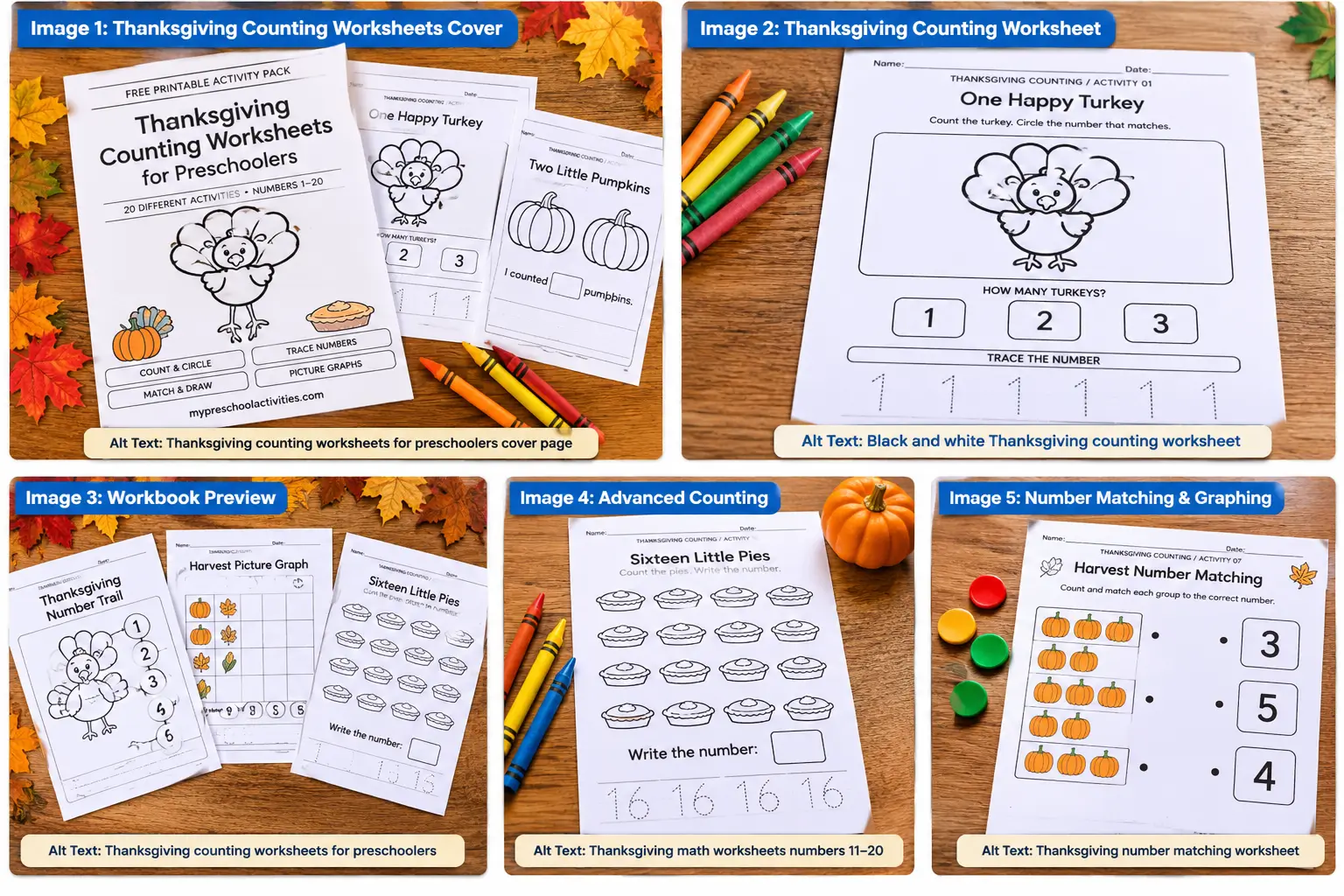
Looking for fun and free Thanksgiving counting worksheets for preschoolers? This printable activity pack makes early math practice more enjoyable with adorable turkeys, pumpkins, fall leaves, corn, pies, and harvest-themed counting activities.
Instead of repeating the same counting exercise, children get to explore numbers in different ways. They can count and circle the correct number, trace numerals, complete number sequences, compare groups, draw pictures, and create simple picture graphs.
Our free Thanksgiving counting workbook includes 20 worksheets covering numbers 1–20, plus a teacher guide and answer keys. The activities are designed for preschool, Pre-K, and kindergarten children, with easier counting pages for beginners and more challenging activities for children who are ready to work with larger numbers.
Best of all, the printable pages feature black-and-white illustrations that children can color themselves, making the pack both engaging and printer-friendly.
Download Your Free Thanksgiving Counting Worksheets PDF
Ready to make Thanksgiving math time more fun?
This free printable includes:
- 20 Thanksgiving-themed counting worksheets for numbers 1–20
- 1 teacher and parent instruction page
- 2 answer key pages
- 1 printable cover page
- Black-and-white illustrations suitable for coloring
- US Letter pages (8.5 × 11 inches)
You can download the complete PDF and print the pages that match your child’s current counting skills.
There’s no need to complete all 20 worksheets in one sitting. Start with a few pages, practice together, and return to the remaining activities throughout your Thanksgiving or fall learning unit.
What’s Included in These Thanksgiving Counting Worksheets for Preschoolers?
The complete printable has 24 pages, including the cover, teacher instructions, 20 student activity pages, and two answer key pages.
Each of the 20 worksheets focuses on a different number or counting challenge, giving children opportunities to practice several early math skills instead of simply counting identical picture groups.
Here is a closer look at the activities inside the workbook.
Numbers 1–5: Building Early Counting Confidence
The first five worksheets introduce small quantities using familiar Thanksgiving pictures.
Worksheet 1 — One Happy Turkey
Children count one friendly turkey, identify the numeral 1, circle the correct answer from three choices, and trace the number.
This page is a gentle introduction for children who are beginning to connect counting words with written numbers.
Worksheet 2 — Two Little Pumpkins
Children count and color two pumpkins, write the number they counted, and practice tracing 2.
The coloring step gives children an extra opportunity to connect each object with one number word.
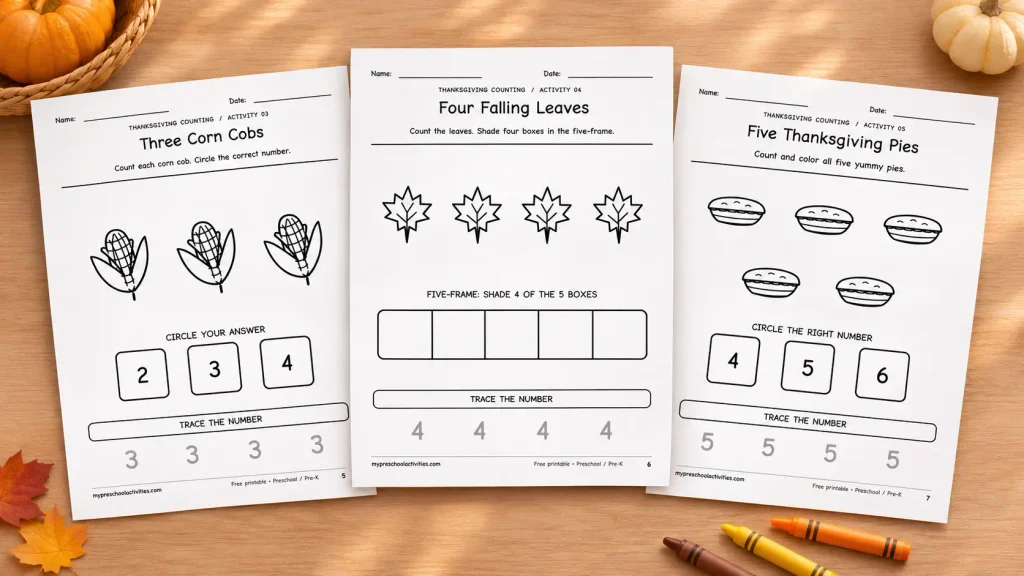
Worksheet 3 — Three Corn Cobs
Children count three corn cobs, circle the correct numeral, and trace the number 3.
Encourage children to point to each corn cob as they say the numbers aloud.
Worksheet 4 — Four Falling Leaves
Children count four fall leaves and shade four boxes in a five-frame.
This activity introduces an important early math representation: showing a quantity using a row of boxes.
Worksheet 5 — Five Thanksgiving Pies
Children count five pies, color the pictures, circle the numeral 5, and practice number tracing.
These first five activities work particularly well for beginners because the picture groups are small and easy to follow visually.
Teaching tip: If a child struggles to count the pictures, place the same number of physical counters on the table. Let them move one counter at a time before returning to the worksheet.
Numbers 6–10: Missing Numbers, Matching, and Graphing
Once children feel comfortable counting smaller groups, they can explore number sequences, comparing quantities, and organizing information.
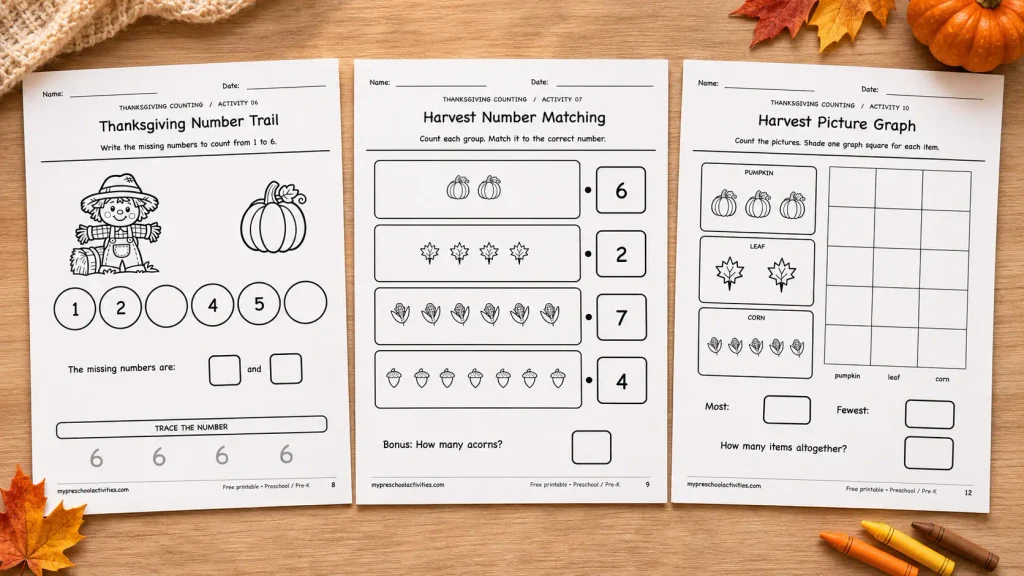
Worksheet 6 — Thanksgiving Number Trail
Children complete a number sequence from 1 to 6 by filling in the missing numbers.
The activity helps children practice number order and recognize which numbers come before and after a given number.
Worksheet 7 — Harvest Number Matching
Children count different Thanksgiving picture groups and match each group to the correct numeral.
This encourages careful counting and helps reinforce the connection between written numerals and quantities.
Worksheet 8 — Make Eight Leaves
Children begin with five illustrated leaves and draw three additional leaves to make eight.
The activity introduces a simple way to understand addition through drawing:
5 + 3 = 8.
Worksheet 9 — Which Patch Has More?
Children compare two pumpkin patches, count the pumpkins in each group, and circle the patch that has more.
This introduces the mathematical language of more, fewer, and comparing quantities.
Worksheet 10 — Harvest Picture Graph
Children count pumpkins, leaves, and corn, then shade graph squares to represent the quantities.
They also answer questions about which category has the most, which has the fewest, and how many items there are altogether.
This is a useful introduction to reading and creating simple picture graphs.
Numbers 11–15: Exploring Teen Numbers
Teen numbers can be challenging because children need to remember a longer counting sequence while beginning to understand how numbers greater than ten are organized.
The next five worksheets introduce larger quantities in manageable groups.
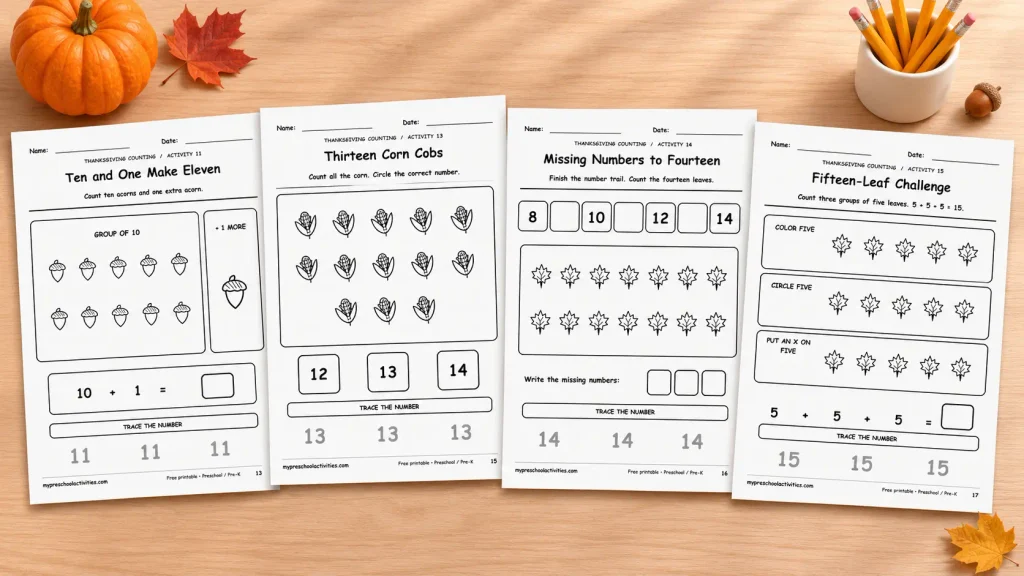
Worksheet 11 — Ten and One Make Eleven
Children count a group of ten acorns and one additional acorn.
They complete the equation:
10 + 1 = 11.
This helps them see that eleven can be represented as ten and one more.
Worksheet 12 — Ten Plus Two Makes Twelve
Children count ten pumpkins and two additional pumpkins to make twelve.
The activity continues the idea of building teen numbers from a group of ten.
Worksheet 13 — Thirteen Corn Cobs
Children count thirteen corn cobs arranged in rows and circle the correct numeral.
Grouping pictures into organized rows can help children keep track of objects without losing their place.
Worksheet 14 — Missing Numbers to Fourteen
Children complete the number sequence from 8 to 14 and count fourteen illustrated leaves.
The activity combines number order, number recognition, and counting quantities.
Worksheet 15 — Fifteen-Leaf Challenge
Children work with three groups of five leaves.
They color five leaves in one group, circle five in another, and put an X on five in the third.
Then they complete:
5 + 5 + 5 = 15.
This worksheet offers an introduction to equal groups and repeated addition while keeping the task visual.
For children who are not ready for teen numbers, these pages can be saved for later. It is more useful to build confidence with smaller numbers than to rush through difficult activities.
Numbers 16–20: Advanced Counting and Number Challenges
The final five worksheets provide more challenging practice for children who already recognize smaller numbers.
Worksheet 16 — Sixteen Little Pies
Children count sixteen pies arranged in four rows of four and write the total.
The organized picture layout helps children explore counting in groups.
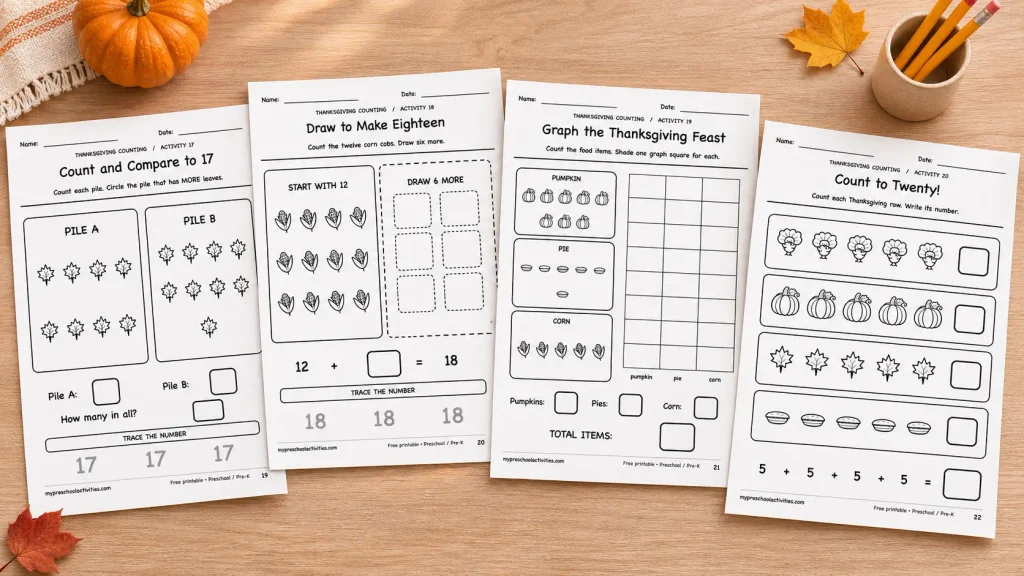
Worksheet 17 — Count and Compare to 17
Children count two groups of leaves, compare their quantities, and identify which group has more.
They also find how many leaves there are altogether.
Worksheet 18 — Draw to Make Eighteen
Children begin with twelve corn cobs and draw six additional corn cobs to make eighteen.
This combines counting, drawing, and simple addition.
Worksheet 19 — Graph the Thanksgiving Feast
Children count pumpkins, pies, and corn and represent the quantities on a graph.
They then record the number of items in each category and find the total.
Worksheet 20 — Count to Twenty!
Children count four groups of five Thanksgiving pictures: turkeys, pumpkins, leaves, and pies.
They write the number for each group and complete:
5 + 5 + 5 + 5 = 20.
This final worksheet gives children an opportunity to see how smaller equal groups can form a larger quantity.
Why Are Counting Worksheets Important for Preschoolers?
Learning to count involves more than memorizing number words.
A child might be able to recite numbers from one to ten but still have difficulty counting ten objects accurately. That’s because counting requires several skills to work together.
One-to-One Correspondence
One-to-one correspondence means matching one number word to one object.
For example, when counting five pumpkins, a child should touch each pumpkin once while saying one number word.
Children sometimes skip pictures or count the same object twice. This is a common part of learning.
Encourage them to slow down, point carefully, and count again when needed.
Number Recognition
Recognizing a written numeral is different from counting aloud.
A child may know how to count seven objects but not yet recognize the written number 7.
The tracing, circling, and matching activities in this workbook provide repeated opportunities to connect written numerals with actual quantities.
Understanding Quantity
Children also need to understand that the final number they say represents the total number of objects in a group.
After your child counts five pies, ask, “How many pies are there altogether?”
If they answer “five,” they are demonstrating an understanding of the quantity.
This concept is known as cardinality.
Comparing Numbers
Comparing quantities helps children understand relationships between numbers.
Activities such as Which Patch Has More? encourage children to think about differences between groups rather than simply naming numbers.
You can extend the activity by asking:
“How do you know this patch has more pumpkins?”
“How many more pumpkins does it have?”
“Could both patches have the same number?”
Fine Motor and Pencil Control
The workbook also includes opportunities for tracing, circling, drawing, and coloring.
These tasks help children practice controlling writing tools while reinforcing math concepts.
The goal is not perfect handwriting. Focus first on understanding the number and completing the counting task.
According to the National Association for the Education of Young Children (NAEYC), playful counting games can help children strengthen number recognition, one-to-one correspondence, and understanding of quantities.
Worksheets are most helpful when combined with real objects, conversation, and hands-on exploration.
How to Print the Free Thanksgiving Counting Workbook
Preparing these free printable Thanksgiving counting worksheets takes only a few minutes.
Step 1: Download the PDF
Use the download button near the beginning of this article to save the complete 24-page workbook to your device.
Step 2: Open the file
Open the PDF using a standard PDF viewer or your browser’s PDF reader.
Step 3: Choose your pages
You don’t need to print the entire workbook.
The PDF is organized as follows:
- Page 1: Printable cover
- Page 2: Teacher and parent instructions
- Pages 3–22: The 20 counting worksheets
- Pages 23–24: Teacher answer keys
Choose the worksheets that match your child’s learning level.
Step 4: Select the correct paper size
The workbook is formatted for US Letter paper, measuring 8.5 × 11 inches.
Choose Actual Size or 100% scale in your printer settings.
Step 5: Print in black and white
All worksheet illustrations are designed in black and white.
You don’t need color ink. Children can color the Thanksgiving pictures after completing the counting activities.
Step 6: Prepare your materials
Set out crayons, pencils, and a few counting objects such as blocks or large counters.
For reusable classroom activities, place the worksheets inside clear plastic sleeves and use dry-erase markers.
How to Teach Counting With These Thanksgiving Worksheets
The best way to use the workbook is to make counting an interactive experience rather than asking children to complete pages independently from beginning to end.
Here are three practical teaching approaches.
1. Begin With Real Objects
Before introducing a worksheet, choose a small group of physical objects.
For example, place four large blocks on the table.
Ask your child to count them slowly, moving each block to the side as they say the number.
Once they have counted all four blocks, ask:
“How many blocks do we have?”
Then show Worksheet 4, Four Falling Leaves.
Invite your child to count the four illustrated leaves and shade four boxes in the five-frame.
This creates a useful connection between touching real objects, recognizing pictures, and representing quantities.
For younger children, keep the quantity small and gradually increase it as their confidence develops.
2. Talk About the Pictures
Don’t rush straight to writing the answer.
Use simple questions to help children think about the numbers they see.
For example, on Five Thanksgiving Pies, ask:
“Can you point to the first pie?”
“Let’s count all the pies together.”
“What number should we circle?”
“How many pies would there be if we added one more?”
These conversations reinforce counting language and encourage children to explain their thinking.
If your child makes a mistake, invite them to count the pictures again instead of immediately providing the answer.
3. Turn Completed Worksheets Into Games
A worksheet doesn’t have to be used only once.
After completing a counting page, try turning it into a simple game.
For a count-and-circle activity, cover the numeral choices and ask your child to identify the quantity without looking at the answers.
For a picture graph, use blocks to build small towers that represent the quantities in each category.
For a missing-number worksheet, write the numbers on separate cards and have children arrange them in order.
These simple changes create extra learning opportunities without requiring additional worksheets.
Thanksgiving Counting Activities for Different Learning Levels
Children develop early math skills at different rates, so it’s helpful to adjust the activities to their needs.
Preschool Beginners: Numbers 1–5
For children who are just beginning to count objects, start with Worksheets 1–5.
Focus on accurate counting rather than speed or handwriting.
Use fingers, counters, and verbal answers when necessary.
A short activity involving one or two worksheets can be enough for a successful learning session.
Pre-K Learners: Numbers 1–10
Children who confidently count smaller groups can explore missing numbers, matching activities, simple comparisons, and the picture graph.
The number trail and harvest matching worksheets provide different ways to practice number recognition.
Encourage children to check their answers by recounting.
Kindergarten Learners: Numbers 11–20
For children who are ready for greater challenges, use the teen-number worksheets.
The activities involving ten acorns plus one, ten pumpkins plus two, and equal groups of leaves provide visual opportunities to explore larger quantities.
Introduce the pages gradually and keep physical counters available for support.
The age or grade label is only a guide. A child should use the activities that match their current abilities, even if that means practicing smaller numbers for longer.
Three Creative Ways to Extend the Printable Activities
You can build a longer Thanksgiving math lesson around the worksheets using simple materials you may already have.
Thanksgiving Harvest Counting Basket
Materials: A small basket, large pom-poms or blocks, and number cards from 1–10.
Place the number cards face down.
Ask your child to select one card and read the numeral with your help.
Then invite them to put that many counters into the basket.
For example, if the card shows 6, the child places six counters inside.
Count the objects together to check the answer.
For children who are ready, extend the activity to numbers 11–20.
Pumpkin Patch Comparison Game
Materials: Two paper circles, large orange counters, and number cards.
Use the circles to represent two pumpkin patches.
Place a different number of orange counters in each patch.
Ask children to count the pumpkins in both groups.
Then ask which patch has more and which has fewer.
After practicing with real counters, complete Worksheet 9, Which Patch Has More?
This helps children understand the comparison task before working with printed pictures.
Thanksgiving Table Counting Challenge
Materials: Plates, napkins, cups, and other safe household objects.
Invite your child to help prepare a pretend Thanksgiving table.
Ask them to count how many plates are needed for four people.
Then ask them to count the same number of napkins.
You can extend the activity with questions such as:
“If one more person comes to dinner, how many plates will we need?”
This turns an everyday routine into meaningful counting practice.
Use large, age-appropriate objects and supervise young children when using small manipulatives.
Tips for Parents and Preschool Teachers
Whether you’re using these worksheets at home or in a classroom, a few small adjustments can make the activities more enjoyable.
Keep Learning Sessions Short
Preschoolers often benefit from short, focused activities.
Instead of assigning several pages at once, begin with one worksheet and add another if your child remains interested.
Allow time for talking, counting, and coloring.
Encourage Children to Count Aloud
Ask children to say each number while pointing to an object.
This makes it easier to notice when they skip an item or count the same object more than once.
Use the Answer Keys as a Teaching Tool
The two answer key pages are designed for parents and teachers.
Use them to check completed activities and guide conversations about counting.
When a child gives an incorrect answer, encourage them to recount the pictures and explain their process.
Make the Activities Reusable
For classroom math centers, place selected worksheets into clear sleeves.
Children can use dry-erase markers to circle numbers, complete missing-number activities, and practice tracing.
Wipe the pages clean for another session.
Celebrate Progress
A child who accurately counts three pumpkins is practicing an important foundational skill, even if they aren’t ready to count twenty.
Celebrate careful counting, persistence, and willingness to try again.
More Thanksgiving Activities for Preschoolers
Once children finish their counting activities, you can continue the Thanksgiving theme with other printable learning ideas.
These activities offer simple ways to talk about kindness, thankfulness, and appreciation at home or in the classroom.
You can also try our Thanksgiving scavenger hunt.
A scavenger hunt encourages children to observe their surroundings, identify objects, and follow a visual checklist.
To add a math connection, ask children to count how many Thanksgiving-themed objects they discover during the hunt.
Combining crafts, movement, conversation, and printable worksheets helps create a varied Thanksgiving learning experience.
Frequently Asked Questions About Thanksgiving Counting Worksheets
Are these Thanksgiving counting worksheets free?
Yes! The complete 24-page Thanksgiving counting workbook is available as a free printable PDF on this page. It includes 20 activity worksheets, teacher instructions, answer keys, and a cover.
What ages are these counting worksheets suitable for?
The activities are designed primarily for preschool, Pre-K, and kindergarten learners, approximately ages 3–6.
Younger children can begin with numbers 1–5, while children who are ready for more advanced counting can practice numbers 11–20.
What math skills do these worksheets teach?
The workbook covers counting objects, recognizing numerals, tracing numbers, completing missing-number sequences, comparing quantities, matching numbers to sets, simple addition, and picture graphing.
Do I need to print these worksheets in color?
No. All the activity pages feature printer-friendly black-and-white illustrations.
Children can color the turkeys, pumpkins, leaves, corn, and pies themselves.
How many worksheets are included in the PDF?
There are 20 student worksheets, each with a different counting challenge. The complete PDF has 24 pages, including the cover, one teacher guide, and two answer key pages.
Can I print only the worksheets I need?
Yes. You can select individual pages when printing.
The student activities are on PDF pages 3–22, so you can choose the pages that match your child’s current learning level.
Can these worksheets be used in a preschool classroom?
Yes. They can be used for small-group math lessons, independent math centers, teacher-guided activities, or seasonal learning practice.
The teacher guide and answer keys make it easier to prepare and review activities.
What should I do if my child struggles with counting to 20?
Start with smaller quantities and use physical objects to make the numbers easier to understand.
Practice counting to five, then ten, before introducing larger groups.
Children develop at different rates, so there’s no need to rush through the workbook.
Can I reuse the printable worksheets?
Yes. Place the worksheets in plastic sleeves or laminate them and use dry-erase markers.
This is especially helpful for classroom centers or children who benefit from repeating the same activity.
Happy counting and happy Thanksgiving!