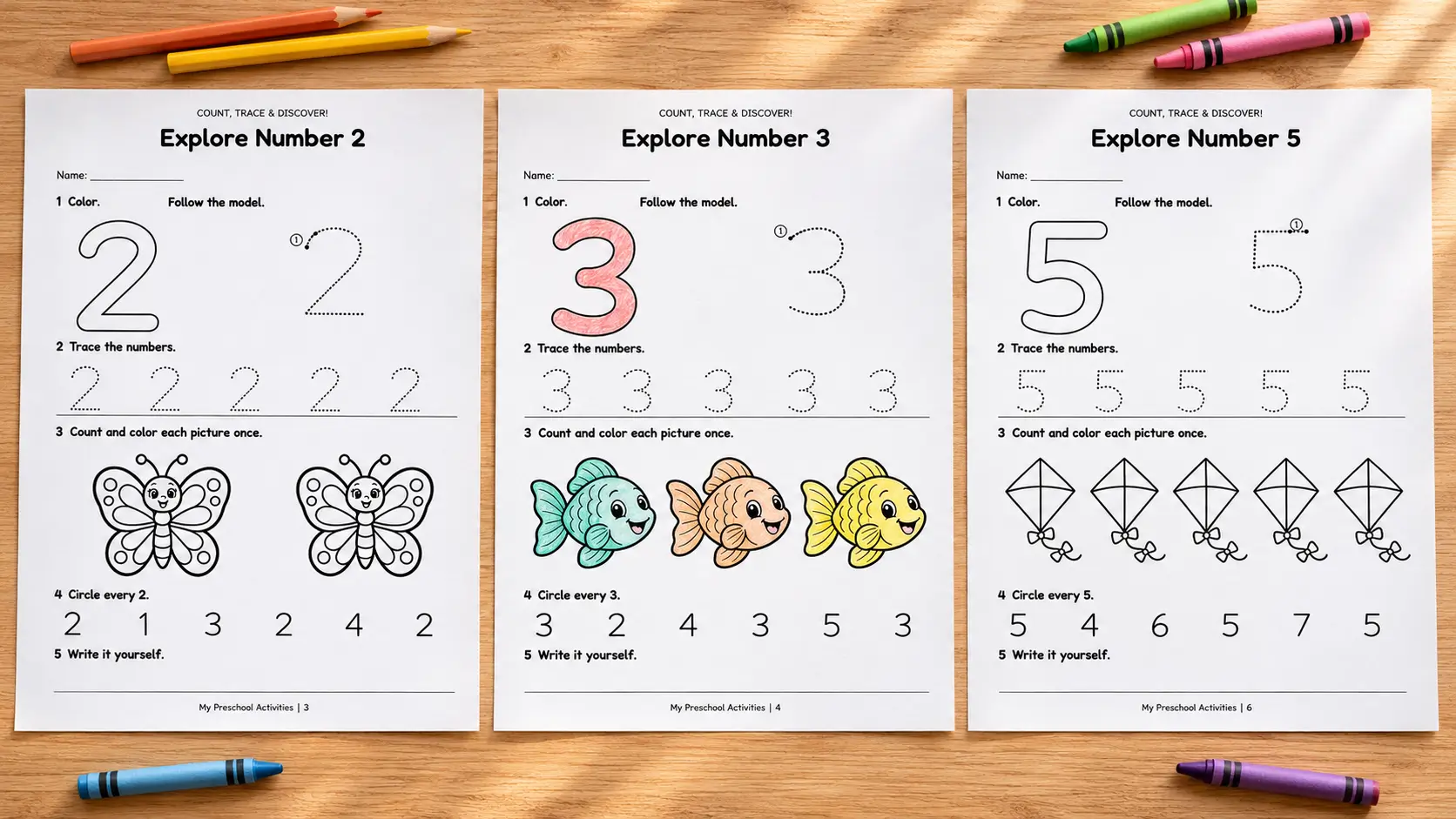
Two butterflies, three fish, five kites: a written number becomes more meaningful when a child can connect it with something to count. These free number tracing worksheets bring the numeral and its quantity together on one page, with coloring, dotted models, picture counting, a number hunt, and space to try writing.
The downloadable pack includes a worksheet for every number from 1 to 20. You can begin with one apple on the number 1 page, explore a few familiar numbers, or use the later pages with a child who is ready for larger quantities.
Below, you will find the exact PDF contents, a page guide, a short teaching routine, and seven hands-on activities. Choose the parts that fit your learner rather than treating the whole pack as a set to finish at once.
Download the Free Number Tracing Worksheets PDF
The Count, Trace & Discover! pack contains 27 US Letter pages:
- 20 number tracing worksheets, one for each number from 1 to 20.
- 5 mixed review pages for counting, matching, drawing, and number order.
- 1 teacher and parent guide, including brief answers for the review activities.
- 1 completed example showing the number 5 worksheet.
The activity pages are black and white. The completed example demonstrates tracing, circling, and writing; its coloring areas remain uncolored because coloring is optional.
Print only the pages you need. For example, the first five number sheets are PDF pages 2 through 6, while the review activities begin on page 22.
What Is on Each Number Worksheet?
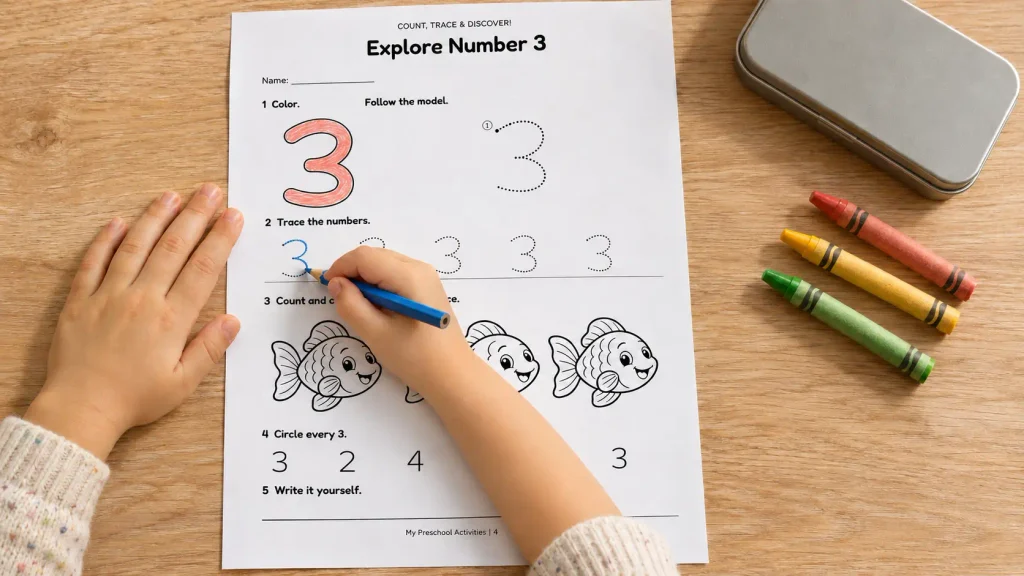
Each of the 20 number pages uses the same five numbered sections. Once an adult has introduced the layout, a child can return to a familiar routine with a different number.
1. Color the Numeral and Look at the Model
A large outline numeral provides space for coloring. Beside it, a dotted formation model shows starting points and directional guidance. For numbers with more than one stroke, the numbered starting points indicate separate movements.
Compare the two versions together. Ask, “Where will you begin?” Then demonstrate the movement on the dotted model before the child tries it.
2. Trace the Smaller Numbers
The next section contains five smaller dotted versions of the target number. A child can trace one, pause, and continue if interested. There is no need to complete all five in one sitting.
For two-digit numbers, model the left digit first and then the right digit. On the number 12 page, that means writing 1 followed by 2 to make twelve.
3. Count and Color the Pictures
The pictured objects match the target quantity. The number 2 page has two butterflies, the number 3 page has three fish, and the number 5 page has five kites.
From 6 onward, the pictures are arranged in rows of up to five. The number 12 page, for example, shows eggs in two full rows of five and a final row of two. This arrangement gives children a clear route to follow while counting.
4. Find the Matching Numerals
The instruction asks children to circle every occurrence of the target numeral in a mixed row. This is a recognition task: the child looks for the written symbol rather than counting a group of pictures.
Some distractors are outside the pack’s target range. For example, the number 20 recognition row includes 21 and 22. Those are comparison choices, not additional tracing worksheets.
5. Try Writing on the Blank Line
The final section provides a blank writing line. Children can look back at the models and copy the number. Independent pencil movement does not have to mean remembering the shape without support.
For an optional challenge, a confident learner can cover the model, try writing, and then uncover it to compare.
Number Tracing Worksheets: PDF Page Guide
Use this guide when printing selected pages. The worksheet number and the PDF page number differ because the adult guide comes first.
| PDF pages | Contents |
|---|---|
| 1 | Teacher and parent guide with brief review answers |
| 2–6 | Numbers 1–5 |
| 7–11 | Numbers 6–10 |
| 12–16 | Numbers 11–15 |
| 17–21 | Numbers 16–20 |
| 22 | Review: Count and Circle |
| 23 | Review: Missing Numbers |
| 24 | Review: Count and Draw |
| 25 | Review: Match the Groups |
| 26 | Review: Number Order |
| 27 | Completed Example: 5 |
The pack includes 20 number worksheets, not 27 separate number worksheets. The remaining seven pages provide review, adult guidance, and the example.
How to Use Number Tracing Worksheets in a Short Session
Set out one page, a comfortable pencil or crayon, and a small collection of blocks or other suitable counting objects. Start with a number the child already encounters in play.
Begin with a Real Quantity
Before offering the number 3 worksheet, place three blocks on the table. Invite the child to move or touch each block while counting. Then point to the printed 3 and name it.
Keep the explanation concrete: “Here are three blocks. This is how we write three.”
Demonstrate One Movement
Follow the starting point and arrows on the large model. Let the child watch once, try the motion with a finger, and then trace with a drawing tool.
Use brief directions that match the movement. Avoid adding a long rhyme or several instructions while the child is already concentrating on the pencil.
Connect Counting and Tracing Numbers
Move between the numeral and the pictured quantity. On the number 5 sheet, count the five kites and then find a printed 5 elsewhere on the page.
Ask, “Can you show me five blocks too?” This adds a second example of the same quantity without asking the child to write another row.
Finish with Recognition or Copying
Choose the number hunt, the writing line, or both. A child who has enjoyed tracing may want to try copying. Another child may prefer finding matching numerals.
You can leave the page unfinished and return later. The aim is useful practice with the number, not completing every section on a schedule.
Choosing a Number Range: 1–5, 6–10, or 11–20
Start with Numbers 1–5
Offer small quantities that are easy to handle and check. Use one apple picture, two butterflies, or three fish from the first pages as conversation starters.
If counting is the main interest, spend more time with the pictures and real objects. If making marks is the interest, try one large model and a short trace. The same sheet can support different amounts of participation.
Explore Numbers 6–10
These preschool number worksheets introduce additional rows of pictures. Show how to move across the first row and then begin the next without counting the same object twice.
The number 10 sheet has ten flowers in two rows of five. You can count each flower once, then look at the written 10. Explain that the two digits work together to represent ten.
Offer Numbers 11–20 When They Fit
Larger numbers ask children to keep track of more objects and write two digits. Keep counting and writing as separate tasks when that is helpful.
For 12, count the eggs row by row. A child who is ready can discuss ten eggs in the first two rows and two more in the last row. Another child can simply count all twelve from the beginning.
These number tracing worksheets for kindergarten can also be used selectively. A learner might need a closer look at 14 or 17 without repeating every earlier page.
What the Five Review Pages Actually Include
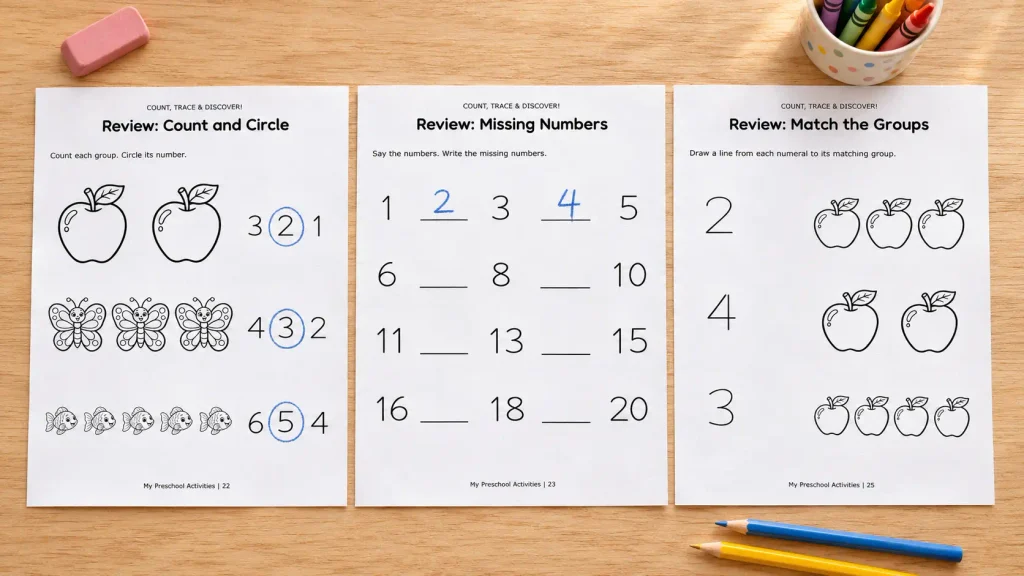
Count and Circle: PDF Page 22
Children count two apples, three butterflies, and five fish, then circle the matching numeral beside each group. Read the instruction aloud and demonstrate how to choose one answer for a group.
Missing Numbers: PDF Page 23
Four rows cover the sequence from 1 to 20. Children fill the gaps while using the printed numbers as clues.
The missing entries are 2, 4, 7, 9, 12, 14, 17, and 19. If four rows feel like too much, cover the lower rows and begin with the first five numbers.
Count and Draw: PDF Page 24
Children trace 1, 2, 3, and 4, then draw that many objects in the corresponding boxes. Simple dots, circles, or short marks work well; detailed pictures are unnecessary.
Match the Groups: PDF Page 25
The numerals 2, 4, and 3 appear beside apple groups arranged in a different order. Children draw lines to connect each numeral with its matching quantity.
Count first, then draw the line. The task is matching amounts, not connecting items that happen to share a row.
Number Order: PDF Page 26
Children fill the missing odd numbers in the 1–10 sequence and trace the even numbers already shown. A second instruction asks them to write 2, 4, 6, 8, and 10 below.
The even-number extension may suit a different stage from the basic counting pages. Introduce it separately or leave it for another day.
7 Hands-On Activities to Pair with Number Tracing Worksheets
The following activities use extra materials. Their cards, floor labels, and playdough mats are optional additions, not pages included in the PDF.
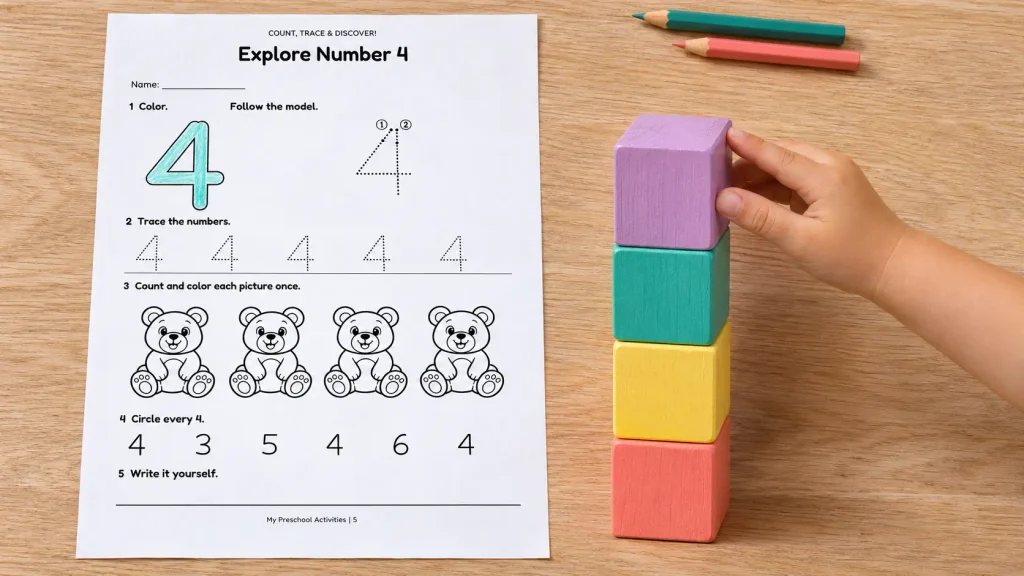
1. Build a Matching Block Tower
Choose a worksheet and place the matching number of blocks beside it. Count while building a tower, then check the finished tower by touching each block.
For the number 4 page, compare four blocks with the four pictured bears. Ask what stays the same even though the objects look different.
2. Make a Counting Collection
Give the child a small basket of large, age-appropriate objects. Ask them to choose the quantity shown on the page and move each selected object onto a separate mat.
Keep extras in the basket so the child has a reason to stop at the target number. Avoid small loose pieces with children who mouth objects.
3. Shape a Playdough Numeral
Roll dough into ropes and arrange them into the numeral, using the worksheet as a nearby reference. Keep the dough on a separate mat.
Then make the matching number of dough balls. For 3, the child can build the shape of 3 and place three balls beside it.
4. Count Crayons Before Coloring
Ask the child to select a small number of crayons before coloring the outline numeral. With the number 2 page, choose two crayons and name the quantity together.
For larger numbers, choose another counting object rather than requiring twenty different crayons.
5. Find a Number in the Room
Look for the target numeral on a calendar, book page, or classroom label. Compare it with the model on the worksheet.
Printed numerals may use different styles. Notice recognizable parts without expecting every example to look exactly like the tracing model.
6. Walk a Short Number Path
Write 1 through 5 on separate cards and secure them to a clear floor area. Invite the child to step beside each card while saying its number.
Ask them to find the number from today’s worksheet. Extend the path only when the smaller sequence is familiar.
7. Make the Quantity Another Way
Show three blocks in a row, then rearrange the same blocks into a triangle. Ask whether there are still three and check together.
This offers a useful change from the PDF’s regular picture rows. You can explore the same quantity in several arrangements without adding more handwriting.
For activities with a different hand movement, explore these fine motor skills worksheets, including tracing paths, paper activities, and dough play.
Counting, Numeral Recognition, and Writing Are Different Tasks
A child may name a printed 6 but still need help counting six objects. Another may collect six blocks accurately while finding the written shape difficult. Notice which part of the activity needs support.
NAEYC’s number and counting games offer related practice with matching number words to objects, recognizing quantities, and connecting amounts with written numerals. These ideas explain why the printable pairs handwriting with counting rather than relying on tracing alone.
After counting, ask how many objects there are altogether. Repeating the total can help connect the last count word with the whole group. A child who recounts may still be developing that connection; one response is not a complete assessment. Observe across several everyday situations. NAEYC
Adjusting the Number Tracing Worksheets
For an easier start, offer one number, one tracing attempt, and a small counting collection. Leave the printed model visible. Demonstrate beside the child and let them choose whether to try with a finger, crayon, or pencil.
For an extension, ask the child to draw a new matching quantity, find one more object, or compare two collections. You can also invite them to copy the numeral and check it against the model afterward.
If a numeral is reversed, compare its direction with the printed model and demonstrate again. Keep the feedback specific to the shape rather than treating one reversed numeral as evidence of a wider difficulty.
Printing and Reusing the Number Tracing Worksheets
Print on US Letter paper, 8.5 × 11 inches, using Actual Size or 100% scale, as the PDF guide specifies. Test one page before printing a larger selection.
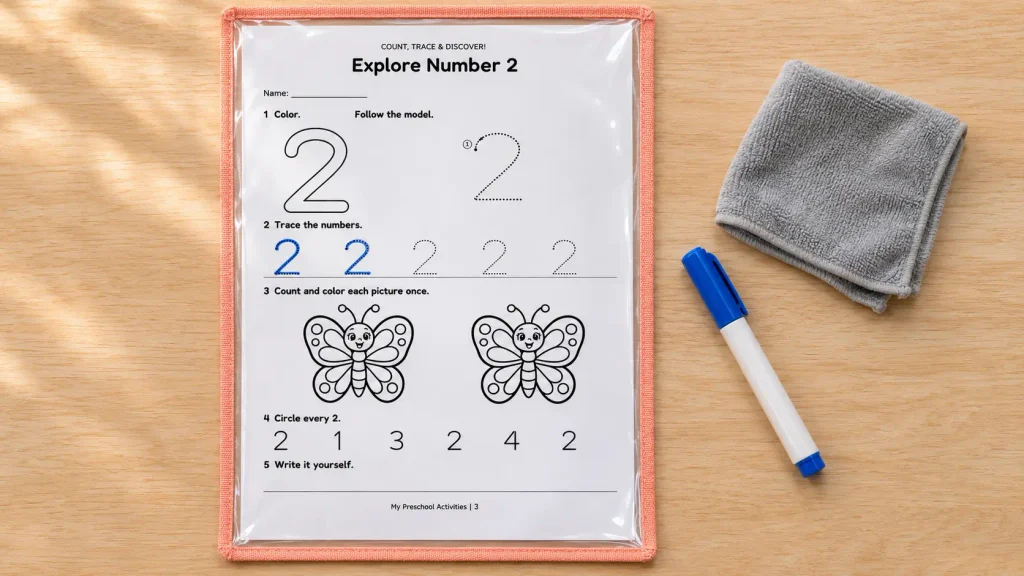
For repeated tracing, place a sheet inside a suitable wipe-clean pocket or laminate it. Use a compatible dry-erase marker and check that it wipes off cleanly. Keep coloring pages on ordinary paper when children want to keep their artwork.
Separate the adult guide and completed example from the blank activity pages. The guide includes review answers, so keep it nearby for checking rather than handing it out as a worksheet.
At home, store a few selected pages with a pencil and counting objects. In a classroom, offer a small selection at a math center and rotate the numbers according to the current activity.
Frequently Asked Questions
Are these number tracing worksheets free?
Yes. The free PDF contains 27 pages: 20 number sheets, five review pages, an adult guide, and a completed example.
Does the printable cover zero?
There is no separate zero worksheet. The target numbers are 1 through 20, although zero appears within numbers such as 10 and 20 and as a recognition distractor on the number 1 page.
Do children need to complete numbers 1–20 in order?
No. Start with a suitable quantity and use the pages selectively. You can revisit a familiar number or print one sheet for a particular activity.
Does the PDF include answers?
The adult guide includes brief answers for the five review pages. The final page shows a completed number 5 example. It does not provide a separate worked answer sheet for every number worksheet.
Can a child copy instead of writing from memory?
Yes. The blank writing line can be used while the printed models remain visible. Covering the model is an optional extension.
Are ten frames included?
No. The PDF uses counted picture groups, including rows of up to five objects. You can draw a separate ten frame if you want that additional support.
What can we do after these worksheets?
Continue with counting collections, number hunts, drawing quantities, and other preschool learning activities. Choose the next task according to what the child enjoys and can explore with useful support.
Choose One Number to Explore
Begin with a quantity your child can investigate: two crayons, three blocks, or five kites on a page. Count it, look at its numeral, and try a short trace or copy.
These number tracing worksheets give you a consistent way to return to that connection, with different numbers and familiar page sections. Print a small selection, keep the models available, and add real objects whenever they help explain the quantity.