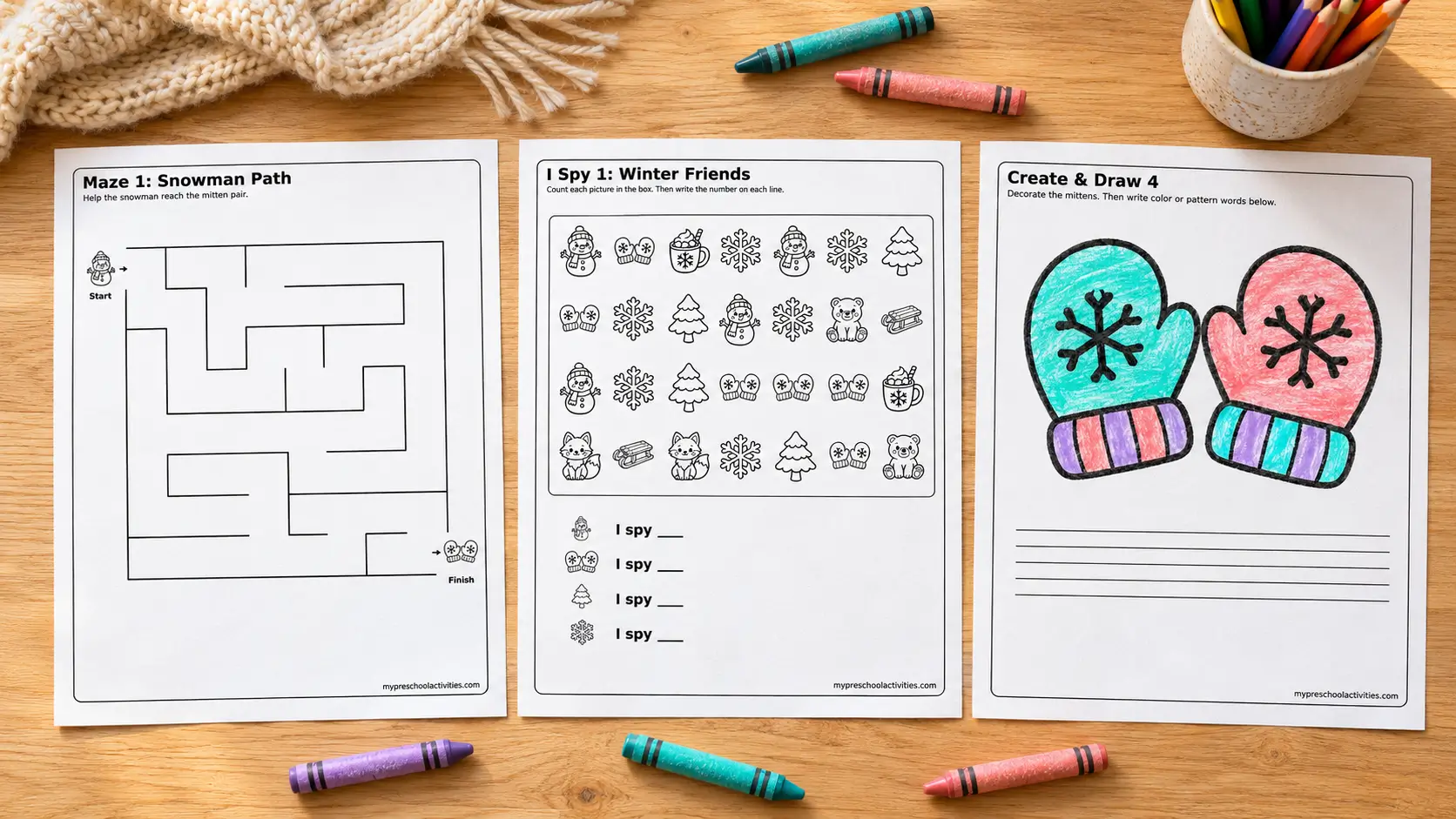
Looking for a winter break activity pack for kids that you can print a little at a time? This free PDF brings together 30 activities, including snowy mazes, winter I Spy pictures, tracing, counting, letter practice, drawing, and matching.
The complete download has 52 pages: one instruction page, 30 activity pages, and 21 answer-key pages. Use the page guide below to choose a starting point, then follow the optional seven-day plan or make your own combination.
The activities offer different levels of challenge for preschool and early kindergarten. Children can point, trace with a finger, draw, count aloud, or write, depending on the page and the support they need.
Download Your Free Winter Break Activity Pack for Kids
The winter break activity pack for kids is a single printable PDF designed for US Letter paper, 8.5 × 11 inches. The children’s activity pages are black and white. Answer pages use colored markings to show solutions.
You can print only the activities you want. Pages 2 through 31 contain the children’s worksheets; pages 32 through 52 contain the answers. Keep the answer pages on your device if you would rather save paper.
What Is Included? A Guide to All 52 PDF Pages
Use these PDF page numbers in your print settings. They refer to the page position in the file, including the opening instruction page.
| Activity group | Number of activities | PDF pages | What children do |
|---|---|---|---|
| Winter mazes | 6 | 2–7 | Follow a route between winter characters and objects |
| Winter I Spy | 4 | 8–11 | Find and count selected pictures |
| Tracing | 5 | 12–16 | Follow straight lines, curves, zigzags, loops, and circles |
| Shapes and counting | 4 | 17–20 | Count pictures, count shapes, and match shapes |
| Alphabet activities | 4 | 21–24 | Find W, match uppercase and lowercase letters, and explore beginning sounds |
| Creative drawing and writing | 4 | 25–28 | Add winter details, draw a scene, and describe or label it |
| Picture matching | 3 | 29–31 | Match winter animals, objects, and silhouettes |
| Answer keys | 21 | 32–52 | Check mazes, I Spy, counting, shapes, alphabet, and matching |
Page 1 contains the adult instructions and contents overview. Tracing and creative drawing pages do not have separate answer keys.
The illustrations include snowmen, polar bears, Arctic foxes, hares, owls, seals, mittens, sleds, cabins, evergreen trees, and winter objects. Some pages also contain gifts and wreaths, so preview the selection if you want activities without holiday imagery.
How to Print and Prepare the Winter Worksheets
Start by opening the PDF and choosing a few pages from the guide. A pencil, crayons, and ordinary printer paper are enough for the main activities.
- Select your page range. For example, print pages 2–7 for the six mazes or pages 29–31 for matching.
- Choose US Letter paper. Start with 100% or Actual Size and check the print preview.
- Check the whole border. If your printer clips an edge, use its fit-to-printable-area option and test one page. For A4 paper, use the preview to check the fit before printing more.
- Keep the answers separate. Print them only if you need a paper copy.
- Set out a small selection of tools. Offer a pencil and a few crayons rather than a crowded tray.
For repeated practice, place a worksheet in a clear reusable sleeve and use a suitable dry-erase marker. Drawing pages can stay on ordinary paper so children can keep their finished work.
Explore the Seven Types of Free Winter Printables for kids
Each section below explains what is actually on the pages and gives a practical way to introduce it. Your winter break activity pack for kids can be a short daily choice rather than a workbook to finish in order.
1. Winter Maze Printables: Six Snowy Routes
Print PDF pages 2–7. Answer keys: pages 32–37.
The six winter maze printables have different starting characters and destinations. The snowman heads toward a pair of mittens, the polar bear toward a snowflake, and the Arctic fox toward a cabin. Other pages feature a hare, a sled, and an owl.
Begin by finding the start and finish together. Invite your child to point to each one before choosing a route. They can try the path with a finger first, then use a pencil or crayon.
If a route stops, retrace it to the last opening and try another direction. Keep the answer key nearby for an adult check rather than showing the solution before the child explores.
For a child who finds the maze crowded, work together on the first few turns. For a different challenge, ask them to describe part of the route using words such as up, down, left, and right.
2. Winter I Spy Printables: Find, Count, and Record
Print PDF pages 8–11. Answer keys: pages 38–41.
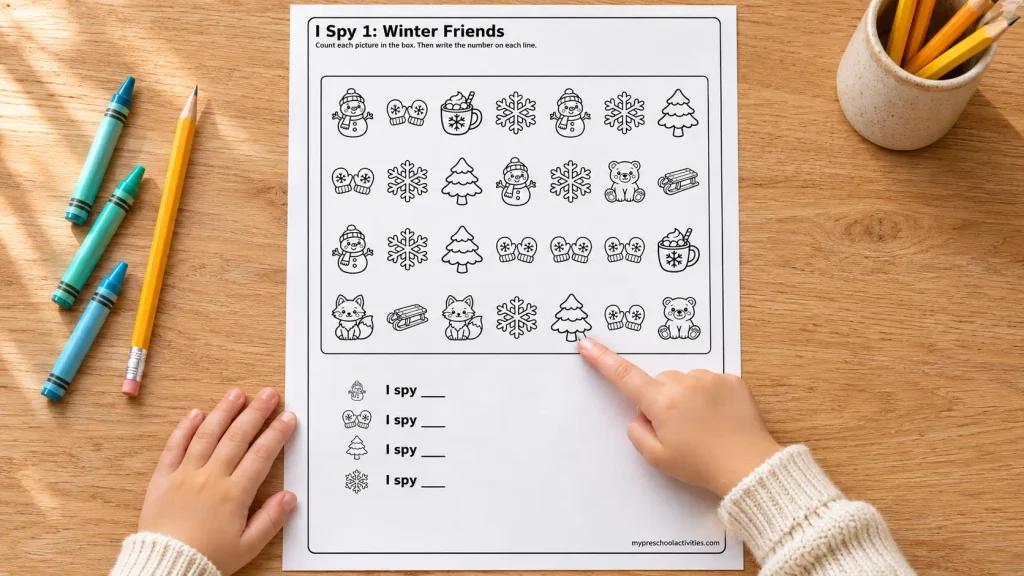
The four winter I Spy printables contain boxes of repeated pictures with selected target images beneath them. Children count the matching pictures inside the large box and record each total on the line.
For example, Winter Friends on page 8 asks children to find snowmen, mitten pairs, trees, and snowflakes. There are four snowmen, six mitten-pair pictures, four trees, and six snowflakes in the box.
Explain that the small pictures beside the answer lines show what to find. They are not part of the count. A mitten pair also counts as one matching picture for this worksheet.
Try one target at a time. Children can lightly mark each matching picture as they count, using a different color for the next target. If writing numbers is difficult, let them say the total while an adult records it.
After the counting is finished, children can color the pictures. A color clue such as “Find something blue” becomes an optional game once there are colored objects to find.
3. Winter Tracing Worksheets: Lines, Curves, and Loops
Print PDF pages 12–16.
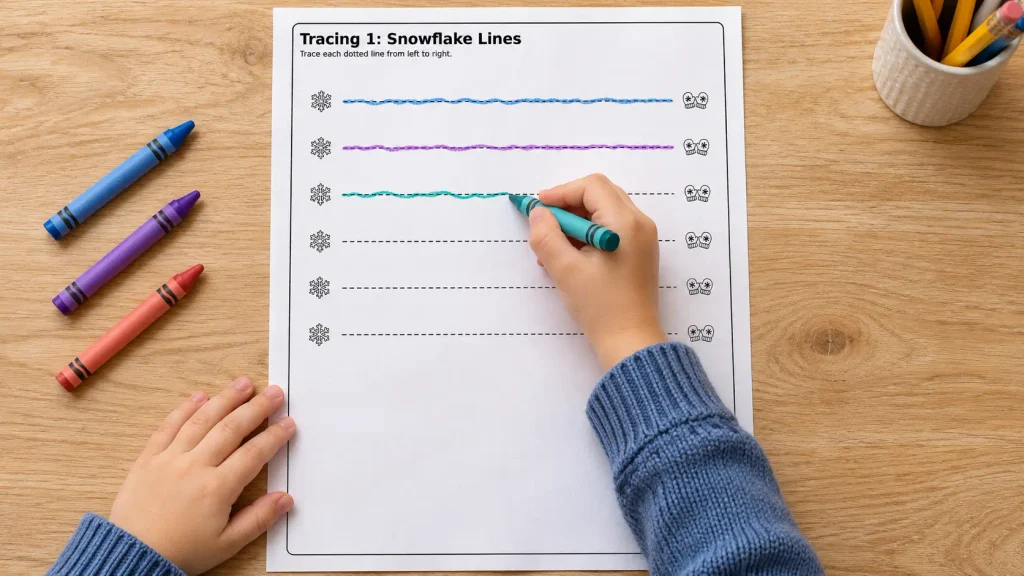
The five winter tracing worksheets offer different movements: straight snowflake-to-mitten lines, winter curves, sled trails, snowball loops, and a mixed pattern page.
On page 12, children follow horizontal dotted lines from left to right. On page 14, the sled trails include zigzag and curved routes. Page 15 provides circles to trace, while page 16 brings several line and shape patterns together.
Point to the beginning of one trail and follow it slowly with a finger. Then offer a crayon or pencil. Children can complete a single row and return to the rest later.
The aim is to explore the movement shown on the page. There is no need to erase every wobble or fill every row in one sitting. For an extension, invite the child to draw a similar trail on blank paper.
4. Shapes and Counting: Pictures, Totals, and Matching
Print PDF pages 17–20. Answer keys: pages 42–45.
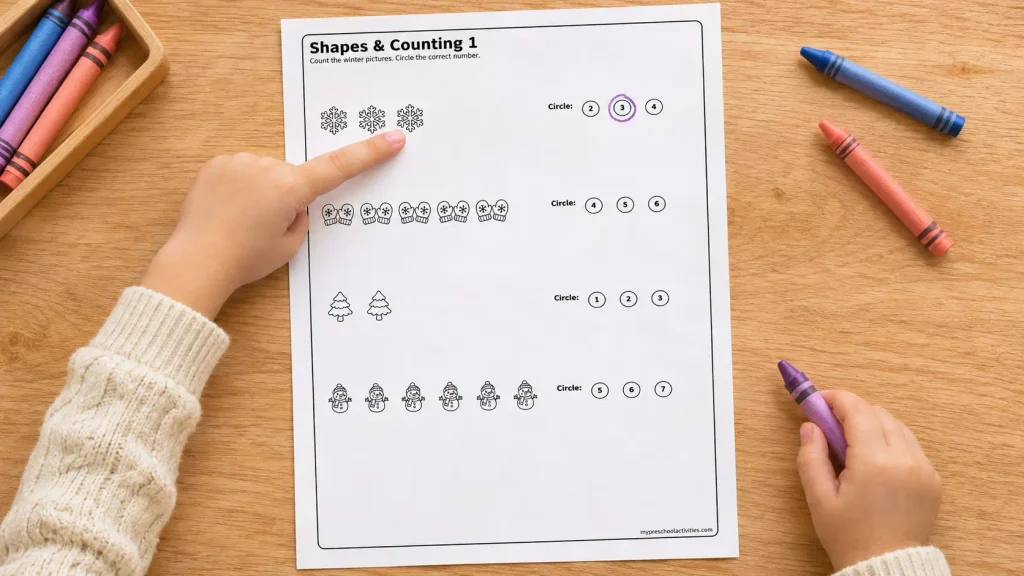
This group includes four different tasks. Page 17 asks children to count pictures and circle a number. Page 18 asks them to write totals. Page 19 contains a mixed collection of shapes to count, and page 20 asks them to connect matching shapes.
Begin with a row on page 17. Touch each picture once while counting aloud, then look at the number choices. The snowflake row has three pictures, so children circle 3.
On page 18, the first row contains four foxes. Children can count aloud before writing 4 in the box. If they are still learning numeral formation, an adult can record the number or offer a separate numeral card to copy.
Save the mixed-shape counting page for a child who is ready to search a busier arrangement. Cover the answer boxes for other shapes while focusing on one type, then uncover the next.
5. Alphabet Activities: Letter Shapes and Beginning Sounds
Print PDF pages 21–24. Answer keys: pages 46–49.
These pages combine letter recognition with matching and sound activities. Page 21 asks children to find uppercase W in a letter grid. Page 22 matches uppercase and lowercase forms, including W/w, S/s, M/m, F/f, T/t, and C/c.
For the W search, show one example and invite your child to look for the same shape. They can point first and circle it afterward. This task is about recognizing the printed letter.
For uppercase and lowercase matching, choose one pair to introduce before asking the child to connect the others. Read the letter names together as needed.
The remaining pages introduce beginning sounds. Page 24 asks children to find pictures whose names begin with S, including snowman, sled, seal, and snowflake. Name each picture aloud before asking the child to listen for the first sound.
Keep letter names and word sounds distinct. A child can recognize a letter shape before being ready to identify that sound in spoken words, so choose the task that fits their current experience.
6. Creative Drawing and Early Writing: Four Winter Prompts
Print PDF pages 25–28.
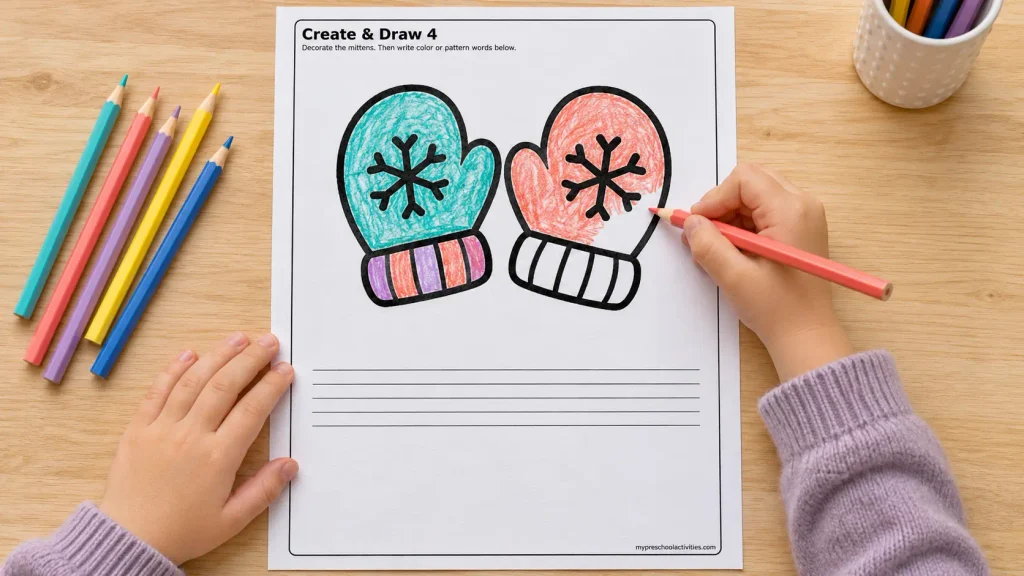
These pages leave room for children’s own ideas. The prompts invite them to add details to a snowman page, draw what a polar bear sees in the snow, illustrate a favorite winter activity, and decorate mittens.
On page 25, a snowman sits beside a drawing box with space for extra winter details. A child might add snowflakes, a hill, a friend, or a cabin.
On page 26, the polar bear prompt leaves the scene open. Ask, “What do you think the bear can see?” Let the answer guide the drawing rather than supplying a model to copy.
The writing lines are optional for children who are not writing independently. They can dictate a sentence, add a label, make early writing marks, or simply explain their picture aloud.
On page 28, children can decorate the large mitten shapes and describe their colors or patterns. An adult can write a short dictated phrase beneath the picture if the child wants.
7. Winter Picture Matching: Animals, Objects, and Shadows
Print PDF pages 29–31. Answer keys: pages 50–52.
The first two matching pages ask children to connect identical pictures. Page 29 features winter animals, and page 30 features objects such as mittens, cabins, sleds, gifts, and wreaths.
The third page changes the task: children connect each picture to its matching silhouette. It includes a winter bird, a mug, a tree, and a snowman.
Start with one picture on the left. Ask your child to find the same one on the right before drawing a line. A finger can follow the connection first if several crossing lines would become confusing.
For shadow matching, talk about the outline: “Which one has branches?” or “Where can you see the handle?” Encourage the child to explain one choice in their own words.
A Simple Seven-Day Plan for Your Winter Break Activity Pack for kids
This plan uses one activity group each day. It is a suggested routine, not a schedule children need to complete. Swap days, repeat a favorite, or choose fewer activities.
| Day | Printable choice | Optional activity away from the worksheet |
|---|---|---|
| 1 | One maze from pages 2–7 | Make a route for a toy using cushions or large blocks |
| 2 | One I Spy page from pages 8–11 | Play I Spy with objects around the room |
| 3 | One tracing page from pages 12–16 | Draw big zigzags and curves in the air |
| 4 | One counting or shape page from pages 17–20 | Count books or find shapes around the room |
| 5 | One alphabet page from pages 21–24 | Look for a familiar letter on a book cover |
| 6 | One creative page from pages 25–28 | Tell a short story about the finished picture |
| 7 | One matching page from pages 29–31 | Find pairs of real mittens or socks |
Begin with one page and see whether your child wants more. Drawing, conversation, movement, and pretend play can continue the theme without adding another worksheet.
For more ideas away from the table, explore these winter activities for preschoolers, including indoor movement and simple creative activities.
Using the Pack at Home or in a Classroom
At home, keep a few selected pages in a folder with crayons and a pencil. Offer two choices, such as a maze and a drawing prompt, so the child can help decide where to begin.
In a classroom, choose one activity for a small group or set out a few types at a choice table. Keep the answers with the adult materials. If children are at different stages, one can count aloud while another records numerals or explains a matching choice.
For children who prefer pointing to writing, accept spoken answers or finger tracing. For children who want more detail, ask them to describe their route, explain a count, or add a sentence to a drawing.
Keep the winter break activity pack for kids alongside books, building, movement, and imaginative play. NAEYC’s guide to playful learning explains how children’s choices and adult guidance can work together in early learning. The worksheets offer one activity option within that broader mix.
If your child wants another creative choice, these Christmas coloring pages for kids provide individual images to open, save, and print.
Frequently Asked Questions
How many pages are in the winter break activity pack for preschoolers?
The PDF has 52 pages: one adult instruction page, 30 children’s activity pages, and 21 answer-key pages. The activities are on pages 2–31, and the answers are on pages 32–52.
What ages can use these preschool winter worksheets?
The pack offers activities for preschool and early kindergarten, roughly ages 3–6 with different amounts of adult support. Choose by task as well as age. Pointing and matching may be a starting point, while numeral writing, sound work, and busy counting pages can require more support.
Are the activities black and white?
Yes. The children’s activity pages are black and white for printing and optional coloring. The answer keys use colored lines, circles, or numbers to show solutions.
Do I need to print the answer keys?
No. You can keep them open on your device. They cover mazes, I Spy, shapes and counting, alphabet activities, and picture matching. The tracing and creative pages do not have separate keys.
Are all the activities about Christmas?
No. Many pages feature winter animals, snowflakes, snowmen, sleds, and tracing patterns. Some also include gifts or wreaths. Preview the pages and choose the ones that suit your setting.
Does my child need to write independently?
No. An adult can record spoken totals or dictated sentences. Children can also point to answers, trace with a finger, or complete the drawing portion without writing a sentence.
Can I print only part of the PDF?
Yes. Use the page guide to choose individual pages or a range. Check your print preview before printing, especially if you use A4 paper or a printer with wider nonprinting margins.
Choose a Page and Start Your Winter Activity Folder
Download the winter break activity pack for preschoolers, choose a page from the guide, and keep the rest for another day. A maze, an I Spy count, or a winter drawing can each be a starting point for a short activity together.