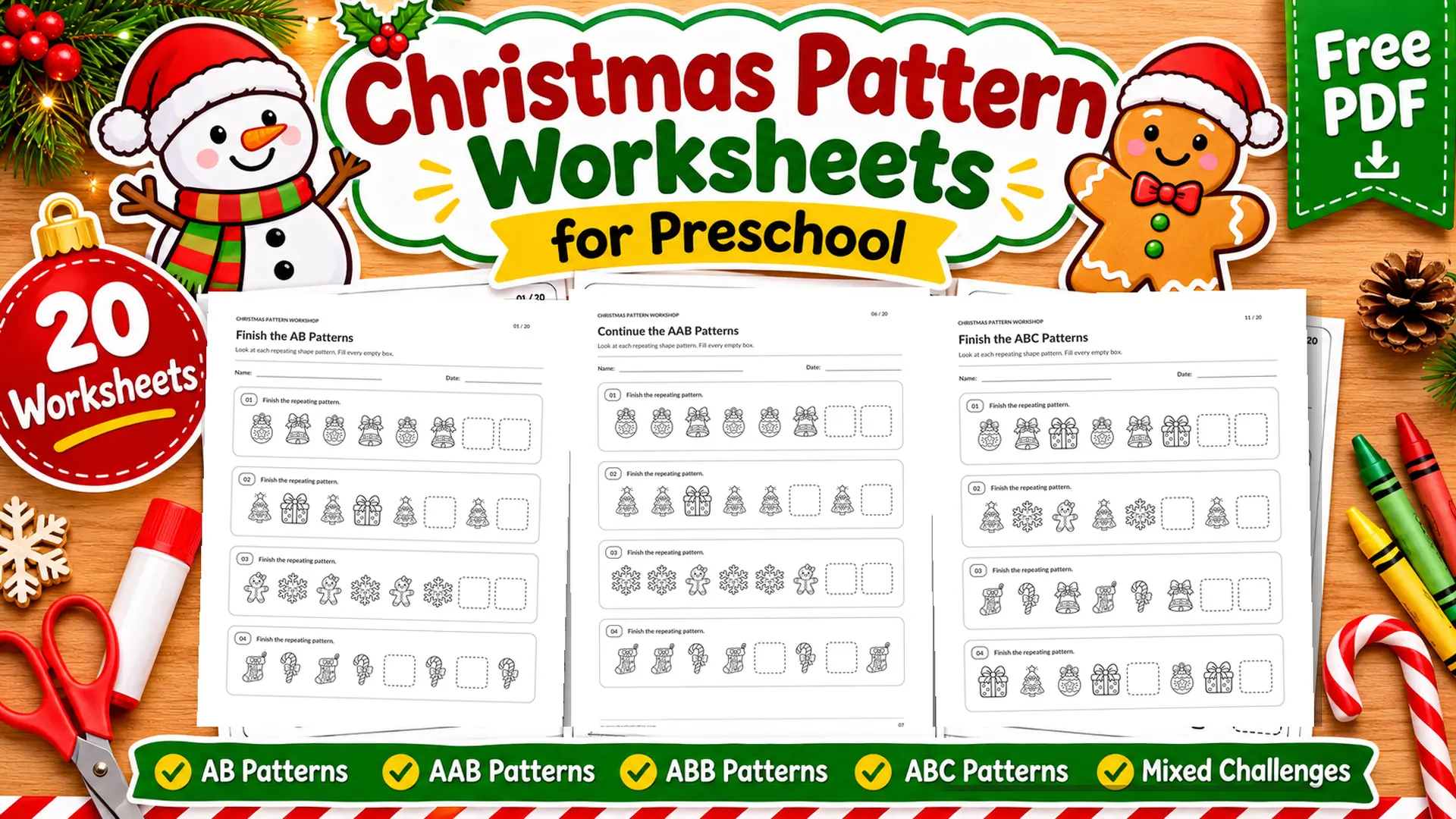
Looking for a fun way to introduce early math skills during the holiday season? These Christmas pattern worksheets for preschool help young learners recognize, complete, and create repeating patterns using cheerful Christmas pictures.
From gingerbread cookies and Christmas trees to bells, ornaments, candy canes, and snowflakes, children can explore patterns while enjoying familiar holiday designs.
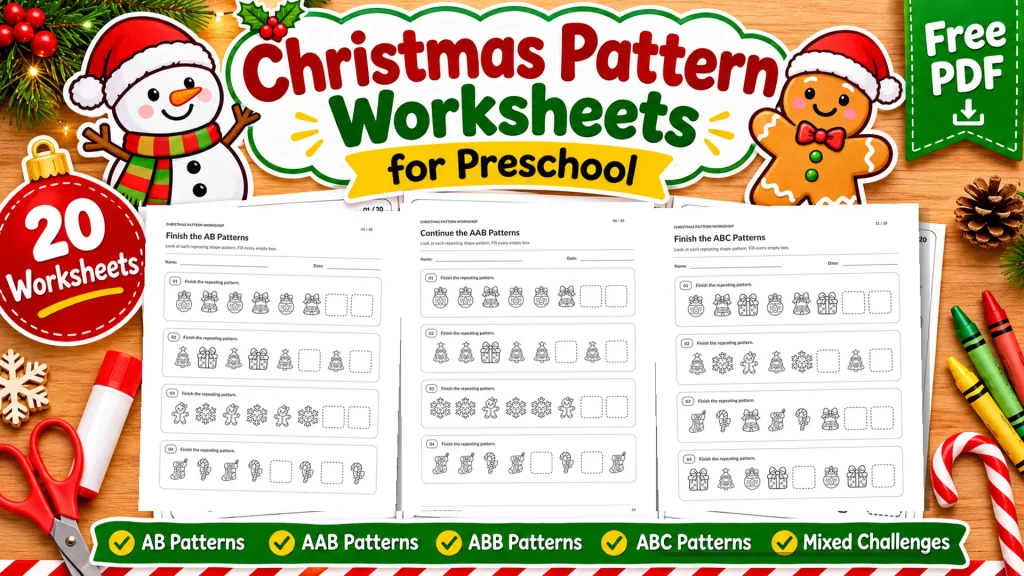
This free 31-page Christmas pattern printable PDF includes 20 engaging worksheets, a teacher guide, and 10 pages of illustrated answer keys. The activities progress from simple AB patterns to more challenging AAB, ABB, ABC, and mixed patterns.
Children will practice identifying what comes next, circling correct pictures, cutting and pasting missing pieces, and drawing their own pattern sequences.
The worksheets are designed for preschoolers, Pre-K learners, and kindergarteners ages 3–6. They work well for December math centers, morning work, homeschooling, small-group lessons, and Christmas learning activities at home.
Best of all, the worksheets are black-and-white, printer-friendly, and easy to use with basic classroom supplies.
Download the Free Christmas Pattern Worksheets PDF
Ready to get started? Download the complete Christmas Pattern Workshop and choose the activities that match your child’s learning level.
Your free printable includes:
- 20 different Christmas pattern worksheets
- 5 AB pattern practice worksheets
- 5 AAB and ABB pattern worksheets
- 5 ABC pattern worksheets
- 5 mixed pattern challenges
- 1 teacher guide with activity instructions
- 10 illustrated answer key pages
- Black-and-white Christmas illustrations suitable for coloring
Printable details:
Recommended ages: 3–6 years
Learning level: Preschool, Pre-K, and kindergarten
Total PDF pages: 31
Worksheet pages: 20
Paper size: US Letter (8.5 × 11 inches)
Format: Printable black-and-white PDF
Skills: Pattern recognition, sequencing, reasoning, and fine motor coordination
You can print the entire pack or select individual worksheets to use throughout the holiday season.
For children who are just beginning to recognize patterns, I recommend starting with Worksheet 1 before introducing the more challenging pages.
What’s Included in These Christmas Pattern Worksheets for Preschool?
The Christmas Pattern Workshop is organized into four learning stages. Each stage introduces new pattern skills while keeping the activities familiar and playful.
The complete PDF includes a teacher guide on page 1, worksheets on PDF pages 2–21, and illustrated answer keys on pages 22–31.
Here is what children will practice.
Worksheets 1–5: AB Pattern Activities
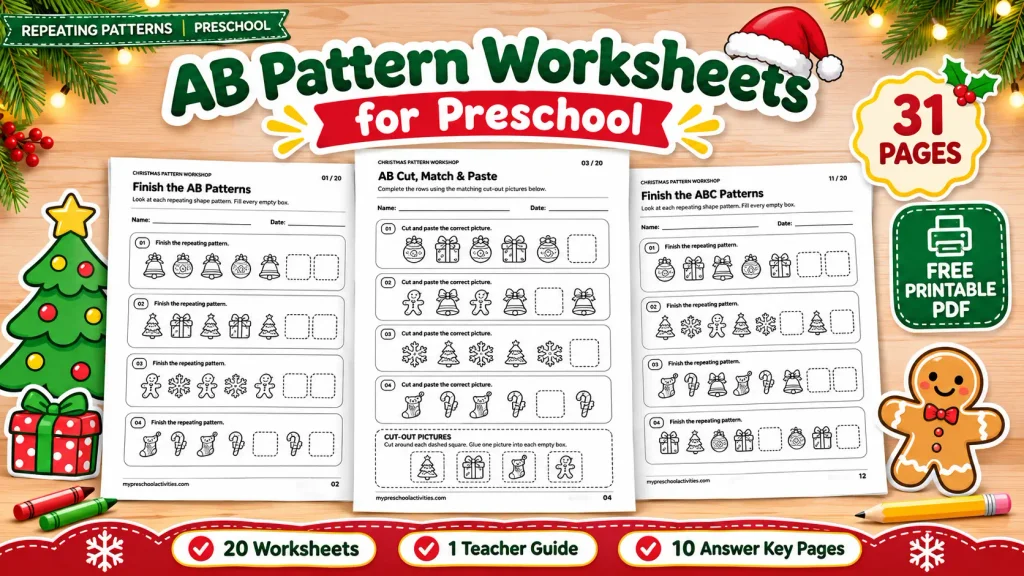
The first five worksheets introduce simple repeating patterns with two alternating pictures.
An AB pattern follows a sequence such as:
Bell – Star – Bell – Star – Bell – Star
Children learn to recognize that the same two pictures repeat in the same order.
The five worksheets include:
Worksheet 1: Finish the AB Patterns
Children look at Christmas picture sequences and fill in the empty boxes with the missing shapes.
Worksheet 2: Which Picture Comes Next?
Each problem shows a repeating pattern and picture choices. Children circle the correct next picture.
Worksheet 3: AB Cut, Match & Paste
Children identify missing pictures and use cut-out shapes from the bottom of the page to complete the sequences.
Worksheet 4: Draw the Next Two: AB
Instead of selecting an answer, children draw the next two pictures in each repeating pattern.
Worksheet 5: Find the Missing AB Pictures
Children identify missing shapes within longer sequences, helping them recognize the repeating rule even when a blank appears in the middle.
These activities provide a useful introduction to patterning for younger preschoolers.
Start with one row at a time and encourage children to say the pictures aloud before answering.
Worksheets 6–10: AAB and ABB Patterns
After practicing AB patterns, children move on to sequences with three-picture repeating units.
An AAB pattern might look like:
Ornament – Ornament – Bell – Ornament – Ornament – Bell
An ABB pattern uses a different order:
Tree – Gift – Gift – Tree – Gift – Gift
These patterns are slightly more challenging because children must recognize when a picture repeats twice.
The activities include:
Worksheet 6: Continue the AAB Patterns
Children complete sequences where the first picture appears twice before the second picture.
Worksheet 7: Continue the ABB Patterns
Children practice patterns where the second picture repeats twice.
Worksheet 8: Choose: AAB or ABB?
Children look carefully at each sequence and circle the correct missing picture.
Worksheet 9: AAB & ABB Cut and Paste
This activity combines pattern recognition with cutting and gluing.
Worksheet 10: Draw the Next Two: AAB / ABB
Children apply their pattern knowledge by drawing the next two pictures in each sequence.
Teaching tip: Before introducing these worksheets, create simple AAB and ABB patterns using three blocks or other large objects.
Ask children to compare the two repeating sequences and explain what changes.
Worksheets 11–15: ABC Christmas Patterns
The next five worksheets introduce ABC patterns, which use three different pictures in a repeating sequence.
For example:
Ornament – Gingerbread – Snowflake – Ornament – Gingerbread – Snowflake
Children must identify the order of three different objects and use that order to complete a pattern.
The activities include:
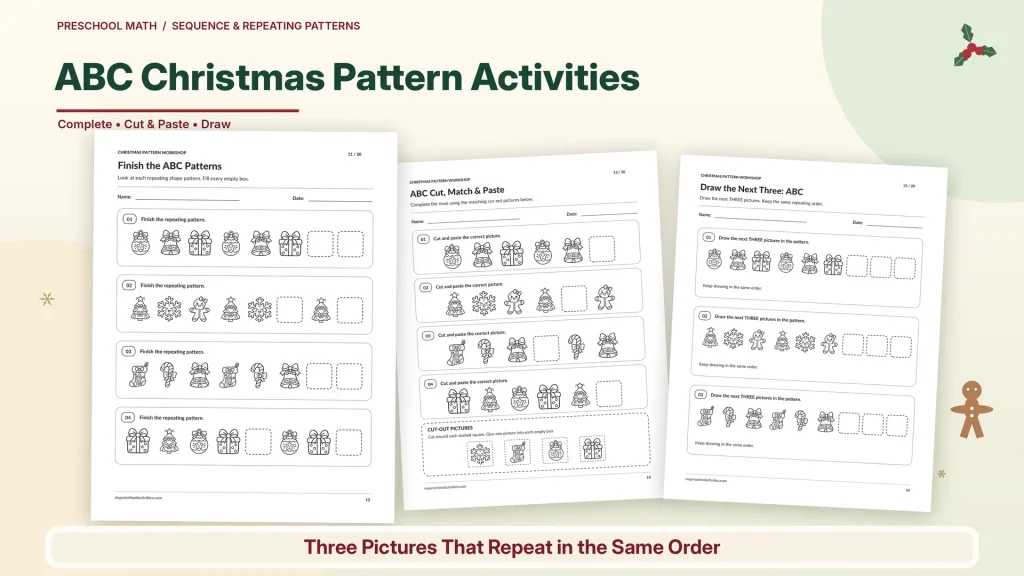
Worksheet 11: Finish the ABC Patterns
Children fill empty boxes in repeating sequences using three Christmas pictures.
Worksheet 12: ABC – Circle the Next Picture
Children examine a sequence and circle the correct next picture from the available choices.
Worksheet 13: ABC Cut, Match & Paste
Children cut and glue the appropriate Christmas pictures into the missing positions.
Worksheet 14: Missing Pictures – ABC
Instead of simply completing the end of a sequence, children identify missing pictures in different positions.
Worksheet 15: Draw the Next Three – ABC
Children draw the next three pictures, repeating the entire ABC unit.
For younger learners, the drawing activity may require additional support.
Children do not need to reproduce every decorative detail of the Christmas illustrations. A simple recognizable version of the correct picture is enough to demonstrate understanding.
Worksheets 16–20: Mixed Christmas Pattern Challenges
The final five worksheets combine different pattern rules and activity formats.
These pages allow children to apply what they have learned rather than practicing only one pattern type at a time.
Worksheet 16: Mix It Up! Choose the Next
Children examine mixed patterns and select the picture that continues each sequence.
Worksheet 17: Mixed Pattern Cut and Paste
Children use cut-out Christmas pictures to complete different repeating patterns.
Worksheet 18: Select the Missing Picture
Children identify missing pictures and circle the correct choices.
Worksheet 19: Draw the Next Christmas Shape
Children recognize the sequence and draw the picture that comes next.
Worksheet 20: Christmas Pattern Master!
The final worksheet combines several activity types, including completing patterns, choosing correct pictures, and drawing the next shapes.
This final page works well as an informal review after children have practiced the earlier pattern worksheets.
You can also use it to observe which types of repeating patterns children understand confidently and which ones need more practice.
What Are AB, AAB, ABB, and ABC Patterns?
Before using the worksheets, it helps to understand how the different pattern types work.
A repeating pattern is a sequence that follows a predictable rule.
The smallest group of items that repeats is called the repeating unit.
For young children, recognizing that repeating unit is more important than memorizing the pattern’s letter name.
AB Patterns: Two Pictures That Alternate
An AB pattern uses two different pictures.
For example:
Tree – Bell – Tree – Bell – Tree – Bell
The repeating unit is Tree–Bell.
If you ask what comes next, the answer is Tree.
This is usually the easiest pattern type to introduce because children can quickly notice the alternating pictures.
Try reading the pattern aloud while pointing to each item.
AAB Patterns: Two of One Picture, Then One Different Picture
An AAB pattern repeats the first item twice before introducing the second.
For example:
Gift – Gift – Star – Gift – Gift – Star
The repeating unit is Gift–Gift–Star.
Children need to pay attention to how many times the first picture appears.
When introducing this pattern, emphasize the repetition by saying:
“Gift, gift, star. Gift, gift, star.”
ABB Patterns: One Picture, Then Two of Another
An ABB pattern begins with one picture followed by two of a second picture.
For example:
Bell – Snowflake – Snowflake – Bell – Snowflake – Snowflake
The repeating unit is Bell–Snowflake–Snowflake.
Children sometimes confuse AAB and ABB patterns because both use two different pictures and a repeating unit of three.
Place an example of each pattern side by side and encourage children to describe the difference.
ABC Patterns: Three Different Pictures
An ABC pattern uses three different pictures in a repeating order.
For example:
Candy Cane – Tree – Gift – Candy Cane – Tree – Gift
The repeating unit is Candy Cane–Tree–Gift.
ABC patterns require children to remember a longer sequence and identify where the pattern begins again.
For children who struggle, use three physical objects before moving to the printed worksheet.
Why Learning Different Pattern Types Matters
Pattern recognition is an important part of early mathematical thinking.
When children identify what repeats, predict what comes next, and explain their choices, they practice recognizing mathematical relationships.
The National Association for the Education of Young Children (NAEYC) also highlights the value of helping preschoolers identify and describe repeating patterns through pictures, words, and sounds.
You can explore its resource on pattern books for preschoolers for additional learning ideas.
The goal is not simply to finish the worksheet. It is to help children notice the rule that makes the pattern work.
Why Christmas Pattern Worksheets Are Helpful for Preschoolers
These Christmas pattern worksheets for preschool offer several opportunities to develop early learning skills.
1. Early Math and Pattern Recognition
Recognizing repeating patterns helps children understand that pictures, shapes, and objects can follow predictable rules.
Children learn to observe a sequence, identify a repeating unit, and use that information to work out what comes next.
These skills contribute to early mathematical reasoning.
2. Visual Discrimination
Children must look carefully at each Christmas picture to distinguish it from the others.
For example, they might compare a Christmas ornament with a bell or identify the difference between a snowflake and a decorated tree.
This encourages attention to shape and visual details.
3. Sequencing Skills
Pattern activities ask children to follow a specific order.
They practice moving from one picture to the next and recognizing how the sequence repeats.
Reading the pictures aloud can help children connect visual information with spoken language.
4. Logical Thinking and Problem-Solving
When a child chooses a missing picture, they are making a prediction based on a rule.
Instead of guessing, encourage them to explain:
“The bell comes after the star because the pattern repeats bell, star.”
Explaining their thinking helps children become more aware of the relationships they notice.
5. Fine Motor Coordination
The printable includes activities that involve circling, drawing, cutting, and pasting.
These tasks provide opportunities to practice hand control and coordination.
For younger children, adults can prepare the cut-out pieces so the child can concentrate on recognizing the pattern.
6. Learning Through a Familiar Holiday Theme
Christmas pictures can make pattern activities more inviting.
Children may already recognize gingerbread cookies, ornaments, stockings, trees, and gifts.
Using familiar illustrations allows them to focus on the order of the pictures rather than learning unfamiliar object names.
How to Print the Free Christmas Pattern Worksheets
The worksheets are designed to be simple to prepare at home or in the classroom.
Step 1: Download the Complete PDF
Use the free download link near the beginning of this article to save the 31-page PDF.
The file contains the teacher guide, all 20 worksheets, and the answer keys.
Step 2: Select Your Worksheets
You don’t need to print all 31 pages at once.
Choose worksheets based on the pattern type your child is practicing.
For example, children learning AB patterns can begin with worksheets 1–5.
Older children who already understand AB patterns may be ready to start with AAB, ABB, or ABC activities.
Step 3: Choose the Correct Paper Size
Use US Letter paper measuring 8.5 × 11 inches.
Select Actual Size or 100% in your printer settings when possible.
This is especially important for the cut-and-paste activities, since the cut-out pictures are designed to correspond with the spaces on the worksheets.
Check your printer preview before printing to make sure the page edges are not clipped.
Step 4: Print in Black and White
The Christmas Pattern Workshop features black-and-white line illustrations.
This makes the worksheets suitable for standard home and classroom printers.
Children can color the pictures after finishing the activities, but coloring is not necessary for solving the patterns.
The differences between the main picture types allow children to identify them by shape rather than color alone.
Step 5: Prepare the Supplies
Gather the following materials:
- Printed worksheets
- Pencils or crayons
- Child-safe scissors
- Glue sticks for cut-and-paste activities
- Optional coloring supplies
- A folder for completed work
For younger preschoolers, consider cutting out the smaller pieces ahead of time.
Step 6: Keep the Answer Keys Separate
The final 10 pages contain illustrated answer keys.
These show completed picture sequences and identify the correct answers.
Teachers and parents can keep these pages separate from the worksheets and use them when checking the activities.
How to Use the Christmas Pattern Worksheets Step by Step
You don’t need a complicated lesson plan to teach patterns.
A short demonstration followed by guided practice is often enough to begin.
Step 1: Introduce a Simple Pattern
Before opening the worksheet, create a pattern using physical objects.
You might arrange a red block, a blue block, another red block, and another blue block.
Ask your child:
“What do you notice?”
“What comes after the blue block?”
“Can you make the pattern continue?”
Once the child understands the sequence, move to the printed pictures.
Step 2: Name the Christmas Pictures
Look at the pictures on the worksheet together.
Point to each one and say its name aloud.
For example:
“Tree, gift, tree, gift.”
Children who can name the pictures may find it easier to hear and recognize the repeating rule.
Step 3: Find the Repeating Unit
Ask:
“Which pictures keep repeating?”
“Where does the pattern start again?”
“What would come next?”
Encourage children to explain what they notice, even if they are not yet familiar with the terms AB, AAB, ABB, or ABC.
Step 4: Complete One Example Together
Use the first activity as a demonstration.
Show children how to look at the full pattern instead of only the final picture.
For cut-and-paste activities, identify the correct picture before reaching for the scissors or glue.
Step 5: Let Children Practice
Give children time to complete the remaining problems.
If they make a mistake, read the pattern aloud together and invite them to try again.
Avoid rushing through the worksheets.
Understanding one repeating sequence is more valuable than quickly completing several pages without understanding the rule.
Step 6: Review With the Answer Key
Use the illustrated answer keys to compare the completed sequences.
Ask children to explain why an answer belongs in a particular position.
This turns checking answers into another learning opportunity.
How to Use the Cut-and-Paste Christmas Pattern Activities
Some of the most hands-on pages in this pack are the cut-and-paste worksheets.
The PDF includes this activity format in Worksheet 3, Worksheet 9, Worksheet 13, and Worksheet 17.
Each of these pages contains pattern rows and cut-out pictures near the bottom.
How to complete the activity:
- Read the repeating pattern from left to right.
- Find the empty picture box.
- Identify the shape that should appear in the missing position.
- Look at the cut-out pictures.
- Cut out the matching picture along its dashed square.
- Place it in the empty box to check the pattern.
- Glue it in place when the match is correct.
For children ages 3–4, adults can prepare the cut-out pieces ahead of time.
Children can then focus on choosing the correct pictures and placing them in the proper order.
Teaching tip: Before using glue, ask the child to put the cut-out picture into the empty space and read the complete pattern aloud. This allows them to change their answer if needed.

Adapting Christmas Pattern Activities for Different Ages
Children develop early math skills at different rates.
The same Christmas pattern printable can be adapted by changing the number of problems, the type of pattern, or the amount of adult support.
Ages 3–4: Beginning Pattern Recognition
Start with simple AB patterns.
Use real objects, picture cards, or spoken examples before completing the worksheets.
For younger preschoolers:
- Choose only one or two pattern rows.
- Read the pattern aloud together.
- Let children point to the correct picture.
- Prepare cutting pieces in advance.
- Focus on recognizing the repeating order.
If drawing feels difficult, allow children to describe the correct picture instead.
Ages 4–5: Building Confidence
Children who can identify AB patterns may be ready for AAB and ABB activities.
Encourage them to notice when an item repeats twice.
Try comparing two patterns side by side.
For example, build an AAB pattern with blocks and then rearrange them into an ABB pattern.
Ask children to describe what changed.
Introduce ABC worksheets when they are comfortable following longer repeating units.
Ages 5–6: Kindergarten Pattern Challenges
Older preschoolers and kindergartners can work with more complex sequences.
Encourage them to:
- Name the pattern type.
- Find the repeating unit.
- Explain the next picture.
- Complete missing positions in longer sequences.
- Create their own patterns.
- Check answers independently with guidance.
The mixed pattern worksheets provide opportunities to apply several skills within one activity.
Children Who Need Extra Support
If a worksheet seems challenging, try reducing the amount of visual information.
Cover part of the page and work on one row at a time.
Use large blocks, toy figures, or other manipulatives to recreate the pattern physically.
You can also offer two picture choices instead of asking the child to draw an answer.
For some children, recognizing the correct picture is easier than producing it.
Children Ready for More Challenges
If a child completes the worksheets confidently, invite them to create their own patterns.
Ask them to draw an AB, AAB, ABB, or ABC pattern for someone else to solve.
You can also deliberately make a mistake in a sequence and ask the child to find and correct it.
This encourages children to apply their understanding instead of simply repeating familiar examples.
Five Fun Christmas Pattern Activities Without Worksheets
The printable can be combined with simple hands-on activities to extend learning.
These activities require very little preparation and can be used at home or in a classroom.
1. Christmas Ornament Pattern Game
Gather two types of safe, unbreakable ornaments or large ornament pictures.
Arrange them in an AB pattern.
For example:
Round ornament – Star ornament – Round ornament – Star ornament
Ask children to continue the pattern.
When they are ready, add a third picture type and create an ABC sequence.
Avoid small, breakable decorations when working with young children.
2. Gingerbread Pattern Bakery
Cut out large paper gingerbread cookies in two different shapes.
For example, use gingerbread people and gingerbread stars.
Arrange them in a repeating pattern and ask children to deliver the correct cookie to the next position.
For additional practice, try an AAB pattern with two gingerbread people followed by one star.
3. Christmas Sound Patterns
Patterns don’t need to use pictures.
Create repeating sounds with clapping, tapping, or jingling.
Try:
Clap – Tap – Clap – Tap
Then introduce:
Clap – Clap – Tap – Clap – Clap – Tap
Pause and ask children to make the next sound.
Sound patterns are especially useful for children who enjoy movement and music.
4. Candy Cane and Gift Pattern Cards
Draw simple candy canes and wrapped gifts on small pieces of paper.
Use the cards to create AB, AAB, or ABB patterns.
Invite children to choose the card that comes next.
This activity can be repeated with different Christmas pictures to reinforce the same repeating rule.
5. Find the Christmas Pattern Mistake
Create a repeating pattern using paper pictures.
For example:
Tree – Star – Tree – Star – Tree – Tree
Ask children:
“Can you find the mistake?”
Encourage them to identify which picture breaks the repeating rule.
You can begin with easy AB patterns and move to more difficult examples once children are confident.
Christmas Pattern Worksheets for Classroom Math Centers
These Christmas pattern worksheets for preschool can be used throughout December without requiring a completely new lesson every day.
One approach is to introduce a different pattern skill each week.
Week 1: AB Pattern Practice
Use worksheets 1–5.
Begin with simple repeating sequences and let children practice circling, completing, cutting, and drawing.
Week 2: AAB and ABB Patterns
Use worksheets 6–10.
Compare patterns with doubled pictures and encourage children to describe the repeating unit.
Week 3: ABC Pattern Activities
Use worksheets 11–15.
Introduce three-picture sequences and practice finding missing shapes.
Week 4: Mixed Pattern Review
Use worksheets 16–20.
Allow children to apply the different pattern rules and practice choosing, completing, and drawing answers.
This schedule is flexible. Children who need additional AB practice can spend more time with the first worksheets before moving forward.
A Simple Preschool Math Center Setup
Place the selected worksheets in a tray with crayons, pencils, and any prepared cut-out shapes.
Keep the activity instructions short.
For example:
- Look at the Christmas pictures.
- Say the pattern aloud.
- Find what comes next.
- Complete the worksheet.
- Check your work with a teacher.
For classroom use, print several copies of the same worksheet when children need to practice a shared skill.
You can also place the answer key in a teacher folder for easy reference.
Using Christmas Pattern Printables at Home
Parents can use the worksheets for short learning sessions during December.
You do not need to finish the entire printable pack in one day.
Begin with one worksheet that matches your child’s current skills.
Look at the pictures together and read the pattern aloud before giving the child time to work independently.
If your child becomes tired of drawing, switch to a circling activity or a hands-on pattern game.
You can also look for repeating patterns during everyday holiday activities.
For example, notice the order of colors on wrapping paper, repeated shapes on decorations, or alternating designs on a scarf.
These familiar examples help children recognize that patterns exist beyond worksheets.
After completing a math activity, children may enjoy some creative time with our Christmas coloring pages for kids.
The collection includes seasonal designs that children can save and print individually.
For another hands-on December activity, explore our free Nativity crafts for kids, which include printable Christmas craft ideas for families and classrooms.
Making Christmas Pattern Worksheets Accessible
These worksheets use different Christmas picture shapes rather than relying on color differences alone.
That makes the activities suitable for black-and-white printing and can help children who have difficulty distinguishing certain colors.
You can further adapt the activities by:
- Naming each picture aloud.
- Pointing to the shapes as the pattern is read.
- Using larger physical objects to model the sequence.
- Allowing children to point instead of draw.
- Preparing cut-out pieces for children who need help with scissors.
- Reducing the number of problems shown at one time.
The important part is understanding the repeating rule, not completing every activity in exactly the same way.
Common Mistakes When Teaching Preschool Patterns
Pattern activities are simple to prepare, but a few common mistakes can make them more difficult than necessary.
Introducing Complex Patterns Too Early
Some children need more practice with AB patterns before moving to AAB, ABB, or ABC sequences.
If a child struggles, return to simpler examples and gradually increase the difficulty.
Focusing Only on the Final Picture
Children may look at the last picture and guess what comes next without examining the full sequence.
Encourage them to read the complete pattern aloud and identify the repeating unit.
Making the Activity Too Difficult With Drawing
A child may understand the correct pattern but struggle to draw a detailed ornament or gingerbread cookie.
Allow simplified drawings or use cut-out pictures when appropriate.
Correcting Without Explaining
Instead of immediately saying an answer is wrong, ask:
“Can we read the pattern together?”
“What part keeps repeating?”
“Does this picture follow the same order?”
These questions encourage children to check their reasoning.
Expecting Every Child to Work at the Same Speed
Some children will complete a worksheet quickly, while others need more time and support.
Adjust the number of questions and offer additional practice when necessary.
Create a Christmas Paper Chain Pattern
After children complete a few worksheets, try turning pattern practice into a Christmas decoration.
A paper chain is a fun way to build and display repeating patterns.
Materials:
- Red, green, and white construction paper
- Child-safe scissors
- Glue or tape
- Optional paper stars, circles, or other large shapes
Instructions:
- Cut construction paper into strips.
- Choose a simple repeating color or shape pattern.
- Make the first paper loop and secure it with glue or tape.
- Add the next strip according to the pattern.
- Continue linking the loops.
- Ask children to identify the repeating unit.
For an AB pattern, you could alternate red and green loops.
For an ABC pattern, use red, green, and white loops in that order.
For children who benefit from shape-based clues, attach a different paper shape to each type of loop so the pattern does not depend on color alone.
Display the finished chain and ask children to predict what the next loop would be if the pattern continued.
This simple extension helps connect worksheet learning with a hands-on Christmas craft.
Frequently Asked Questions About Christmas Pattern Worksheets
Are these Christmas pattern worksheets for preschool free?
Yes! The complete Christmas Pattern Workshop is available as a free printable PDF.
It includes 20 worksheets, a teacher guide, and illustrated answer keys.
How many pages are in the printable PDF?
The complete PDF contains 31 pages.
These include one teacher guide, 20 activity worksheets, and 10 answer key pages.
What ages are these worksheets designed for?
The activities are intended mainly for preschoolers, Pre-K students, and kindergarteners ages 3–6.
Younger children can begin with AB patterns, while older learners can practice AAB, ABB, ABC, and mixed sequences.
What is the difference between AB and ABC patterns?
An AB pattern repeats two different pictures.
For example:
Bell – Star – Bell – Star
An ABC pattern repeats three different pictures.
For example:
Bell – Star – Tree – Bell – Star – Tree
The repeating unit is longer in an ABC pattern.
Do I need a color printer?
No. These Christmas pattern worksheets are designed with black-and-white illustrations.
Children can identify the pictures by shape and details without relying on color.
Can children color the worksheets?
Yes! Children can color the Christmas illustrations after completing the pattern activities.
Coloring is optional and does not affect the repeating pattern rules.
Are the worksheets suitable for kindergarten?
Yes. Kindergarten students can use the AAB, ABB, ABC, and mixed pattern worksheets for additional practice.
Teachers can adjust the activities based on students’ current skills.
Do the worksheets include cut-and-paste activities?
Yes. The PDF includes four cut-and-paste worksheets featuring different types of patterns.
The cut-out picture choices appear near the bottom of these pages.
Are answer keys included?
Yes. Ten illustrated answer key pages are included at the end of the PDF.
They show the completed sequences and correct answers for the 20 worksheets.
Can I print only certain worksheets?
Absolutely.
You can select individual PDF pages instead of printing the entire pack.
This makes it easy to choose the appropriate difficulty level and save paper.
How long should a preschool pattern activity take?
For many preschoolers, a short session of about 5–10 minutes is a reasonable starting point.
Some children may enjoy working longer, while others benefit from completing only one or two problems at a time.
Follow your child’s interest and attention level.
How can I help a child who doesn’t understand repeating patterns?
Start with physical objects instead of worksheets.
Create a simple two-object pattern, read it aloud, and ask your child to continue.
Once the repeating rule becomes familiar, introduce an easy AB worksheet.