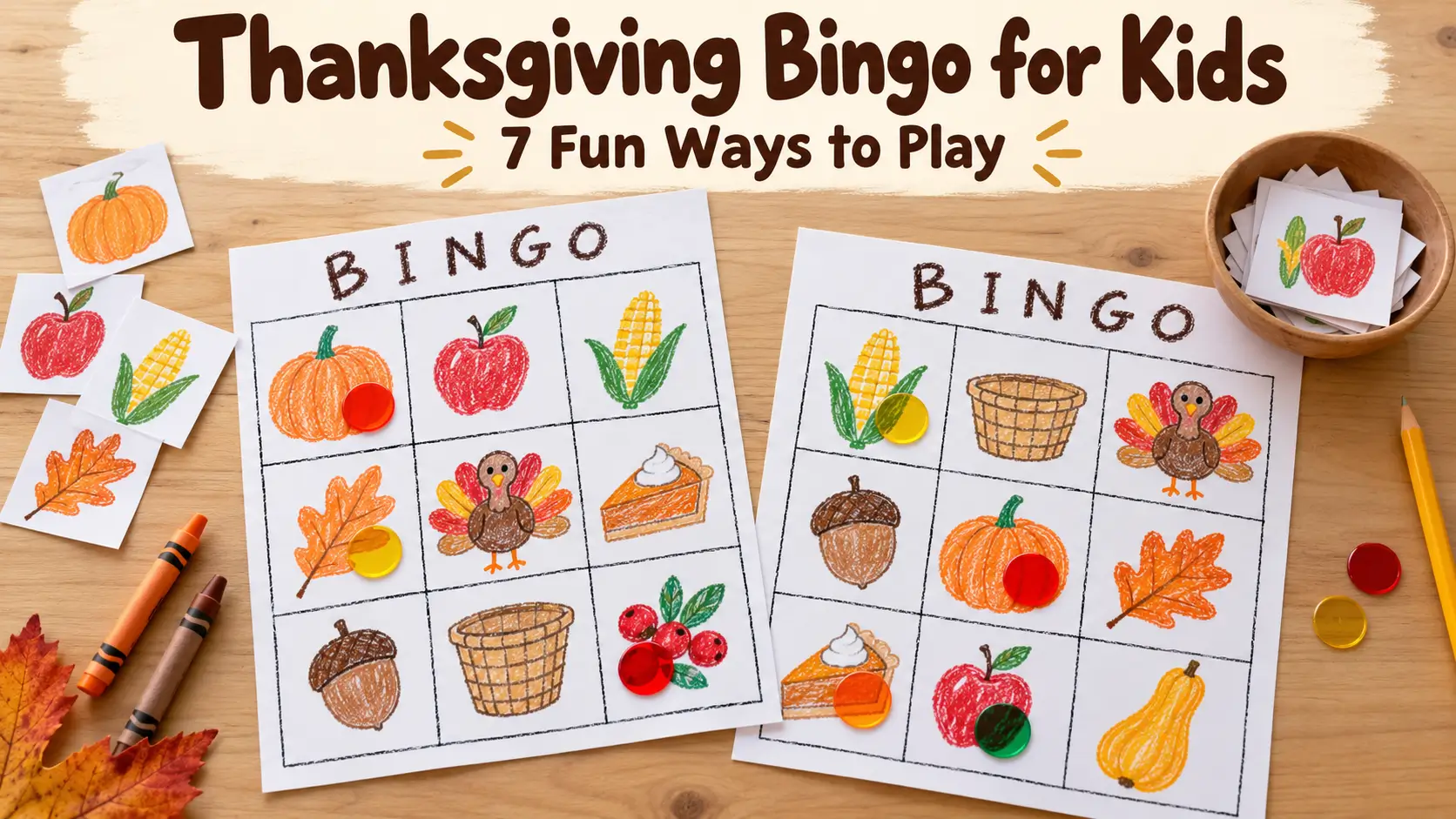
Thanksgiving bingo for kids is a picture-matching game you can prepare for a classroom gathering, a family afternoon, or a homeschool activity. Instead of reading words, children look for familiar seasonal pictures, such as pumpkins, leaves, apples, and pies.
This guide explains the setup, the rules, and seven ways to adapt the game. You will also find a homemade version using plain paper and drawings, along with advice on free spaces, calling cards, and simultaneous winners.
What Is Thanksgiving Picture Bingo?
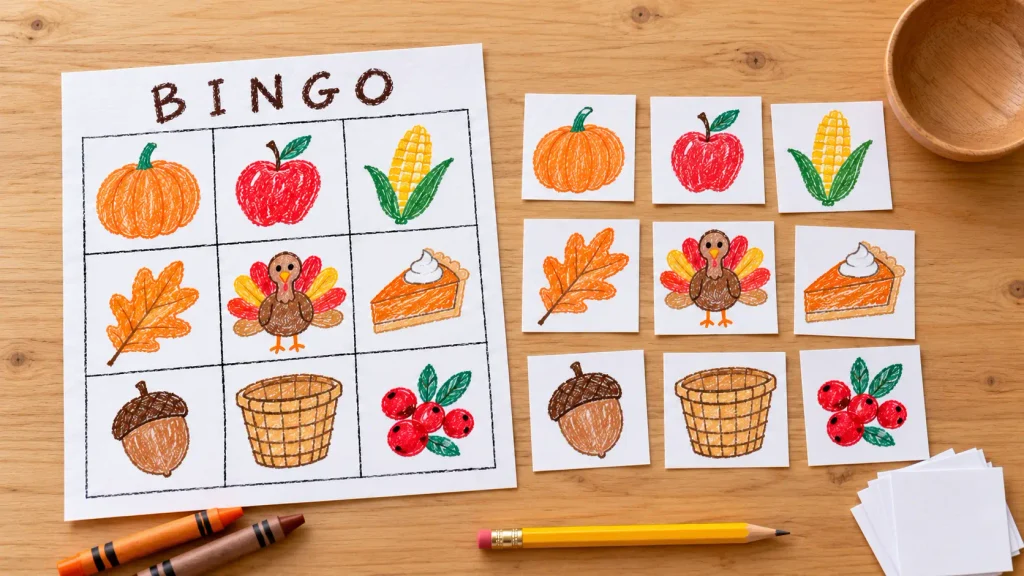
A game of Thanksgiving bingo for kids needs three things: a picture board for each player or team, a matching set of calling pictures, and an agreed winning pattern.
The caller draws a picture, shows it, and says its name. Players mark the matching picture if it appears on their own board. When someone completes the agreed pattern, they say “Bingo!” An adult checks the claim against the pictures already called.
Thanksgiving bingo for kids does not require independent reading. Children who can match the pictures can participate while an adult names and displays each card.
Prepare Thanksgiving Bingo for Kids
Gather the following supplies:
- Bingo boards: one for each player or partner team.
- Calling pictures: one card for every distinct picture appearing anywhere on the boards.
- Markers: pencils, crayons, or large paper squares.
- A container: a bag, bowl, or box for mixing the calling cards.
- A display area: somewhere to keep the pictures already called visible.
A printable version of Thanksgiving bingo for kids can save drawing time, but check its contents before starting. The homemade instructions below work without a purchased resource.
Check the Calling Set
Compare every board with the calling cards. A picture that appears on a board must also appear in the calling set.
A missing calling picture may block some winning patterns. It also makes full-card bingo impossible for a board containing that picture. Fix missing or unclear images before the game begins.
For Thanksgiving bingo for kids, use pictures that are easy to distinguish. If you include both a whole pumpkin and a slice of pumpkin pie, name and show them clearly during the practice turn.
Check the Grid and Free Space
Boards may use a 3 by 3, 4 by 4, or 5 by 5 grid. Count the squares needed for your chosen pattern instead of assuming every board works the same way.
A free space counts as already marked only if the boards include one or the group agrees to add one before playing. It does not need a matching calling card. Every regular picture square must wait for its picture to be called.
How to Play Thanksgiving Bingo for Kids
Use this routine for the first round:
- Give out the boards. Each player or pair receives one board and markers.
- Explain the winning pattern. Show a sample of the line or arrangement that will count.
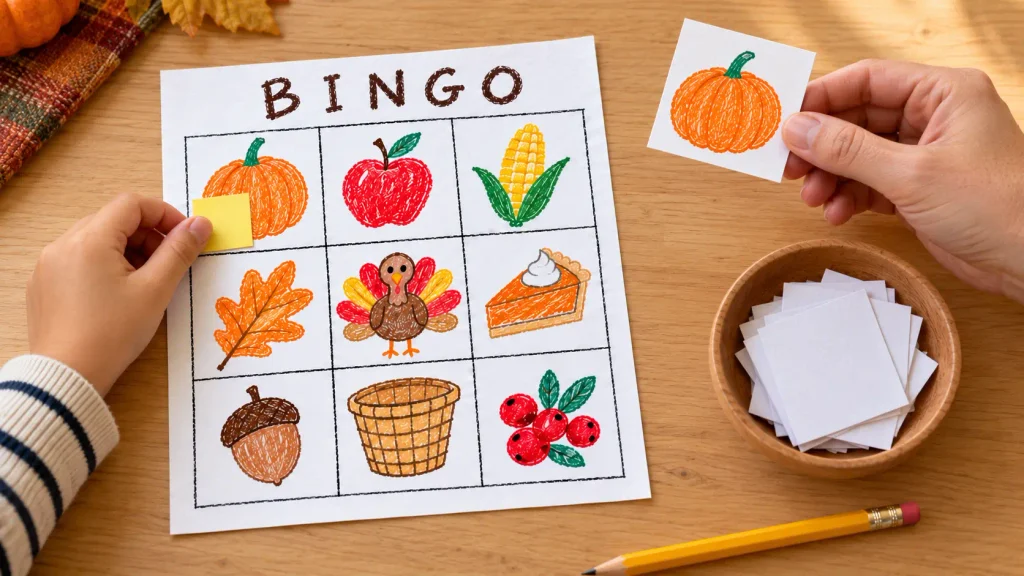
- Demonstrate one turn. Show a calling picture, find its match on a sample board, and mark it.
- Mix the calling cards. Place them in the container.
- Draw and display one card. Say the picture’s name clearly.
- Allow time to look. Players mark the picture only if it appears on their board.
- Keep the called card visible. Set it aside without returning it to the container.
- Continue calling. Stop when a player announces a completed pattern.
- Check the claimed pattern. Match its regular picture squares against the called cards. An agreed free space counts without a calling card.
- Confirm the result. Accept a complete, correctly marked pattern. Correct mistakes and continue if the pattern is incomplete.
If there are extra marks elsewhere on the board, help the child correct them separately. Check the actual claimed winning pattern when deciding whether the player has won.
A Practice Call
The caller shows a pumpkin card and says “pumpkin.” A child with a pumpkin on their board marks that square. A child without a pumpkin leaves their board unchanged.
In Thanksgiving bingo for kids, seeing the picture as well as hearing its name makes the action clear. A player should not mark a leaf simply because it sits beside the pumpkin.
What Counts as a Line?
On a 3 by 3 board, a complete line contains three squares. On a 4 by 4 board, it contains four, and on a 5 by 5 board, it contains five.
Before playing, explain whether horizontal, vertical, and diagonal lines all count. If you are using horizontal lines only, show one and keep that rule for the whole round.
Seven Ways to Play Thanksgiving Bingo for Kids
The versions below change either the winning pattern, the way children participate, or what happens after a round. They do not require seven different printable sets.
1. Classic Straight-Line Bingo
Setup: Give each player a board and prepare the full calling set.
How to play: The caller draws and shows pictures. Players mark matching squares.
Winning condition: One complete horizontal, vertical, or diagonal line, using the directions agreed before starting.
Example: On a 3 by 3 board, an apple, pie, and leaf fill the top row. Once all three have been called, that row is complete.
Adjustment: For children new to Thanksgiving bingo for kids, begin with horizontal lines only. Demonstrate other directions in a later round.
2. Four Corners
Setup: Use the same boards, but point out the four corner squares before the first call.
How to play: The caller draws pictures normally. Players watch for their corner pictures and mark them when called.
Winning condition: All four corners are marked. Other squares do not affect this pattern.
Example: A board has a turkey, pumpkin, acorn, and pie in its corners. That player needs all four pictures to be called.
Adjustment: Four Corners gives players four specific spaces to watch. It is not guaranteed to finish sooner than a line game. On a 3 by 3 board, a line needs three squares, while this version needs four particular corners.
3. Full-Card Bingo
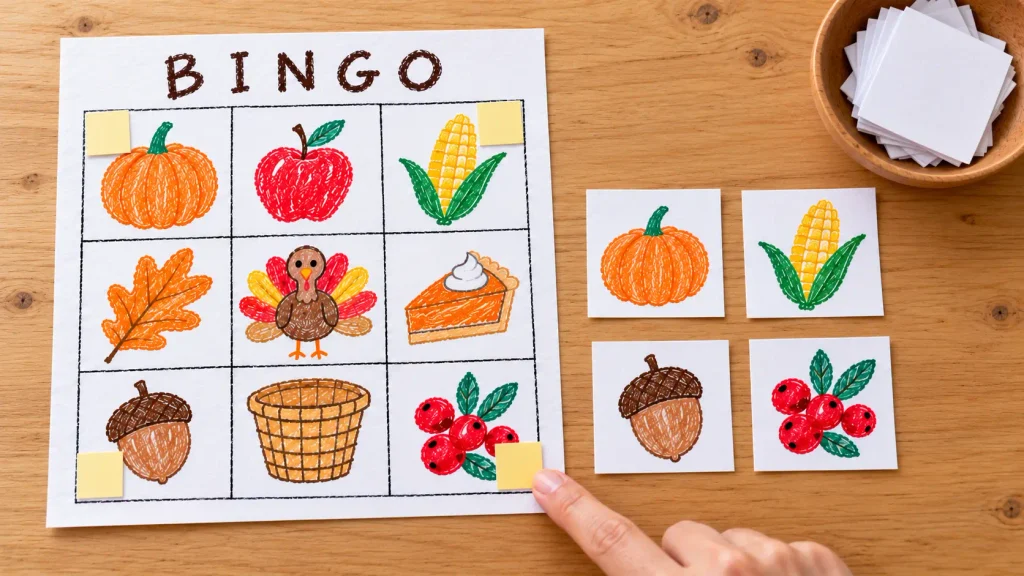
Setup: Prepare boards and the complete calling set. Include any agreed free space when explaining the target.
How to play: Keep drawing until a player has marked every required picture on their board.
Winning condition: The entire board is marked correctly, including any free space that counted from the start.
Example: A 3 by 3 board without a free space needs all nine of its pictures to be called.
Adjustment: Full-card Thanksgiving bingo for kids can require more calls than a line game. Boards containing exactly the same set of required pictures will finish on the same call, even if their arrangements differ. Plan to recognize simultaneous winners.
4. Partner Bingo
Setup: Give one board to each pair.
How to play: Partners look for each called picture together. One points while the other marks, then they switch roles.
Winning condition: Keep the normal winning pattern unchanged. The pair shares the win.
Example: One child finds the corn picture and their partner places a paper marker over it.
Adjustment: Partner Thanksgiving bingo for kids allows an adult to pair a child who needs help with someone comfortable following the routine. Keep both children involved by changing roles.
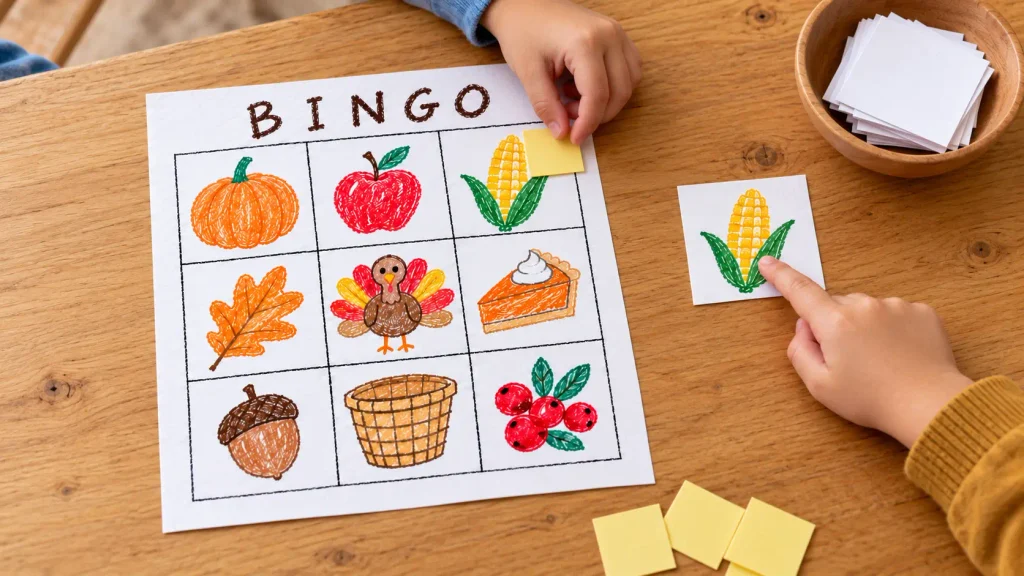
5. Show-and-Match Bingo
Setup: Place called pictures where everyone can see them.
How to play: Hold up a card, name it, and leave it displayed while players compare it with their own boards. Children mark the matching square on their own board.
Winning condition: The agreed pattern stays unchanged. This adaptation changes the calling routine rather than the winning target.
Example: Show a pie card and give children time to find the same picture before drawing another.
Adjustment: For Thanksgiving bingo for preschoolers, use clear images and a pace that allows everyone to check. Children can point to a match before marking it.
6. Picture-Clue Bingo
Setup: Prepare a short, clear description for each calling picture.
How to play: Give the clue, then show and name the card to confirm the intended picture before players mark it.
Winning condition: Keep the agreed pattern unchanged.
Example: Say, “Find the fruit that is often red or green and grows on a tree.” Then show the apple card.
Adjustment: Picture-clue Thanksgiving bingo for kids can use simple descriptions such as color and shape. Avoid clues that could reasonably describe several pictures on the boards, or clarify them before anyone marks.
7. Bingo with a Gratitude Extension
Setup: Choose any version above.
How to play: Finish the round and check the winning boards. Then invite children to name something they appreciate.
Winning condition: Gratitude sharing does not change who wins. It happens after the game.
Example: A child chooses the apple picture and says, “I appreciate having a snack.” Another child shares something unrelated to the pictures.
Adjustment: Keep the extension optional. Children may speak, point, or pass. For more activities to pair with Thanksgiving bingo for kids, explore these gratitude activities for kids.
Compare the Seven Versions
| Version | Preparation | What changes |
|---|---|---|
| Straight-Line | Boards and calling cards | Complete an agreed line |
| Four Corners | Identify the corner spaces | Mark four specific corners |
| Full-Card | Check the complete calling set | Mark the whole board; ties may occur |
| Partner | One board per pair | Share the search and marking |
| Show-and-Match | A visible place for called cards | Allow more time for visual comparison |
| Picture-Clue | Prepare clear clues | Describe, then confirm each picture |
| Gratitude Extension | Any version above | Add optional sharing after the round |
Make Thanksgiving Bingo for Kids at Home
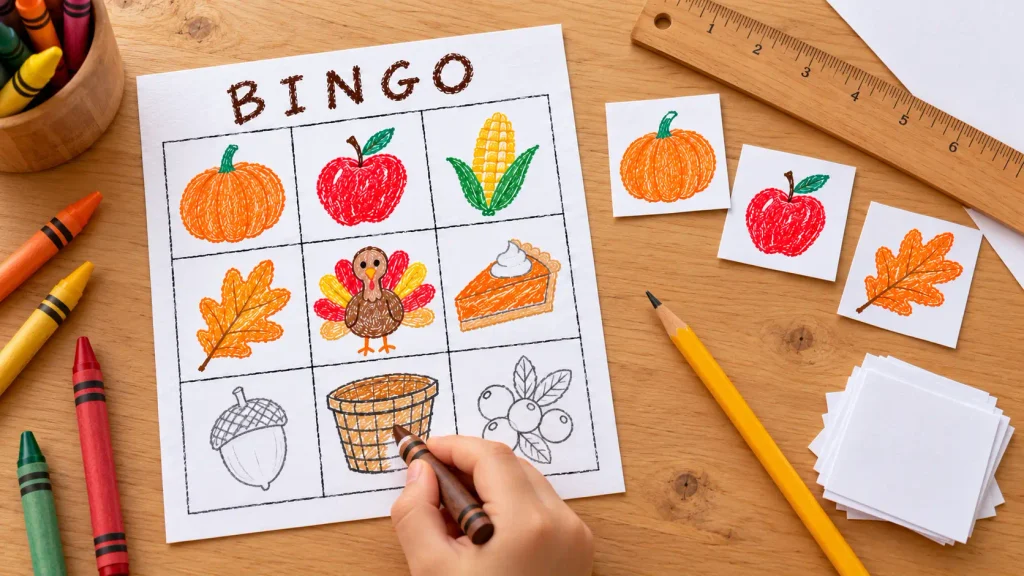
You can draw a working game with paper and crayons. This section explains a homemade activity; it does not include a downloadable file.
1. Choose a Shared Picture Collection
For a small homemade game of Thanksgiving bingo for kids, begin with twelve recognizable pictures: pumpkin, leaf, apple, turkey, pie, corn, acorn, squash, cranberries, basket, sweet potato, and wheelbarrow.
Use simple drawings with clear differences. If two pictures look too similar, change one before making the boards.
2. Draw the Boards
Draw a 3 by 3 grid on each sheet. Without a free space, each board needs nine different pictures.
If you want a free center, put a star in the middle square and use eight pictures in the remaining spaces. Explain that the star counts from the beginning.
3. Vary the Picture Selection and Positions
Choose pictures from the same shared collection, but vary which ones appear on each board and where they sit.
For example, one board might omit the basket, cranberries, and wheelbarrow. Another might omit the apple, corn, and sweet potato.
Different arrangements can produce different line patterns, but ties remain possible. If boards contain the same required pictures, rearranging them does not prevent simultaneous full-card wins.
4. Make the Calling Cards
Draw each of the twelve pictures once on a separate card. These form your calling set.
You do not need one calling card for every occurrence of a picture across all boards. One apple card can serve every board containing an apple.
5. Check and Demonstrate
Compare every board with the calling set. Make sure all regular pictures can be called and any free spaces are clearly identified.
Try one demonstration round of Thanksgiving bingo for kids before using the boards with a group. Check that players can recognize the drawings and understand where to place their marks.
Practical Tips for Classroom and Family Groups
A little preparation makes Thanksgiving bingo for kids easier to organize.
- Show the winning pattern first. Use a sample board and point to the exact spaces.
- Keep called cards visible. This provides a record for checking claims and catching missed calls.
- Allow time between calls. Watch whether players have finished looking before moving on.
- Use partners where helpful. Share one board deliberately rather than accidentally giving identical copies to separate players.
- Accept simultaneous winners. If several players complete the pattern on the same call, check and recognize each valid claim.
- Plan the round length through its rules. A straight-line game can finish before a full-card game on the same boards. Four Corners is a different target, not a guaranteed shortcut.
- Change rules between rounds. Explain the new pattern before starting again.
If you are planning several Thanksgiving classroom games and activities, these turkey disguise ideas offer a separate craft project to use alongside bingo.
A Note on Printable Resources
I create printable learning resources under the name SmartPrint Kids. You can browse my resources on Teachers Pay Teachers.
For Thanksgiving bingo for kids, the homemade method above provides a complete way to prepare and play. If you choose a printable set, check its grid size, calling pictures, and free-space rules before using it.
Frequently Asked Questions
Can Preschoolers Play Without Reading?
Yes. Thanksgiving bingo for kids can use pictures throughout. An adult shows and names each card while children compare it with their boards. Demonstrate a turn and check that the pictures are recognizable.
How Many Bingo Boards Do I Need?
For Thanksgiving bingo for kids, prepare one board per player or partner team, plus a spare if helpful. You need one calling card for each distinct regular picture appearing anywhere on the boards.
Can Several Players Use the Same Board?
They can share a board as partners. Separate players with identical boards and correct marks will complete the same patterns together. Different arrangements can vary line wins, but they do not guarantee a single winner.
What If Several Children Win Together?
Check each claimed pattern against the called cards, allowing any agreed free space. Recognize all valid winners from the same call. Explain this approach before starting, especially for full-card rounds.
How Can I Make the Game Shorter?
For a shorter version of Thanksgiving bingo for kids, choose straight-line wins on a small grid rather than full-card wins, and stop after the first confirmed winning call. A smaller calling collection can also help, but it must still contain every picture used on the boards.
Ready to Play
Choose one version of Thanksgiving bingo for kids, prepare the boards and matching calling pictures, and demonstrate a practice turn. Agree on the winning pattern and how to handle ties before the first round. Afterward, decide whether to repeat the same version or try another with the group.