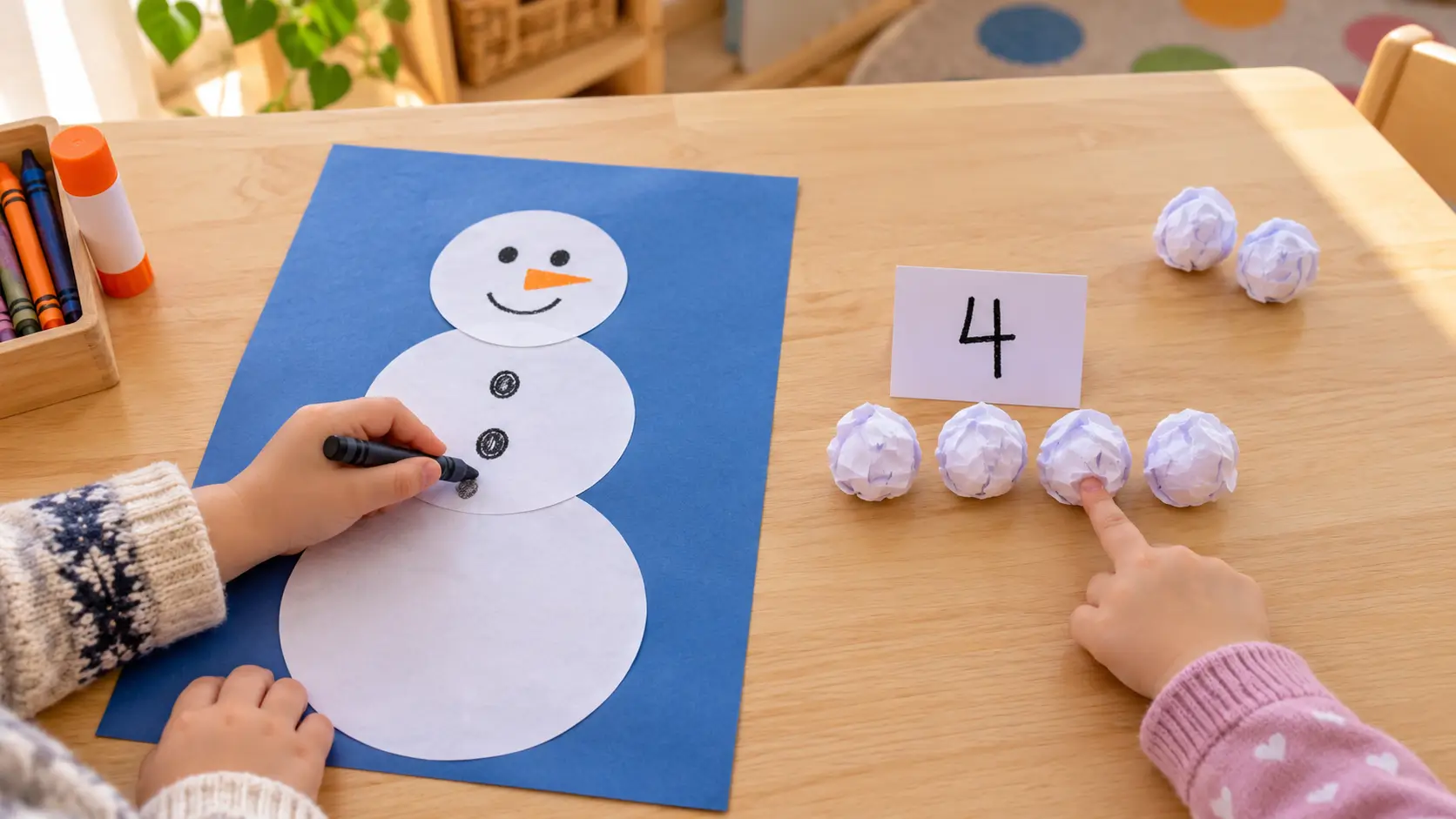
Winter looks different depending on where you live. Some families have deep snow, some have cold rain, and some only need a light jacket. These winter activities for preschoolers work in every one of those places because none of them needs snow outside.
Each idea uses paper, crayons, a glue stick, or an ice cube tray, and each comes with steps you can follow at a table or on a cleared patch of floor. Children ages 3 to 5 can match, count, tear, stamp, draw, move, and talk about winter ideas.
You will find crafts, early math, letter practice, scissor and crayon practice, one simple ice experiment, and a gentle movement game. Choose one or two to begin.
Getting Ready: Basic Supplies and Preparation
Most winter activities for preschoolers in this guide use the same short supply list, so one small tub can hold almost everything:
- Printer paper or scrap paper, plus blue and dark construction paper
- Crayons and washable markers
- Glue sticks and scissors made for children
- Washable white paint and a cardboard tube
- Index cards, or paper cut into card-sized pieces
- Two shallow containers, a towel, and an ice cube tray
Do the cutting and drawing before children sit down, and stay close during scissor, paint, and ice activities. Use large paper pieces and washable materials, and leave out small loose decorations such as buttons or beads.
No printer or downloadable template is required. Choose activities that use supplies you already have, and substitute similar materials when needed. Where an activity needs cards or a drawn outline, the steps tell you exactly how to make it.
Use this comparison of winter activities for preschoolers to choose an idea that fits your supplies and preparation time. Times are approximate estimates and will vary.
| Activity | Age suitability and adaptation | Approximate preparation | Main type of practice |
|---|---|---|---|
| 1. Match the Mittens | Ages 3 to 5; start with 3 pairs | 15 minutes | Visual matching |
| 2. Build a Paper Snowman | Ages 3 to 5; adult cuts circles | 5 minutes | Comparing sizes, gluing |
| 3. Count Paper Snowballs | Ages 3 to 5; use cards 1 to 3 first | 10 minutes | Counting |
| 4. Make a Hat and Mitten Pattern | AB for younger, AAB for older | 10 minutes | Repeating patterns |
| 5. Decorate a Winter Name Hat | Children starting to notice letters | 10 minutes | Letter recognition |
| 6. Sort Winter Clothing Pictures | Ages 3 to 5; talk through choices | 15 minutes | Sorting, explaining |
| 7. Snip a Paper Snowflake | One fold or an unfolded circle for beginners | 5 minutes | Scissor control |
| 8. Stamp a Snowy Picture | Ages 3 to 5; adult pours paint | 5 minutes | Stamping, hand control |
| 9. Create a Torn Paper Winter Tree | Ages 3 to 5; tearing is the main task | 10 minutes | Tearing, gluing |
| 10. Follow Winter Drawing Paths | Finger first, crayon when ready | 5 minutes | Drawing control |
| 11. Observe an Ice Cube Melting | Ages 3 to 5; drawing replaces writing | 5 minutes | Predicting, observing |
| 12. Tell a Lost Mitten Story | Ages 3 to 5; speaking only | 10 minutes | Storytelling, vocabulary |
| 13. Make Pretend Animal Tracks | Ages 3 to 5; copy one pattern | 10 minutes | Pattern comparing, drawing |
| 14. Play a Gentle Indoor Winter Movement Game | Seated versions welcome | 10 minutes | Following directions, movement |
| 15. Draw a Response to a Winter Picture Book | Ages 3 to 5; short reading section | 5 minutes | Listening, drawing |
15 Indoor Winter Activities for Preschoolers
Choose from the winter activities for preschoolers below according to the supplies you have and what your child enjoys. Some involve matching and counting, while others invite drawing, storytelling, or movement. Start with one activity and prepare its materials before inviting children to join.
1. Match the Mittens
Make six pairs of large paper mittens, twelve pieces in all. Cut one simple mitten shape from a cereal box to use as a template, trace it twelve times on paper, and cut the shapes out.
Color each pair with its own color or pattern, such as red stripes or blue dots, so the twins are easy to tell apart.
- Spread all twelve mittens face up on the table.
- Let your child choose one mitten.
- Ask them to find the matching mitten and set the two together.
Try saying, “This mitten has blue dots. Where is another one with blue dots?”
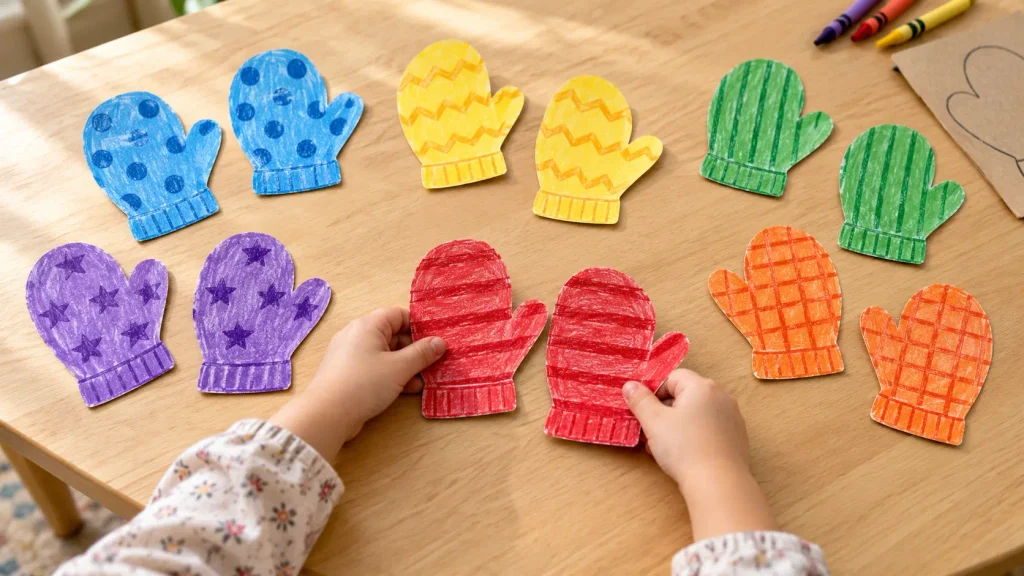
For a simpler version, start with only three pairs. To extend it, make pairs that look alike except for one added detail.
2. Build a Paper Snowman
You need three white paper circles in different sizes, about 4, 3, and 2 inches across, a sheet of blue or black construction paper, a glue stick, and markers.
- Put the three circles on the table and ask your child to line them up from largest to smallest.
- Glue the largest circle near the bottom of the dark paper, the middle circle above it, and the smallest circle on top.
- Draw eyes, a nose, a mouth, and buttons with markers. Skip loose buttons or beads.
Ask, “Which circle goes at the bottom? Where should the head go?”
Talking about size and position gives your child a reason to compare. If gluing is tricky, let them place the circles first, then lift one at a time while you add glue.
3. Count Paper Snowballs
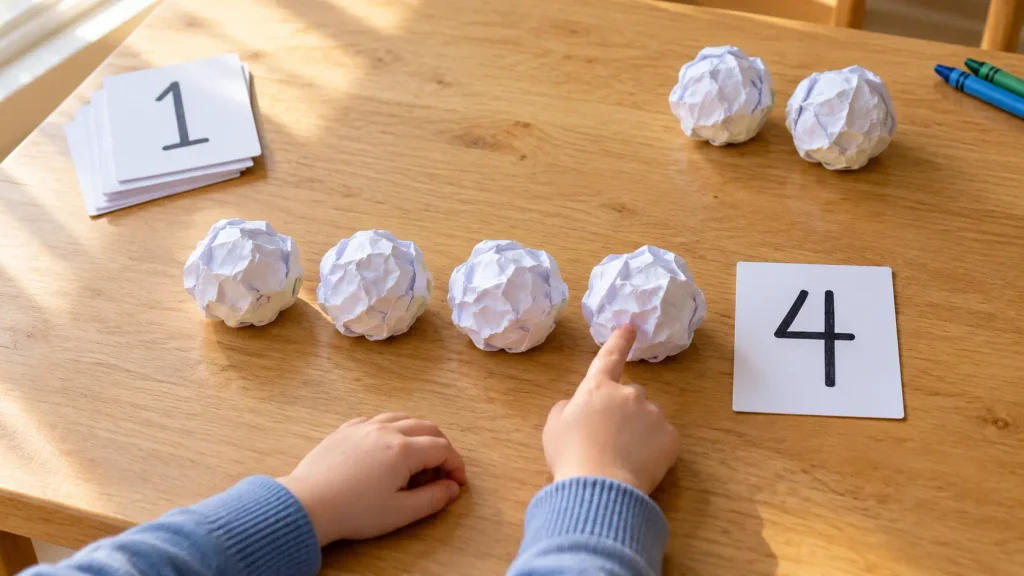
Make six cards numbered 1 to 6 from paper or index cards. Crumple six sheets of scrap paper into large balls, each about the size of a fist.
- Set the cards in a row and the six paper snowballs in a pile.
- Your child picks one card and says the number.
- They place that many snowballs beside the card, touching each ball once while counting aloud.
- Return all the snowballs to the pile, then choose another card.
Six balls cover only one card at a time, so the reset matters. Say, “The card says 4. Count them with me.”
When planning winter activities for preschoolers with different counting skills, offer cards 1 to 3 first and introduce larger numbers as needed. To extend the game, call out a number without showing the card.
4. Make a Hat and Mitten Pattern
Cut or draw four paper hats and four paper mittens, each about the size of your hand. Keep the hats alike and the mittens alike.
- Place a hat, then a mitten, and say, “Hat, mitten is one repeat.”
- Add another hat and mitten so your child sees the repeat twice.
- Invite your child to continue with the remaining pieces, saying the pattern aloud.
Once your child can continue this AB pattern, try AAB. Explain the new repeating unit first: hat, hat, mitten.
For three complete AAB repeats, use six hats and three mittens: draw two more hats and set the extra mitten aside.
If the pattern goes off track, say it aloud together from the start and listen for the spot where it changes.
5. Decorate a Winter Name Hat
Draw a large winter hat on a sheet of paper and write your child’s name in big capital letters on it.
Then cut paper squares, one for each letter in the name, and write one letter on each. Repeated letters need their own cards. For ELLA, you need four cards: E, L, L, and A.
- Mix up the letter cards on the table.
- Point to the first letter on the hat and ask your child to find the same letter.
- Place the cards in order beneath the hat, using the written name as a model.
- Decorate the hat with crayons.
Say, “ELLA has two L letters, so we need two L cards.”
This practices matching letter shapes in a name. For a separate activity with letter sounds, explore these phonics posters for early reading practice.
6. Sort Winter Clothing Pictures
Adapt winter activities for preschoolers to the weather children actually know.
Draw eight simple picture cards on paper squares. These are homemade drawings, not a download. Draw four items useful in cold weather, such as a coat, mittens, a scarf, and boots, and four other items, such as sandals, a swimsuit, shorts, and sunglasses.
What counts as winter clothing depends on the real weather where you live, so choose clear examples that match your climate.
- Write “cold weather” on one sheet of paper and “other” on another.
- Your child picks a card and names the picture.
- They decide which sheet it belongs on.
Ask, “What made you choose that spot for the boots?”
Listen to the reason, even if it is not the one you expected. In a mild climate, a light jacket and a swimsuit can make an easier contrast.
7. Snip a Paper Snowflake
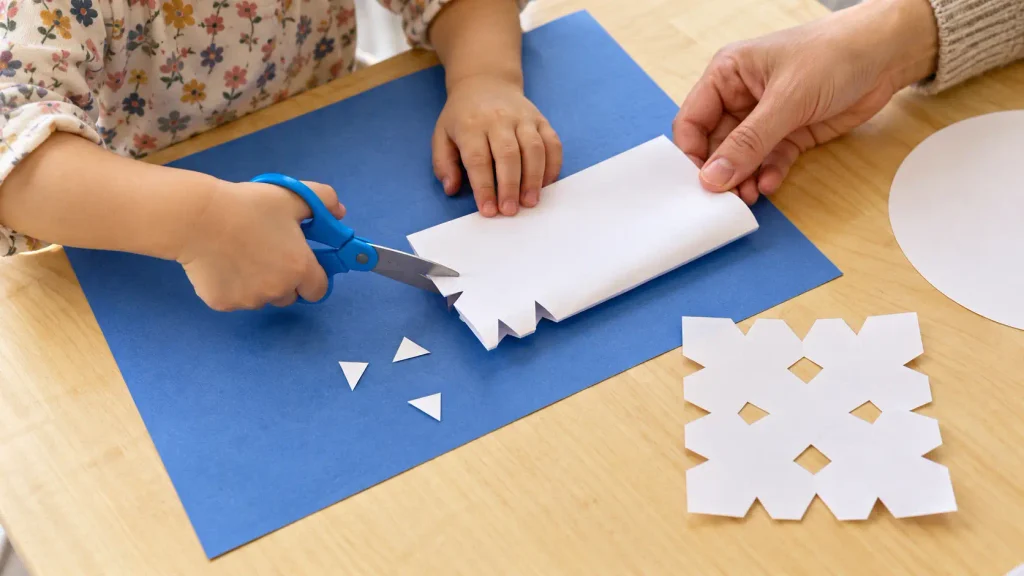
You need a paper square about 6 inches wide and scissors made for children. The adult prepares the folds and helps with the cutting.
- Fold the square in half and crease it firmly. Two layers are plenty for a beginner, because several folded layers can be hard to cut.
- Show your child where to snip small notches along the edges.
- Help hold the paper steady while they make a few cuts, then unfold it.
An easier option is to snip around the edge of an unfolded paper circle. The result is a decorative paper shape inspired by snow.
Try, “Can you snip a little triangle on this edge?”
If your child enjoys cutting, fine motor skills worksheets offer an optional extension.
8. Stamp a Snowy Picture
For winter activities for preschoolers that involve paint, cover the work surface before setting out materials.
You need washable white paint, dark paper, a shallow plate or lid, and a cardboard tube. The broad end of the tube is the stamp.
- Pour a thin layer of paint onto the plate.
- Dip the end of the tube lightly into the paint.
- Press it onto the dark paper, then lift straight up.
- Let the paint dry, then add details with crayons, such as a scarf, a mitten, or a street.
Ask, “Can you stamp two circles beside each other?”
If the prints come out blobby, dab the tube on a paper towel first to remove extra paint.
9. Create a Torn Paper Winter Tree
Draw a simple bare tree trunk with a few branches on blue paper using a brown or black crayon. You also need white paper and a glue stick.
- Tear the white paper into pieces, some small and some larger.
- Rub glue on a branch or on the back of a piece.
- Press the pieces on and around the branches as imagined snow.
To cut down on preparation and cleanup, tear a pile of pieces into a bowl ahead of time and use a glue stick instead of liquid glue.
Ask, “Where do you think the snow would land first?”
This is just one imagined tree. Trees look different in different places and seasons.
10. Follow Winter Drawing Paths
On one sheet of paper, draw three large paths: a straight route, a wavy route, and a zigzag route. Mark each start with a green dot and each finish with a red star.
These are drawing paths for your child to follow, not letters to trace.
- Your child follows one path with a finger from start to finish.
- When they feel ready, they try the same path with a thick crayon.
- Repeat with the other paths.
Say, “Start at the green dot and slide along the wavy path.”
If following a single line is difficult, draw two lines to make a wide pathway for the crayon. For more challenge, draw a new path and ask your child to follow it without lifting the crayon.
11. Observe an Ice Cube Melting
Include an observation question in your winter activities for preschoolers: “What will happen when ice warms up?”
Take two similar ice cubes from the same tray. Set two shallow containers on a towel. Leave one container empty and add a little room-temperature water to the other. Do not use hot water.
- Ask your child to predict what will happen to each cube.
- The adult places one cube in each container.
- Watch together and talk about what changes.
- Your child draws what they see. No writing is needed.
Ask, “What do you notice about the ice now?”
Explain simply that melting is a change from solid ice to liquid water. Melting time varies, and the two containers may not look the same, which is fine.
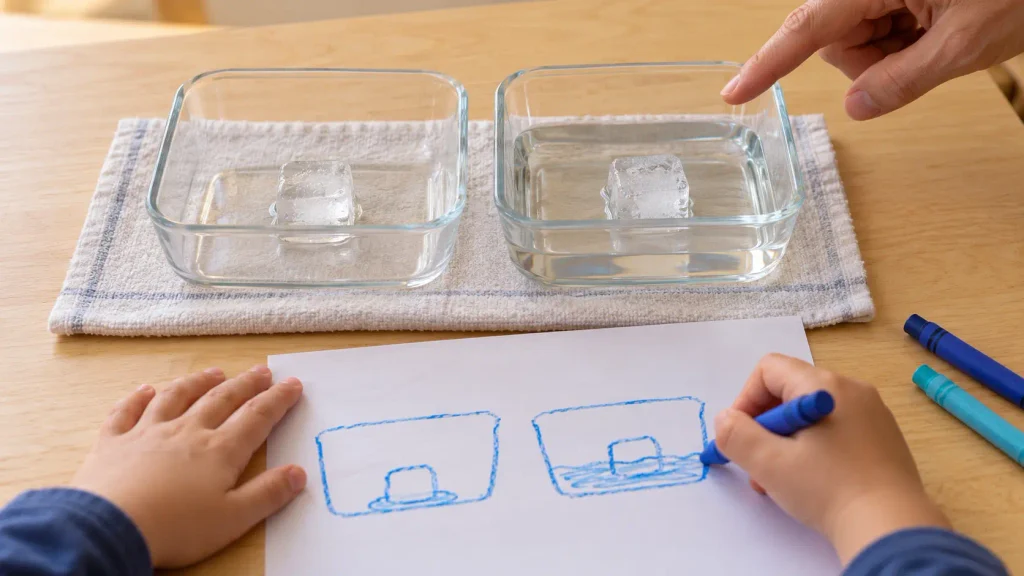
The adult handles spills and keeps the containers away from electrical equipment.
12. Tell a Lost Mitten Story
Cut out two large paper mittens and draw a face on each. For simple puppets, tape each mitten to a craft stick or a rolled paper strip.
- Introduce the story idea: one mitten cannot find its partner.
- Ask your child for a beginning: “Where was the mitten when it noticed?”
- Ask for one event: “Who did the mitten meet?”
- Ask for an ending: “How did the mittens find each other?”
Let your child move the puppets while you tell the story together. You can write their words on paper to read back.
If ideas are slow, offer two choices, such as “Did the mitten hide under a bed or behind a chair?”
13. Make Pretend Animal Tracks
Cut two long paper strips, each about 3 inches wide. On the first, draw a repeated track of paired ovals. On the second, draw a repeated three-pronged footprint, such as three short lines joined at a point.
You also need crayons and a blank strip.
- Lay the two strips side by side and ask how they are different.
- Point to one pattern and ask your child to name the next mark.
- They copy the pattern onto the blank strip with a crayon.
Use these pretend marks to compare and copy patterns.
Ask, “Which strip has the three-toed prints? What comes next?”
To extend it, invite your child to invent a new track pattern.
14. Play a Gentle Indoor Winter Movement Game
When choosing winter activities for preschoolers for a small room, use movements children can do in one spot.
Draw three picture cards showing easy movements: reaching up like a tall tree, slowly marching in place, and curling into a snowball shape. Clear a space on a dry, nonslip floor and put away anything loose.
- Hold up one card and show the movement.
- Everyone does it together for a slow count of five.
- Hold up the next card and switch.
Say, “Show me a tall tree stretching up high.”
Children who prefer to stay seated can do the same movements from a chair or the floor. Keep it relaxed, with no elimination and no racing. Choose footwear that grips the floor and keep the movement space dry and clear.
15. Draw a Response to a Winter Picture Book
Choose a winter-themed picture book you already own or borrow from a library. You also need paper and crayons.
- Read a short section aloud and pause after a scene.
- Talk about what was happening on that page.
- Invite your child to draw their own response on a fresh sheet of paper.
Ask, “What would you draw if you were in this scene?”
Encourage your child to draw their own picture instead of copying the book’s illustrations. Keep the reading section short if attention fades.
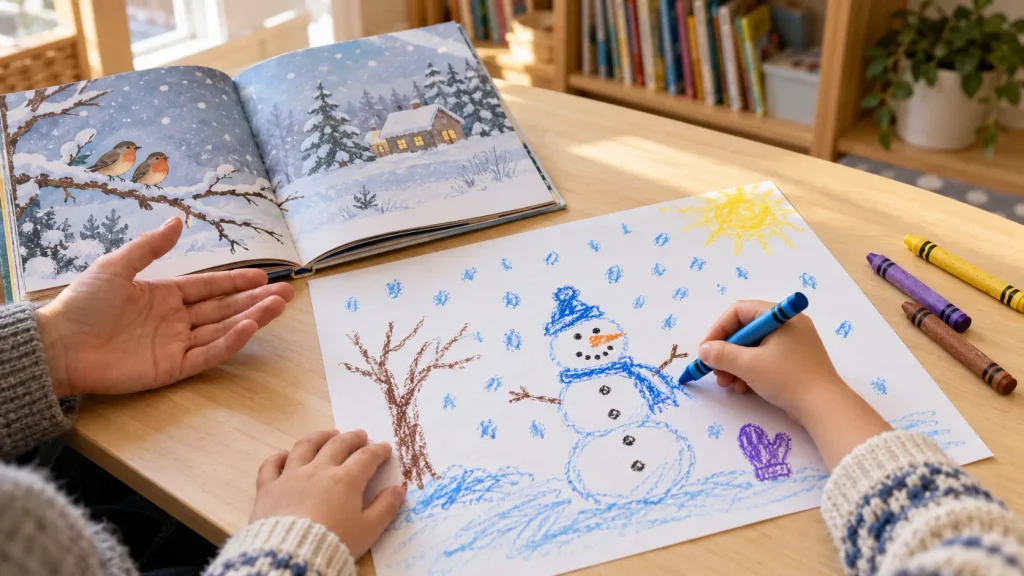
Choose a book with language and pictures suitable for your child, and leave time to talk about the story. For more ideas on discussing stories with children, explore Reading Rockets’ guide to reading aloud and building comprehension.
A Sample 25 Minute Activity Session
Here is one way to fit winter activities for preschoolers into a short block. It uses three activities, and the mittens, number cards, snowballs, and drawn paths are all made ahead of time.
- 3 minutes: Set out the mittens, the six cards, the six paper snowballs, and the path sheet.
- 6 minutes: Match the Mittens, Activity 1.
- 6 minutes: Count Paper Snowballs, Activity 3.
- 7 minutes: Follow Winter Drawing Paths, Activity 10.
- 3 minutes: Cleanup, with your child putting the mittens and snowballs back in the tub.
If your child is still enjoying one activity at the end of its time, let it run a little longer and skip another.
Adjusting for Younger and Older Preschoolers
Preschoolers vary a lot, so treat the steps as a starting point. These winter activities for preschoolers can be made easier or harder without changing the supplies.
For younger children:
- Use three mitten pairs instead of six.
- Count with cards 1 to 3 only.
- Tear paper for the tree instead of cutting.
- Follow the drawing paths with a finger before using a crayon.
- Make AB patterns only.
For older children:
- Make mitten pairs that differ by one small detail.
- Try AAB patterns, or ask your child to make one for you to continue.
- Call numbers aloud for snowball counting without showing the card.
- Ask your child to draw their own winter path for someone else to follow.
- Write down the lost mitten story as your child dictates it.
Frequently Asked Questions
How many winter activities for preschoolers should I do in one sitting?
One to three is plenty. You might plan a 20 to 30 minute session, then shorten or extend it according to the child’s interest. You can spread the 15 ideas across several days or weeks.
What if my child loses interest partway through?
Stop and offer to come back later. You can also change the task, for example by letting your child watch the ice cube instead of drawing it. Finishing every step is optional.
Can I use these ideas where it never snows?
Yes. These winter activities for preschoolers use indoor materials, so they work without outdoor snow. For the clothing sort, pick pictures that match what people actually wear near you.
What if my child cannot cut with scissors yet?
Prepare the cut shapes yourself and invite your child to arrange, glue, or decorate them. Tearing paper for the winter tree is another option.
If your child can make single snips but struggles with folded paper, try the unfolded-circle version of the snowflake activity with your help.
Start Small and Have Fun
The best winter activities for preschoolers are the ones you can set up in a few minutes and adjust as you go. Pick one idea, gather the paper and crayons, and see how your child responds.
You can repeat favorites, skip the ones that do not fit, and choose activities that suit your space and weather. When you want more planning inspiration after these self-contained activities, browse more printable learning activity ideas.