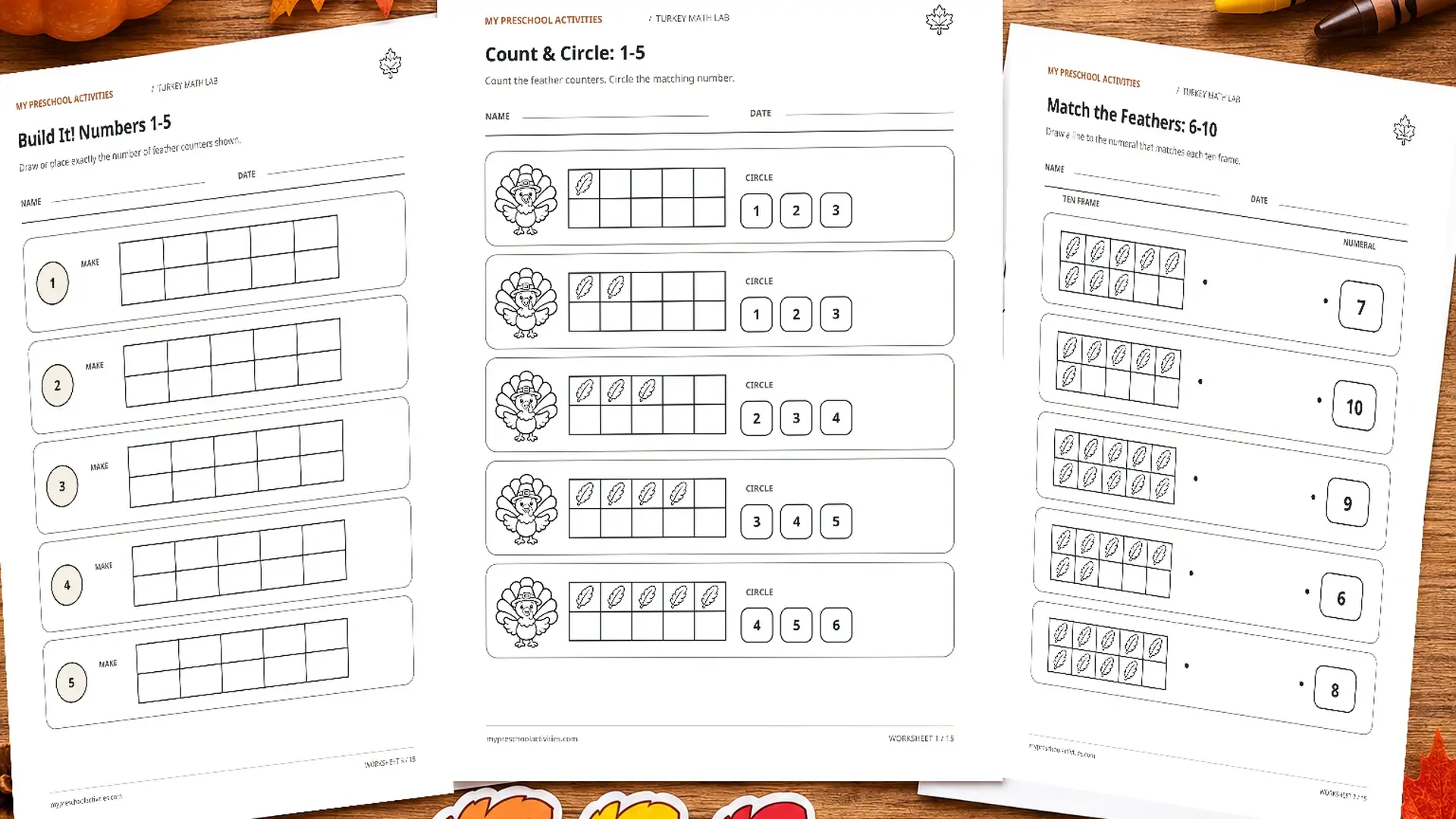
Looking for fun turkey ten frame math activities to help preschool and kindergarten children practice counting, number recognition, and early addition? This free Thanksgiving-themed printable pack brings together hands-on math practice and adorable turkey illustrations in one easy-to-use resource.
Ten frames are a wonderful way to help young learners understand numbers. Instead of simply memorizing counting sequences, children can see how quantities are organized, discover number patterns, and explore combinations that make five and ten.
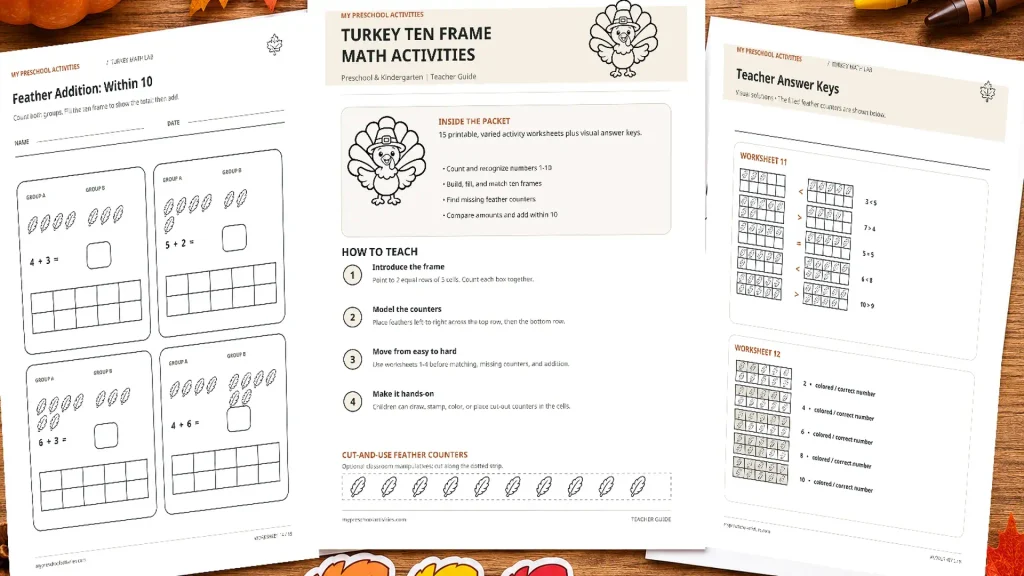
Our free 24-page Turkey Ten Frame Math Activities printable includes 15 different worksheets, a teacher instruction page, and eight pages of visual answer keys. Children can count feather counters, match numbers, complete ten frames, compare quantities, and solve simple addition problems.
Whether you’re preparing November math centers, planning Thanksgiving activities for kindergarten, or practicing numbers at home, this printable offers a flexible way to support early number sense.
Download Your Free Turkey Ten Frame Math Activities PDF
Ready to get started? You can download the complete turkey-themed math packet and begin practicing numbers with your little learners.
What’s Included in the Free Printable?
This 24-page PDF contains:
- 15 different math activity worksheets
- 1 teacher instruction and preparation page
- 8 pages of visual answer keys
- Number recognition and counting activities from 1 to 10
- Fill-the-frame and missing-counter challenges
- Matching and number comparison exercises
- Addition activities with sums up to 10
- Turkey and feather illustrations designed for coloring and counting
The worksheets are designed for US Letter paper (8.5 × 11 inches) and are suitable for preschool, Pre-K, kindergarten, and children who need extra practice with foundational counting skills.
Free printable for personal, homeschool, and individual classroom use.
The activities can be completed using crayons or pencils. For an additional hands-on experience, children can use paper feather counters or suitable classroom manipulatives.
What Is a Ten Frame?
A ten frame is a rectangular math tool divided into two rows of five equal-sized boxes, giving children a total of ten spaces.
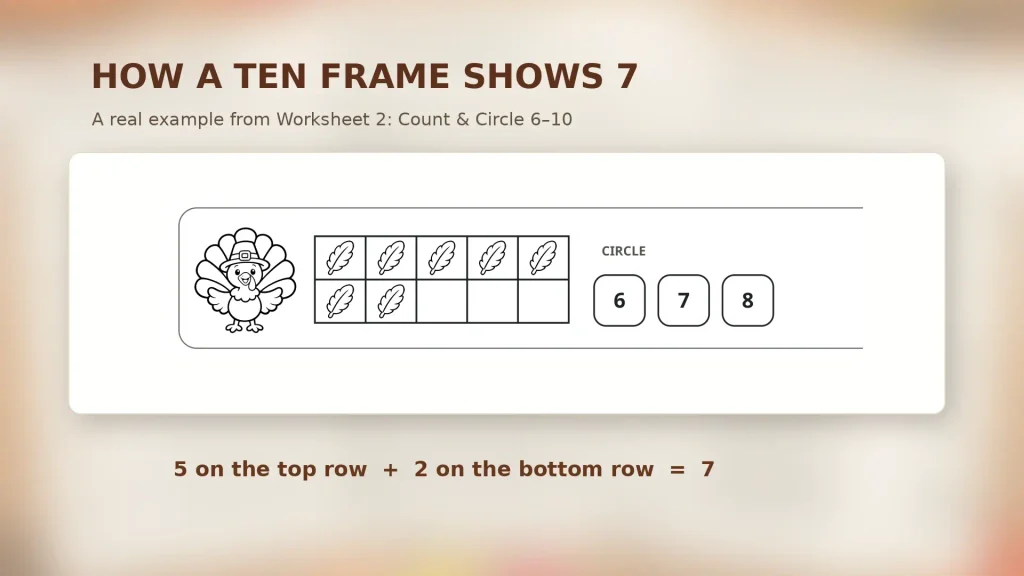
Each space represents one object or counter. Children place or draw counters in the boxes to represent different numbers.
For example:
Number 3: Three boxes contain counters, while seven remain empty.
Number 5: The entire top row is filled with five counters.
Number 7: The top row contains five counters, and the bottom row contains two more.
Number 10: Both rows are completely filled.
This consistent arrangement helps children recognize groups of five and ten instead of counting every object from the beginning.
How to Fill a Ten Frame Correctly
When introducing ten frames, teach children to fill the spaces in a consistent order.
Start with the first box in the top-left corner. Move across the top row from left to right until all five boxes are filled. Then continue from the left side of the bottom row.
For example, a ten frame representing seven should show five counters across the top and two counters on the bottom left.
Using this same pattern allows children to recognize quantities more easily.
Why Are Ten Frames Important for Early Math?
Ten frames help children develop several important foundational math skills.
One-to-one correspondence: Children learn that each object represents one counted item.
Number recognition: They begin connecting written numerals with actual quantities.
Subitizing: Repeated exposure helps children recognize familiar number patterns without counting every counter individually.
Part-part-whole understanding: Children discover that numbers can be separated into smaller groups. For example, seven can be represented as five and two.
Addition readiness: Children can see how two groups combine to make a larger number.
Understanding ten: A completely filled ten frame provides a clear visual representation of ten objects.
The Math Learning Center also offers a free Number Frames learning tool, which allows children to explore counting and number relationships using digital counters.
The combination of visual models and hands-on activities makes ten frames useful for both classroom instruction and home learning.
What’s Inside the 15 Turkey Ten Frame Math Worksheets?
Our turkey ten frame math activities progress from basic counting to more challenging tasks involving number relationships and addition.
Each worksheet focuses on a particular skill, helping children gradually develop confidence as they move through the printable packet.
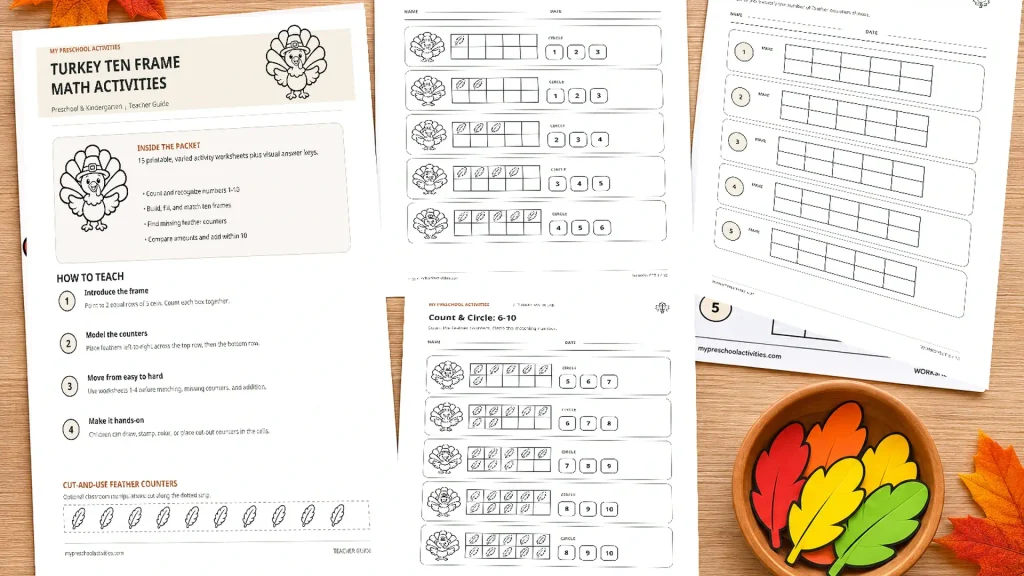
Worksheets 1–2: Count and Circle Numbers 1–10
The first two worksheets introduce children to counting feather counters inside ten frames.
In Worksheet 1: Count & Circle 1–5, children practice identifying quantities from one to five.
In Worksheet 2: Count & Circle 6–10, children work with larger quantities and begin recognizing full groups of five.
Each exercise provides a ten frame containing feather counters and three possible number answers.
Children count the feathers and circle the matching numeral.
Learning goals:
Recognizing written numbers, counting objects accurately, and associating quantities with numerals.
Teacher Tip: Before children circle their answers, encourage them to explain how they counted. Some may count every feather, while others may begin identifying familiar patterns.
Worksheets 3–4: Build It! Numbers 1–10
The next two worksheets help children represent numbers independently.
In Build It! Numbers 1–5, children are given empty ten frames and target numbers from one to five.
In Build It! Numbers 6–10, they extend their practice to larger numbers.
Children can draw feathers, color boxes, or place counters inside the frames.
For example, when the worksheet says “Make 8,” children should represent eight counters, filling the first five boxes across the top row and three boxes along the bottom.
This activity supports number formation through visual representation.
Hands-on variation: Give children paper feather counters and allow them to build the number before drawing their answers.
Worksheet 5: Feather Detective
Feather Detective encourages children to examine a ten frame and determine the number it represents.
Each activity displays a filled frame alongside three numeral choices.
Children carefully count or recognize the feather pattern and circle the correct number.
The worksheet focuses on quantities from six to ten, offering practice with larger number patterns.
Teaching idea: Ask children to look at a frame for a few seconds before counting. Can they identify a complete group of five and the remaining counters?
This encourages children to begin noticing number relationships.
Worksheets 6–7: Match the Feathers
These matching activities connect visual quantities with written numbers.
Worksheet 6: Match the Feathers 1–5 features five ten frames representing numbers from one to five.
Worksheet 7: Match the Feathers 6–10 introduces matching tasks for numbers from six to ten.
Children draw a line from each ten frame to its corresponding numeral.
Unlike the counting-and-circle worksheets, these activities require children to compare several quantities and identify the correct matches.
Learning goal: Strengthening the connection between number symbols and the groups of objects they represent.
Worksheet 8: Make Five!
Making five is an important early math concept because five provides a helpful reference point for understanding larger numbers.
In the Make Five worksheet, children are shown partially filled ten frames.
Their task is to determine how many additional feather counters are needed to make five.
For example, if a frame already contains two feathers, children must add three more.
They then write the number of feathers they added.
This simple activity introduces number combinations and subtraction-related thinking without requiring formal equations.
Try asking:
“If we have three feathers, how many more do we need to make five?”
Children can answer using fingers, physical counters, or drawings.
Worksheet 9: Make Ten!
Once children are comfortable making five, they can explore combinations that make ten.
The Make Ten worksheet includes partially filled ten frames with quantities from five to nine.
Children must determine how many more counters are needed to fill all ten spaces.
For example:
- 5 + 5 = 10
- 6 + 4 = 10
- 7 + 3 = 10
- 8 + 2 = 10
- 9 + 1 = 10
The visual representation helps children understand how different pairs of numbers can create the same total.
Teacher Tip: Encourage children to describe both the filled and empty spaces.
For example, ask, “I see seven feathers. How many empty boxes are left?”
This turns a counting task into a conversation about number relationships.
Worksheet 10: Turkey Feather Count
This worksheet combines friendly turkey illustrations with ten-frame counting practice.
Children examine the feather counters displayed inside each ten frame and write the matching number.
The worksheet includes quantities of three, five, seven, and ten.
Unlike multiple-choice activities, children must produce the answer independently.
This provides an opportunity to observe their number recognition and early number-writing abilities.
Home activity idea: Ask your child to recreate the quantity using crayons, buttons, or paper leaves after completing each problem.
Worksheet 11: More, Less, or Equal?
Understanding which quantity is greater or smaller is another important part of early number sense.
This worksheet displays two ten frames side by side.
Children count or compare the feather counters and write the correct mathematical symbol between the frames:
> means greater than.
< means less than.
= means equal to.
For example, when comparing three feathers and five feathers, children choose the less-than symbol because three is smaller than five.
Before introducing symbols, teachers can begin with everyday language:
“Which turkey has more feathers?”
“Which frame shows fewer?”
“Do both frames contain the same amount?”
Once children can answer these questions, introduce the corresponding symbols.
Worksheet 12: Color the Feather Counters
This activity combines number recognition with coloring and careful counting.
Each ten frame contains ten outlined feather counters.
Children are given a target number and must color exactly that many feathers.
The worksheet includes the numbers 2, 4, 6, 8, and 10.
For example, when the target number is six, children should color the first six feathers, following the standard ten-frame order.
Learning goals: Counting, number recognition, visual organization, and controlled coloring.
This can also serve as a quieter independent activity after a hands-on math lesson.
Worksheets 13–14: Feather Addition Within 5 and 10
These two worksheets introduce simple addition using feather groups and empty ten frames.
Worksheet 13: Feather Addition Within 5 focuses on smaller sums.
Children count two groups of feathers, represent the combined quantity inside a ten frame, and complete the addition equation.
Examples include:
1 + 2 = 3
2 + 2 = 4
3 + 1 = 4
2 + 3 = 5
Worksheet 14: Feather Addition Within 10 extends the practice to larger sums.
Children solve problems such as:
4 + 3 = 7
5 + 2 = 7
6 + 3 = 9
4 + 6 = 10
The ten frames offer a visual way to check each answer.
Teacher Tip: Encourage children to show the first group of counters in one color and the second group in another color.
For example, a child might color four feather counters orange and three brown to represent 4 + 3 = 7.
This helps children see how smaller quantities combine to form a total.
Worksheet 15: Turkey Math Lab Final Challenge
The final worksheet brings several math skills together.
Children complete five different challenges:
A. Count and Write: Identify a quantity represented by feather counters.
B. Build 9: Represent nine inside an empty ten frame.
C. Add to Make 10: Determine the missing number of counters needed to complete the frame.
D. Addition: Solve 3 + 4 using a ten frame.
E. Compare Numbers: Compare quantities representing five and seven.
This final activity can serve as an informal review after children complete the earlier worksheets.
It is also useful for identifying skills that may need additional practice.
How to Prepare and Print the Turkey Ten Frame Activities
These free turkey ten frame math activities require very little preparation.
Step 1: Download the PDF
Use the free download button near the beginning of this article to get the complete 24-page packet.
Save the file to your computer or device so you can print the worksheets whenever you need them.
Step 2: Choose Your Worksheets
The packet includes 15 different activity pages, but children do not need to complete every page in one sitting.
For younger learners, begin with counting and building numbers from one to five.
For children who already recognize numbers to ten, try missing-counter activities, matching games, and simple addition.
Step 3: Print at Actual Size
The printable is formatted for US Letter paper, measuring 8.5 × 11 inches.
Select “Actual Size” or 100% in your printer settings, and check the first printed page before making multiple copies.
The worksheets have mostly black-and-white activity elements, making them suitable for regular classroom printing.
Step 4: Gather Simple Materials
You can use pencils or crayons alone.
For hands-on practice, gather a few optional materials:
- Paper feather counters
- Large classroom counting manipulatives
- Crayons or colored pencils
- Dry-erase markers and reusable sleeves
- Child-safe scissors for adult-supervised preparation
The teacher page also includes optional cut-and-use feather counters.
Small loose counters should only be used with appropriate supervision and should not be given to children who may put them in their mouths.
Step 5: Keep the Answer Keys
The final eight pages contain visual answer keys for the worksheets.
Teachers and parents can use these pages to check completed activities and review number patterns with children.
Keeping the answer keys separate from student worksheets makes preparation easier.
How to Teach Turkey Ten Frame Math Activities Step by Step
If your students are new to ten frames, a short introduction before beginning the worksheets can make the activities more meaningful.

1. Start With a Blank Ten Frame
Show children a blank ten frame and ask how many spaces they can see.
Count the five spaces across the top row and the five spaces across the bottom row.
Explain that the frame contains ten boxes altogether.
Ask children to point to the first box at the top left.
2. Model a Number Using Counters
Choose a small number, such as four.
Place one counter in each box from left to right.
Count aloud as you place each counter.
Ask children to describe what they notice.
For example:
“How many boxes are filled?”
“How many spaces are empty in the first row?”
“How many more counters would make five?”
3. Let Children Build Their Own Numbers
Give children a blank frame and ask them to represent a number.
Start with small numbers before moving to quantities greater than five.
Encourage children to check their work by counting each counter.
4. Connect the Frame to Written Numerals
Show a numeral card or write a number on the board.
Ask children to create the matching quantity using their ten frames.
Reverse the activity by showing a filled frame and asking children to identify the number.
This helps connect visual counting with number recognition.
5. Introduce Making Five and Ten
Show a partly filled ten frame.
Ask children how many additional counters they need to reach five or ten.
Let them add the missing counters and explain their answers.
Once they understand this concept, introduce the Make Five and Make Ten worksheets from the printable packet.
6. Move Toward Simple Addition
When children are comfortable representing numbers, introduce two groups of counters.
For example, place three orange counters and two brown counters in a ten frame.
Ask children to count the total and explain what they see.
You can then connect the model to the equation 3 + 2 = 5.
Five Fun Ways to Use These Worksheets in November Math Centers
The worksheets can be used in several ways beyond traditional pencil-and-paper practice.
1. Turkey Counting Station
Set up a small math center with the Count & Circle worksheets, a few crayons, and a tray of counters.
Children can count the feathers on each page, identify the correct numeral, and recreate the quantity using manipulatives.
This station is suitable for independent or partner practice after children understand the instructions.
2. Build-a-Turkey Number Game
Prepare ten paper numeral cards labeled 1 through 10.
Ask a child to choose one card and build that number in a ten frame using paper feather counters.
After completing the frame, have the child count the filled boxes and identify how many remain empty.
You can repeat the activity with different numbers.
3. Thanksgiving Make-Ten Challenge
Use the Make Ten worksheet with a set of loose counters.
Children look at the feathers already shown, predict how many more are needed, and add the missing quantity.
You can turn this into a partner activity by letting one child create a partly filled frame and asking the other child to complete it.
The goal is accurate reasoning rather than speed.
4. Turkey Number Detective
Display a completed ten frame for a few seconds, then cover it.
Ask children to explain what number they saw.
Encourage answers such as:
“I saw five on top and two more underneath, so it was seven.”
Reveal the frame again so children can check their thinking.
This is a playful way to explore familiar number arrangements.
5. Color and Compare
Use the Color the Feather Counters worksheet followed by the More, Less, or Equal worksheet.
First, children practice coloring a specified number of counters.
Then they compare two completed frames.
Ask them to describe which frame contains more or fewer counters before introducing the mathematical symbols.
This connects visual counting with comparison skills.
Adapting the Activities for Different Learning Levels
Not every preschool or kindergarten child will be ready for the same math tasks.
The turkey ten frame math activities can be adjusted to support different levels of understanding.
For Preschool Beginners
Begin with numbers from one to five.
Use Worksheets 1 and 3 to introduce counting and number building.
Allow children to place physical counters before drawing or coloring.
Keep instructions short and focus on recognizing small groups.
If a child is still learning one-to-one correspondence, practice touching each counter while saying its number.
For Pre-K Students
Introduce numbers from one to ten once children are comfortable with smaller quantities.
Add matching activities and counting tasks using both rows of a ten frame.
Encourage children to notice when the top row contains five counters.
Begin asking questions such as:
“How many more to make five?”
“How many more to make ten?”
For Kindergarten Students
Use the full worksheet progression.
Include number comparisons, missing-counter problems, and addition within ten.
Encourage children to explain how they solved problems instead of focusing only on the final answer.
For example, when a child solves 6 + 3, ask:
“How did the ten frame help you find nine?”
For Children Who Need Extra Support
Reduce the number of problems completed in one session.
Use larger counters and provide additional time for counting.
Read instructions aloud and model the first exercise together.
You can also use the same worksheet several times with a reusable sleeve before moving to a new skill.
For Children Ready for a Challenge
Ask children to create their own number combinations.
For example, invite them to find different ways to make ten:
5 + 5, 6 + 4, 7 + 3, or 8 + 2.
Have children explain how many spaces are filled and how many remain empty.
You can also challenge them to predict the missing number before using counters to check their answer.
A Simple Five-Day Turkey Math Lesson Plan
If you’re planning Thanksgiving math activities for preschool or kindergarten, the packet can be divided into five short learning sessions.
Day 1: Counting and Number Recognition
Introduce the ten-frame structure.
Complete the Count & Circle activities for numbers one through five.
Let children practice building these quantities with physical counters.
Day 2: Numbers Six Through Ten
Review the filling pattern.
Use the second Count & Circle worksheet and the Build It activities for numbers six through ten.
Discuss the importance of a complete top row.
Day 3: Matching and Number Relationships
Introduce Feather Detective and Match the Feathers.
Help children connect the visual patterns to written numerals.
Finish with a quick number-recognition game.
Day 4: Making Five and Making Ten
Use the Make Five and Make Ten worksheets.
Let children predict the missing number of counters and check their work using ten frames.
Encourage them to explain the number combinations they discover.
Day 5: Comparing, Adding, and Reviewing
Introduce the comparison and addition worksheets according to children’s readiness.
Finish with the Turkey Math Lab Final Challenge.
Use the answer keys to review completed work and identify any skills that need additional support.
This five-day sequence is only a suggestion. You can spread the activities across several weeks or repeat individual lessons as needed.
Try a No-Print Ten Frame Activity at Home
You don’t need a printed worksheet every time you want to practice counting.
One simple variation uses a homemade ten frame.
Draw a rectangle on a piece of paper and divide it into two rows of five equal boxes.
Gather ten safe counting objects, such as large building blocks or paper circles.
Call out a number and ask your child to place that many objects into the frame.
After filling the correct number of spaces, ask how many boxes remain empty.
For example, if your child places six counters, ask:
“How many more would we need to make ten?”
You can also practice comparing numbers by drawing two separate ten frames and filling them with different quantities.
The most important part is maintaining the same two-row, five-column structure so children can recognize familiar number patterns.
Common Ten Frame Mistakes and How to Avoid Them
Ten frames are simple, but a few common mistakes can make number recognition more difficult.
Filling the Boxes in Random Order
Encourage children to fill boxes from left to right, beginning with the top row.
A consistent pattern helps them recognize quantities based on familiar groups of five.
Counting a Counter More Than Once
Ask children to touch each object as they count.
This helps strengthen one-to-one correspondence and reduces accidental double counting.
Moving to Addition Too Quickly
Children benefit from being able to represent and recognize quantities before attempting addition.
If addition feels difficult, return to simpler building and matching activities.
Ignoring the Empty Boxes
Empty spaces can provide useful information.
Ask children how many more counters would make five or ten.
This encourages thinking about number combinations instead of simply counting filled spaces.
Completing Too Many Worksheets at Once
Young children often benefit from short, focused activities.
You can complete a few problems, play a counting game, and return to the worksheet later.
The goal is meaningful practice rather than finishing every page quickly.
More Thanksgiving Learning Activities for Kids
Turkey ten frame math activities can be combined with other seasonal learning experiences to create a balanced November activity plan.
For example, you might begin with a short math center and then transition to a creative Thanksgiving craft.
Our Turkey Disguise Ideas for Kids provide opportunities for children to color, design, and create imaginative turkey characters.
Combining counting activities with art, conversation, and seasonal projects helps offer variety throughout the school day.
Frequently Asked Questions About Turkey Ten Frame Math Activities
What age are turkey ten frame math activities suitable for?
These activities are designed primarily for children ages four to six, including preschool, Pre-K, and kindergarten.
Younger children can focus on numbers one through five, while older learners can explore number comparisons and addition within ten.
The appropriate starting point depends on each child’s existing counting skills.
How many pages are included in the free printable?
The complete PDF contains 24 pages: one teacher instruction page, 15 activity worksheets, and eight pages of visual answer keys.
The worksheets cover counting, matching, building numbers, making five and ten, comparing quantities, coloring counters, and simple addition.
Are these worksheets suitable for kindergarten math centers?
Yes. The packet can be used in kindergarten math centers, small-group instruction, independent practice, or take-home activities.
Children can complete worksheets with pencils or use physical manipulatives for additional hands-on learning.
Do I need special counting materials?
No special materials are required.
Children can draw or color the feather counters directly on the worksheets.
Optional materials such as paper counters, large classroom manipulatives, crayons, and reusable sleeves can make the activities more interactive.
Can I use these worksheets for Thanksgiving lessons?
Yes. The turkey and feather illustrations make the packet especially suitable for November and Thanksgiving-themed math lessons.
However, the number skills themselves are useful throughout the school year.
How do ten frames help children learn addition?
Ten frames provide a visual way to combine quantities.
For example, children can represent four counters and add three more to see that the total is seven.
As they gain experience, they may begin recognizing these number combinations without counting every object separately.
Are the answer keys included?
Yes. The PDF contains eight pages of teacher answer keys.
These provide solutions and visual examples for checking the 15 activity worksheets.
Can I print only selected worksheets?
Yes. You can choose specific pages in your PDF reader’s print settings.
For example, you might print only the early counting worksheets for preschool students or the addition worksheets for children ready for more challenging work.
Are the turkey ten frame worksheets free?
Yes. The printable packet is offered as a free educational resource on My Preschool Activities.
You can print it for personal, homeschool, or individual classroom use. Please direct others to the original download page rather than redistributing the PDF.